Sewing machine skipping stitches: needle, timing or feed first
Change to a new, correct needle first, then re-thread with the presser foot up. If sewing machine skipping stitches continues, check the hook timing gap and presser foot pressure next. Most skips are needle or threading, not timing.
On this page (8 sections)
- The short version
- Pattern check: why sewing machine skipping stitches on zigzag but not straight stitch
- Needle first: how size, type, burr and insertion cause skips by fabric
- Thread path: bobbin, top thread and tension errors that mimic skips
- Timing check: hook timing and needle-to-hook gap you can see
- Feed and pressure: presser foot and feed dogs on thick, stretch and sheer
- Fix order: test needle, timing and feed in sequence before calling the shop
- Still wondering?
Key figures
- First fix
- New needle 80/12 universal
- Re-thread rule
- Presser foot up
- Needle insertion
- Flat to back, fully up
- Bobbin check
- Correct class, even wind
- Hook gap sign
- Hook misses loop
- Feed test
- Fabric moves steadily
The short version
- Diagnose by when it skips: zigzag, stretch, thick seams or random every few stitches points to a different cause.
- Install a new needle fully up with flat to back and match size/type to fabric.
- Re-thread top and bobbin with presser foot up and check the bobbin is the right class for your machine.
- If skips persist on all fabrics, check needle-to-hook gap and feed pressure before you adjust timing.
Pattern check: why sewing machine skipping stitches on zigzag but not straight stitch
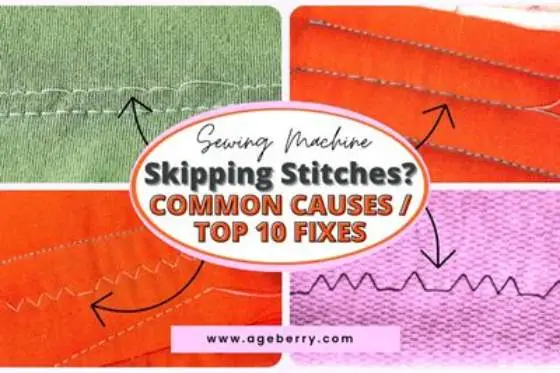
Sewing machine skipping stitches tells you more by pattern than by sound. Note when it skips and you can cut the cause list in half before you touch a screw. Zigzag that skips on the side swing but straight stitch sews fine usually points to needle deflection or hook timing. Random skips every few stitches often point to a burr or a thread path error.
Zigzag asks the needle to form a loop at an angle while the hook passes. If the needle is slightly bent, too small for the fabric, or a little low, the hook misses the loop on one side only. Straight stitch gives the hook one consistent place to catch, so it may still sew. You will see a long unsewn gap where the zig should have caught, then normal stitches again.
Thick seams that skip at the hump but sew on flats point to presser foot pressure and feed, not timing. Stretch knits that skip in a regular rhythm point to the wrong needle point. Sheer wovens that skip with puckering point to a needle that is too large and is pushing fabric into the needle plate. Each pattern has a different fix.
Start with a quick isolation test on two layers of plain quilting cotton with a new 80/12 universal and 50 wt thread. Sew 6 inches (15 cm) straight, then 6 inches (15 cm) wide zigzag, then over a folded seam hump. Note which test skips. That result decides whether you chase needle, thread path, timing or feed next. The other half of this decision is how to avoid sewing errors.
| Pattern you see | Likely cause group | Check first |
|---|---|---|
| Zigzag skips on one side, straight is fine | Needle deflection or hook gap | New needle, then hook gap |
| Skips every 3-6 stitches, random | Burr, wrong needle size, thread path | Needle and re-thread |
| Skips only on thick seams/humps | Feed and presser foot pressure | Pressure and walking foot |
| Skips only on stretch knit | Ballpoint needed | Ballpoint/jersey needle |
Needle first: how size, type, burr and insertion cause skips by fabric
Needles cause more skips than any other part, and they are the cheapest fix. A needle that is dull, bent, too small, wrong point type, or not fully seated will not form a clean loop for the hook to catch. Change it before you chase tension or timing. Even a new needle can be wrong for the fabric in front of you.
Size sets the size of the loop and the hole. Too small for heavy denim and the needle flexes, so the loop forms late and the hook misses. Too large for sheer lawn and it pushes fabric into the plate and the loop collapses. As a rule of thumb, match the needle to the weight: finer fabric, finer needle. Use 70/10 to 80/12 for light wovens, 80/12 to 90/14 for medium and denim, 75/11 to 90/14 ballpoint for knits.
Point type matters because fibres move. Universal works for most wovens. Ballpoint or jersey slides between knit loops instead of piercing them, which keeps the loop open. Microtex or sharp pierces tightly woven fabrics cleanly. Leather needles cut. Using a universal on a stretch knit is a classic cause of regular skips, and no tension change will fix it. The other half of this decision is best sewing machine for upholstery.
Insertion matters as much as selection. Push the needle fully up into the clamp with the flat to the back and tighten firmly. A needle that sits 0.5 mm low changes when the loop forms. Run a fingertip lightly down the point to feel a burr, and sight along the shaft against white paper to spot a bend. If the skip disappears after a correct new needle, you are done.
- Universal 80/12: your baseline for quilting cotton and poplin, change every 6-8 hours of sewing.
- Ballpoint/jersey 75/11 to 90/14: for T-shirt knit, jersey, ponte and sweatshirt fleece.
- Microtex/sharp 70/10 to 90/14: for tightly woven cotton, batik, chambray and silk.
- Denim/jeans 90/14 to 100/16: for canvas, denim and thick seams, go slow over humps.
- Stretch 75/11 to 90/14: for high Lycra knits and swim fabric, with polyester thread.
Thread path: bobbin, top thread and tension errors that mimic skips
A skip is not always a missed hook. Sometimes the top thread never formed a loop at all because it was not seated in the tension discs or the bobbin thread was not feeding. Those look like skips but they are really thread path errors. They are common after re-threading with the presser foot down or with the wrong bobbin.
Top thread must go through every guide with the presser foot up, so the discs open. If you thread with the foot down, the thread rides outside the discs and tension stays near zero. The loop then is too slack or too tight to catch. Floss the thread firmly into the take-up lever and check that it moves freely without catching on the spool. Use a spool cap that matches the spool size so the thread unwinds straight. We cover knit-friendly serger machine in its own article.
Bobbin errors mimic skips in a different way. A bobbin wound unevenly, too full, or in the wrong class for your machine will feed jerkily. Insert it so the thread pulls in the direction your manual shows and clicks under the tension spring. Pull the tail and you should feel light, even drag. If the bobbin case has lint under the spring, tension jumps and the stitch looks skipped or looped.
Test tension on a scrap, not your project. Sew two layers of cotton with 50 wt thread and look at the underside. Balanced tension shows the top and bobbin threads meeting in the middle. If you see loops on top, the bobbin is too loose or the top is too tight. If loops show below, the top is too loose. Re-thread first, then adjust in small steps. The Sewing Machine Doctor on this site lets you turn the machine in 3D and click where the thread nests or skips to get the fix for your model.
Most skipped stitches are not timing at all, they are a dull needle or thread that never seated in the tension discs.
Timing check: hook timing and needle-to-hook gap you can see
Hook timing is the moment the hook point passes behind the needle to catch the loop. If timing is late or early, or the gap is too wide, the hook misses and you get a true skip. Timing rarely drifts on its own unless the machine hit a pin, sewed over a very thick hump, or jammed and the user forced the handwheel. Do not adjust timing until needle and thread path are ruled out. We go through sewing machine timing off step by step elsewhere on the site.
You can see a lot without tools. Remove fabric, bobbin case and needle plate. Install a new 90/14 universal, turn the handwheel slowly toward you, and watch from the front. As the needle rises about 2.0 to 2.5 mm from its lowest point, the hook point should be just behind the needle, about just above the eye and very close to the scarf, the cutout on the back of the needle. That is the window where the loop is open.
Gap matters as much as timing. The hook point should pass almost touching the needle scarf, with about a hair's width of clearance. If you can see daylight of more than about 0.5 to 1.0 mm, loops will escape, especially on zigzag or stretch. A bent needle, a burr on the hook, or lint packed around the hook race can mimic a gap problem. Clean lint first and try a new needle before you call it timing.
If the gap is wide on all needles and the timing window is clearly off, the machine needs service. Hook timing adjustments move the relationship between needle bar and hook, and a small error makes things worse. Note what you saw, take a short video, and take it to a shop. If the machine still sews straight but skips only zigzag after a correct needle, mention that pattern. It points the tech straight to the hook gap. Before you commit to anything, it is worth looking at fixing bobbin tension.
| What you see | What it suggests | Next step |
|---|---|---|
| Hook meets needle just above eye on the rise | Timing window looks normal | Recheck needle size and thread path |
| Hook passes well below eye or far above | Timing off | Do not adjust, book service |
| Visible gap between hook and scarf | Gap too wide | Clean, new needle, then service if still wide |
Feed and pressure: presser foot and feed dogs on thick, stretch and sheer
Feed problems look like skips because the fabric did not move the right distance between stitches. The machine then sews in place or the needle flexes and the hook misses. Two controls decide this: the feed dogs that move the fabric and the presser foot pressure that holds it against them. When either is wrong for the fabric, you get skips at humps, on knits, or on sheers.
Thick seams need even pressure and steady feed. As you climb a hump, the foot tilts and pressure drops on the leading edge, so the dogs slip. Slow down, hold the fabric gently without pulling, and keep the hump level with a folded scrap behind the foot as a shim. A walking foot helps because its upper feed matches the lower dogs. Reduce pressure slightly if your machine allows, so the layers can advance together.
Stretch knits need lighter pressure and the right foot. Too much pressure stretches the knit as you sew, then it snaps back and the stitch skips or ripples. Lighten pressure, use a ballpoint needle, and lengthen stitch to about 3.0 mm. A walking foot or a stretch stitch with a slightly looser top tension often cures rhythmic skips on knits without touching timing. It helps to understand thread not catching bobbin before going further.
Sheer and slick fabrics need the opposite. They slip and get pushed into the needle plate hole, which collapses the loop. Use a straight-stitch plate with a small hole if you have one, a sharp 70/10 or 80/12 Microtex, and normal to slightly lighter pressure. Hold the thread tails for the first two stitches so the fabric does not get sucked in. If the fabric still flags up and down with the needle, your needle is too large or dull.
Fix order: test needle, timing and feed in sequence before calling the shop
Work in order from cheapest to most invasive, and stop when the test passes. That order is needle, thread path, feed and pressure, then timing. Each step has a clear pass or fail, so you know whether to go on. Keep a small scrap of the problem fabric for every test so results mean something.
Start with needle and thread path together because they are linked. Put in a new needle of the correct type and size for your fabric, fully up with flat to back. Re-thread top with foot up and re-seat the bobbin with the right class. Sew the three tests again: straight, zigzag and over a hump. If any test now sews without skips, you fixed it. Make a note of which needle and thread solved it. Before you commit to anything, it is worth looking at puckering seams sewing.
If skips remain, test feed and pressure. Clean lint from feed dogs and bobbin area with a brush, not canned air that packs lint deeper. Check that dogs are up for sewing and not dropped for darning. Sew the hump test with a walking foot or with pressure eased by one step. If thick seams now feed without skips but zigzag still skips, feed was part of it and hook gap is still suspect.
Only then look at hook timing and gap by hand-turning as described. If the hook clearly misses the loop window or the gap is wide with a new needle, do not adjust it yourself unless your manual shows that exact adjustment for your model. Book service and show your pattern notes and video. You will save time and avoid turning a small gap into a full timing job. I would keep a small needle assortment and a proper bobbin set on hand and test on scraps first every time.
- Install correct new needle for fabric, flat to back, fully up. Re-thread top with foot up, re-seat correct bobbin.
- Sew 6 inches (15 cm) straight, 6 inches (15 cm) zigzag, and over a folded hump on scrap. Note which test skips.
- Clean feed dogs and bobbin race, check feed dogs are up, test hump with walking foot or lighter pressure.
- Hand-turn and watch hook meet needle just above eye on the rise, with hair-width gap to scarf.
- If gap or timing is off on all tests with a new needle, stop and book service with your notes and video.
- DIY needle and thread fix: fast, low cost, solves most skips
- Timing adjustment: needs tools and risks worse damage if guessed
Still wondering?
Why does my machine skip on zigzag but sew straight stitch fine?
Zigzag needs the hook to catch the loop at an angle on each side swing. A slightly bent needle, a needle a little low, or a hook gap that is a touch wide will miss on one side only. Straight stitch gives the hook one steady place to catch, so it can still sew. Try a new correct needle first, then check the hook gap by hand-turning.
What needle should I use to stop skipping on stretch knit?
Use a ballpoint or jersey needle in 75/11 to 90/14 and polyester 50 wt thread. The rounded point slides between knit loops and keeps the thread loop open for the hook. A universal point can pierce the loop and collapse it, which looks like regular skips. Lighten presser foot pressure and use a 3.0 mm stitch length.
Can wrong bobbin or tension look like skipped stitches?
Yes. If the top thread is not seated in the tension discs or the bobbin is the wrong class, wound unevenly, or lint is under the bobbin tension spring, the loop never forms cleanly. Re-thread with the presser foot up and re-seat the correct bobbin. Test on scrap and balance tension so threads meet in the middle of the layers.
How do I know if timing is really off?
With a new needle installed, hand-turn slowly and watch the hook pass behind the needle just above the eye as the needle rises 2.0 to 2.5 mm from the bottom. The hook should almost touch the scarf with only a hair's width gap. If the hook passes well below or above the eye or the gap is clearly wide, timing or gap is off and a shop should adjust it.
Why does it skip only on thick seams or humps?
The presser foot tilts on the hump and loses pressure, so the feed dogs slip and the needle flexes. The hook then misses. Sew slower, keep the foot level with a scrap shim behind it, and use a walking foot. A jeans needle 90/14 to 100/16 and slightly reduced pressure help the layers feed evenly.