How to tell real four-way stretch from two-way before you cut
Real four-way stretch gives and recovers in both the lengthwise and crosswise directions. Two-way stretches one way only, usually crosswise. The number that matters is what your pattern specifies.
On this page (9 sections)
- Fit check
- The short version
- Four-way vs two-way stretch: what the labels really mean
- How to test stretch direction on the bolt
- What poly-spandex and cotton-spandex actually do
- Sewing four-way stretch: needles, thread and stitch settings
- How much stretch a pattern needs and how to match fabric to it
- Buying four-way stretch fabric by the yard online: what to check
- Still wondering?
Part of our guide on fabric for hot humid weather

ITY Jersey Fabric | Spandex Knit | 2-Way Stretch | 95% Poly, 5%
Gives you a black poly-spandex ITY knit with a stated 5% spandex and explicit four-way stretch, so it
Check it on Amazon
EOVEA - Cotton Spandex Fabric by The Yard - 4 Way Stretch
A cotton-spandex jersey with 5% spandex and listed 4-way stretch, appropriate as the softer, breathable
See this alternative
LitLook Double Brushed Poly 4-Way Stretch Knit Fabric
A double-brushed poly-spandex knit with 4% spandex and stated non-balanced four-way stretch, suitable as a
See the budget option| Product | spandex content in blend | Verdict | |
|---|---|---|---|
| ITY Jersey Fabric | Spandex Knit | 2-Way Stretch | 95% Poly, 5% Barcelonetta | Spandex content stated: 5% spandex and listing text: '4-way stretch' (stated in bullets). | Meets it | View on Amazon |
| LitLook Double Brushed Poly 4-Way Stretch Knit Fabric LITLOOK | Spandex content stated: 4% spandex and listing text: 'Non-Balanced Four-Way Stretch' (stated in bullets). | Meets it | View on Amazon |
| EOVEA - Cotton Spandex Fabric by The Yard - 4 Way Stretch Jersey Knit EOVEA | Spandex content stated: 5% spandex and title: '4 Way Stretch' (stated in bullets/title). | Meets it | View on Amazon |
Key figures
- Four-way definition
- Stretch and recovery in both directions
- Spandex in blend
- Read the bolt tag percentage
- Recovery target
- Returns to shape at once when released
- Standard swim blend
- Check the listing for the elastane share
- Everyday poly blend
- A common blend in activewear
- Needle for knits
- Ballpoint or stretch needle
- Stitch type
- Narrow zigzag or overlock
The short version
- Grip the fabric and pull sideways, then lengthwise. Both must give and spring back.
- Read the elastane percentage on the bolt tag. Low percentages often deliver weak lengthwise recovery.
- Your pattern states the stretch it needs. Match your fabric to that number, not to a generic threshold.
- Test on the bolt before it is cut. Cut yardage is yours to keep.
- Match the fibre to the garment: poly for swim and activewear, cotton blends for casual.
Four-way vs two-way stretch: what the labels really mean
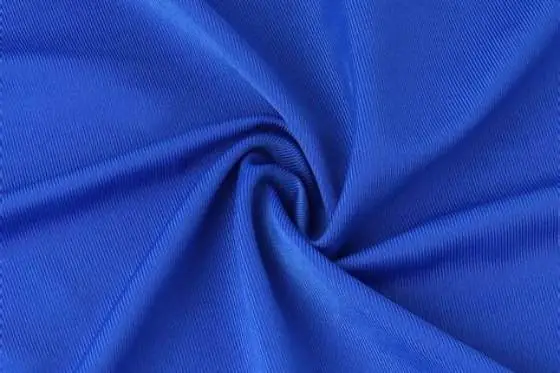
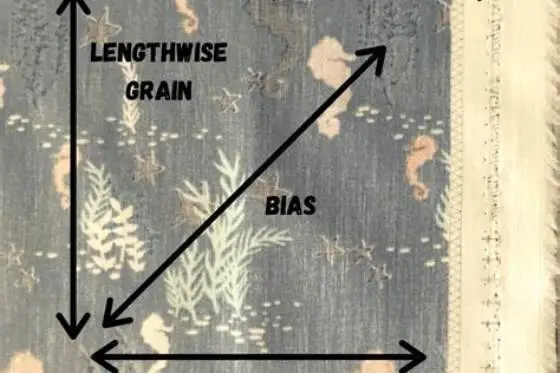
Four-way stretch means the fabric gives in both the lengthwise direction and the crosswise direction. Lengthwise runs along the selvedge, with the grain. Crosswise runs selvedge to selvedge, across the grain. Two-way stretch gives in one direction only, usually crosswise. A knit that stretches crosswise but feels rigid lengthwise is a two-way fabric no matter what the bolt-end sticker says.
Most stretchy knits do stretch a little in both directions. What separates four-way from two-way is whether that lengthwise give is meaningful and whether the fabric springs back when you let go. Recovery in both directions is the defining test.
Here is the practical consequence. A pattern drafted for four-way stretch assumes the fabric can expand around the body in both directions. Cut that pattern from a two-way knit and the garment will fight you.
Your job before you cut is simple. Find out how far the fabric stretches in each direction, how sharply it recovers, and whether the elastane percentage supports the recovery your pattern needs. Before you commit to anything, it is worth looking at best fabric for swimsuits.
There is no legal definition for four-way stretch on a bolt-end label. Some shops print it when the fabric gives in both directions at all, while others reserve it for true performance knits. Test the actual bolt rather than trusting the label.
How to test stretch direction on the bolt
You can do this at the cutting counter in under a minute, and you should do it every time before they cut. Fold the fabric back on itself by about 4 inches. Grip a 4-inch section of the fold between both hands, thumbs about 4 inches apart. Pull steadily sideways.
Mark where your thumbs started using the fabric's own edge as a guide. Stretch to the limit of comfortable give, then measure how far your thumbs moved apart. If they started 4 inches apart and ended at 5 inches, that's 25% stretch. Same test, rotated to pull along the selvedge, gives you the lengthwise number. We cover fabric grain explained in its own article.
Release one hand and watch the fabric. A good stretch knit returns to shape at once, with real bite. A tired one stays stretched and feels slack. The difference is immediate and obvious under your fingers.
Recovery speed differs between crosswise and lengthwise in most knits. Crosswise recovery is usually faster because the knit structure loops that way. Lengthwise recovery lags, and in cheaper cotton-spandex blends it can be slow enough that the garment grows longer through a day of wear. Lengthwise give is often noticeably less than crosswise in real knits. Test both directions and feel the difference.
One more reading worth taking: let the fabric hang from one corner for ten minutes. Fabric with poor lengthwise recovery will visibly grow longer under its own weight. That growth is what a fitted bodice does to a two-way knit. Before you commit to anything, it is worth looking at fabric widths explained.
If you already have yardage at home, test it on your cutting table before you cut the pattern pieces. Cut a 1-inch strip from the cut edge and pull it firmly. If the edge curls into a tight roll, the elastane is working. If the edge lies flat and lazy, the recovery is not there.
This curl test works because the elastane fibres contract when cut, pulling the fabric edge inward. A fabric with good recovery curls sharply. A fabric with slack elastane stays flat. Use this test on swatches you own, not on a bolt you have not bought.
- Fold fabric 4 inches (10 cm) crosswise and grip the fold with thumbs 4 inches apart.
- Stretch to full comfortable give and note how far your thumbs travel.
- Repeat along the lengthwise grain, pulling with the selvedge.
- Release and feel whether the fabric returns to shape at once or stays slack.
- To convert your measurement to a percentage: subtract the starting span from the stretched span, divide by the starting span, then multiply by 100.
ITY Jersey Fabric | Spandex Knit | 2-Way Stretch | 95% Poly, 5% Spandex |
Gives you a black poly-spandex ITY knit with a stated 5% spandex and explicit four-way stretch, so it supplies the four-way stretch fabric the pattern calls for.
- Size 2 Yards
- Weight 1.21 lb
- Height 0.03 inches
What poly-spandex and cotton-spandex actually do
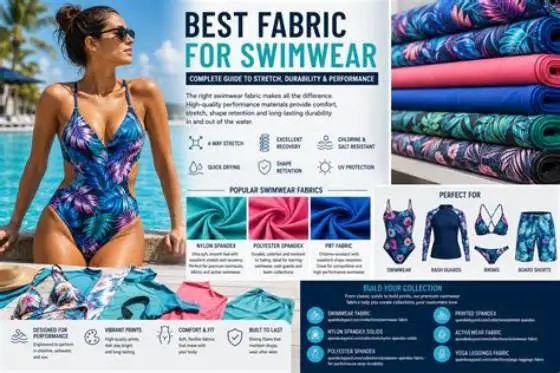
Poly-spandex is a common blend in affordable activewear and swimwear. The polyester gives it durability, colour hold and quick drying. The spandex gives it enough stretch to move with you and enough recovery to hold its shape.
Cotton-spandex feels cooler and more natural against the skin, which is why it dominates casual wear, kids clothes and loungewear. The trade is recovery. Most cotton-spandex blends have only a small share of spandex, and lengthwise recovery is the weak spot. Cotton-spandex knits often spring back slowly, and a fitted top can grow longer at the hem over a long day. Read the listed percentage on the actual bolt.
The elastane percentage interacts with the knit type. A single jersey stretches more and recovers faster than an interlock with the same percentage, because the interlock double-knit structure resists the pull. Ponte knits feel stable and structured, closer to a woven.
Polyester blends tend to tolerate chlorine, saltwater and sunscreens better than cotton blends, which is why many swim fabrics use polyester or nylon with elastane. Formulations vary, so follow the garment care instructions. The limitation is heat. Poly-spandex does not like a hot iron. Use a dry iron or a low steam setting under a pressing cloth. Press too hot and the fibres glaze, and the stretch is gone for good at that spot.
| Property | Poly-spandex (common ITY and swim knits) | Cotton-spandex (common jersey) |
|---|---|---|
| Feel against skin | Cool, slightly slick | Soft, matte, breathable |
| Recovery speed | Fast, sharp snap | Slower, can lag lengthwise |
| Best for | Swim, activewear, leggings | Casual tees, kids clothes, loungewear |
| Pilling tendency | Low | Higher on cotton face |
| Chlorine resistance | Good | Poor |
LitLook Double Brushed Poly 4-Way Stretch Knit Fabric
A double-brushed poly-spandex knit with 4% spandex and stated non-balanced four-way stretch, suitable as a mid-weight budget option with four-way stretch.
- Size 1 Yard
- Height 0.1 inches
- Length 36.0 inches
A poly-spandex knit and a cotton-spandex knit can both say four-way stretch and behave nothing alike at the machine.
Sewing four-way stretch: needles, thread and stitch settings
Use a ballpoint or stretch needle for most knits, with 50 wt polyester thread. Sew with a narrow zigzag or an overlock so the seam can stretch with the fabric. A straight stitch will pop the first time the garment is pulled on.
The ballpoint tip slides between the knit loops instead of piercing them. A sharp needle snags the loops and skips stitches. If your machine has a stretch stitch setting, use it. If not, a narrow zigzag works for most seams.
Test your stitch on a scrap before you sew the garment. Stretch the sewn scrap firmly. If the thread snaps, your stitch is too tight or your tension is too high. If the fabric puckers, your stitch length is too short. Adjust and test again.
Pin within the seam allowance so the holes stay hidden, and use clips on thick ponte. A walking foot helps feed both layers evenly on slippery poly-spandex. Lower the presser foot pressure if your machine allows it, and let the feed dogs move the fabric rather than pulling it through. Stretch the fabric gently as you sew only if the seam needs to stretch with the garment, and test on a scrap first.
EOVEA - Cotton Spandex Fabric by The Yard - 4 Way Stretch Jersey Knit
A cotton-spandex jersey with 5% spandex and listed 4-way stretch, appropriate as the softer, breathable option the pattern could use for casual tees or kids' clothes.
- Weight 10 oz
- Size 1 Yard
- Height 0.03 inches
How much stretch a pattern needs and how to match fabric to it
Patterns usually state the stretch requirement as a percentage. If yours does not, check the envelope or the pattern instructions page. The number tells you how much the fabric must stretch to make the fit work, often crosswise but sometimes in both directions. Most home sewers measure by hand.
Measure your stretch with the method from the testing section. Match the fabric number to the pattern requirement. If the numbers are close, the pattern will generally work with minor tweaks. Further apart than that and you should look for a different fabric or a different pattern.
If the fabric offers substantially more stretch than the pattern expects, you may end up with excess fabric and a baggy fit. The effect depends on fabric weight and pattern shaping. When it is less stretchy, the seams strain and pop. The cleanest fix is to match the numbers before you cut.
Crosswise and lengthwise stretch requirements differ by garment type. A fitted legging needs both, while a loose tee can get by with crosswise alone. A legging pattern that calls for both directions will say so.
| Pattern stretch called for | Typical garment | Fabric to look for |
|---|---|---|
| Stable to moderate | Loose tee, swing top | Stable jersey, interlock |
| Moderate stretch | Fitted tee, simple leggings | Cotton-spandex, ponte |
| High stretch | Fitted leggings, active tops | Poly-spandex ITY or swim knit |
| Maximum stretch | Swim, compression wear | Nylon-spandex, high elastane content |

Ball Point Jersey Machine Needles-Sizes 10/70 (2)
Provides ballpoint (jersey) machine needles in assorted sizes, the right needle type to sew stretch knits without snagging.
Buying four-way stretch fabric by the yard online: what to check
Online, you cannot grip the bolt. You read the listing instead. The fibre content should be spelled out as percentages, not just stretch knit.
Look for the words crosswise stretch and lengthwise stretch stated separately. A listing that says four-way stretch but only describes the crosswise number is hiding something.
Printed weights should be treated the same way as solids. A print on a poly-spandex base behaves like the base, not like the print. Heavy plastisol ink can stiffen the fabric slightly, so allow a little give-and-take at the seams. Check a printed swatch the same way you would check a solid.
Black is a common colour for stretch knits and can make surface issues less visible. Pull a black swatch lengthwise in daylight and inspect it for whitening when stretched. If it whitens or shows a chalky line, the elastane is stressed.
If possible, order a small swatch or a single yard to test stretch and recovery before committing to larger yardage. Match needle and stitch to a stitched test swatch before you commit to cutting the pattern pieces.
- Fibre percentages: spandex should be stated, not hidden in 'stretch blend'.
- Stretch direction: look for crosswise and lengthwise both named.
- Weight: ounces per square yard or grams per square meter both work.
- Swatch first: buy a single yard before committing to a whole project.
- Seller questions: if they can't state the stretch, don't buy for a fitted make.
Match the stretch percentage to the pattern's stated requirement, not to the word 'stretch' on the bolt.
Still wondering?
Can I use two-way stretch fabric for a pattern that calls for four-way?
Usually not for fitted garments. Two-way stretch can work in patterns drafted for stable knits or loose tops, where the lengthwise give does not matter. For leggings, swim or close-fitted activewear, the pattern relies on stretch in both directions.
Does a higher spandex percentage always mean a better fabric?
No. Above a certain share, spandex starts to dominate the hand and the fabric feels rubbery and unstable. Most useful everyday blends have a modest share of spandex. What matters is whether the percentage matches the knit structure and the garment's job.
Will printed four-way stretch behave the same as the solid version?
The base fabric is the same, but heavy plastisol inks can stiffen a print slightly and reduce local stretch. If you are making a fitted garment, cut a small swatch from the printed yard and re-test the stretch before you commit the pattern pieces.
How do I convert my grip-and-pull measurement to match a pattern requirement?
Subtract your starting thumb span from the stretched span, divide by the starting span, then multiply by 100. If your thumbs started 4 inches apart and stretched to 6 inches, that is 50% stretch. Match that number to the pattern stated requirement.
What if my pattern doesn't state a stretch percentage at all?
Check the pattern envelope for a stretch ruler or fabric suggestion. Some indie patterns skip the percentage and list fabric types instead. If nothing is stated, test a scrap of the suggested fabric at the shop.
What does 'recovery' mean in practice?
Recovery is how sharply the fabric snaps back after you stretch it and let go. Good recovery means the fabric returns to its original shape. Poor recovery means it stays slack or takes time to shrink back.