Why your sewing needle keeps breaking and what to check first
Your sewing machine needle keeps breaking because it is hitting something it should miss. Swap to a new, correct-size needle, seat it fully up with the flat to the back, tighten the screw, then turn the hand wheel slowly to check clearance before you sew.
On this page (8 sections)
- The short version
- Common causes: why your sewing machine needle keeps breaking on repeat
- Choice: how to choose needle size and type for fabric and thread weight
- Fit: how to insert, orient and tighten the needle so it misses the plate and foot
- Timing and strike points: why a needle hits the bobbin case, hook or feed dogs
- Not the same fault: needle breaking versus thread breaking, unthreading or a loose needle
- Replace and test: how to change the needle and free a broken tip safely
- Still wondering?
Part of our guide on sewing machine skipping stitches
Key figures
- First fix
- New needle, size 80/12 for medium cotton
- Needle life
- Change every 6-8 hours sewing
- Hand test
- 2 slow turns before power
- Pin rule
- Never sew over pins
- Pulling fabric
- Causes deflection and breaks
- Shop time
- If needle hits hook repeatedly
The short version
- Test in order: new correct needle, correct insertion, clearance check, then timing.
- Match needle EU/US size and point type to fabric weight and thread weight.
- Turn the hand wheel toward you for two full stitches before using the pedal.
- Pulling fabric or sewing over pins bends the needle into the plate.
Common causes: why your sewing machine needle keeps breaking on repeat
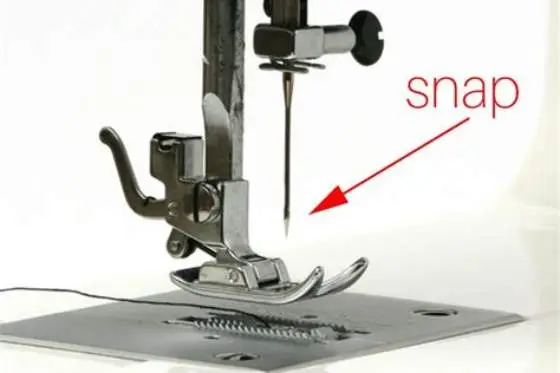
A needle that snaps every 20 to 50 stitches is almost always striking metal, not just wearing out. You will hear a sharp tick or pop, then find the tip snapped or bent. That strike leaves a tiny burr on the throat plate or presser foot that then breaks the next needle too.
Your sewing machine needle keeps breaking for a handful of repeat reasons you can test in order. The most common is wrong needle size or type for the fabric, so a fine 80/12 flexes and deflects on denim or canvas. Next is a bent or burred needle that was nicked on a pin, a thick seam or the plate itself. Pulling the fabric from behind bends the needle sideways into the plate while it is still in the fabric.
Other frequent causes are a needle not pushed fully home, a loose needle clamp screw, the wrong presser foot for the stitch, and lint packed around the bobbin case that lifts it into the needle path. If you sew over pins, even once, check the needle tip with your fingertip. A hook you can feel means the needle will not sew straight again.
Start cheap and simple and you will catch most breaks without tools. Put in a fresh needle of the right size, re-thread with the presser foot up, clean lint from under the plate, and turn the hand wheel before you press the pedal. If the new needle clears on two slow hand turns, you fixed the deflection problem. For the detail, see our notes on correcting needle alignment.
- Wrong size/type: needle flexes, misses the needle hole, hits plate
- Bent or burred needle: hits hook or plate on the next stitch
- Sewing over pins or thick seams: instant bend and snap
- Needle not fully seated or screw loose: needle sits low and strikes hook
- Pulling fabric: drags needle sideways while it is still down
Choice: how to choose needle size and type for fabric and thread weight
A 80/12 universal needle sews medium cotton with 50 wt thread at about 2.5 mm stitch length without deflection. Go finer or heavier and the balance shifts. The needle must be heavy enough to pierce the fabric without bowing, and the eye must fit the thread without friction.
Match point type to fabric structure first, then size to weight. Use universal 80/12 or 90/14 for woven cotton and linen, ballpoint 80/12 for jersey and interlock, stretch 75/11 for lycra blends, jeans/denim 90/14 to 100/16 for twill and canvas, and leather 90/14 only for real leather or vinyl. Change the needle when you change fabric family, not just when it breaks.
Thread weight matters as much as fabric. A 50 wt cotton or polyester runs well in 80/12 to 90/14. A heavier 40 wt topstitch thread needs 90/14 to 100/16 so the eye does not shred the thread and increase drag. If you see shredding or popping sounds, go up one size or switch to a topstitch needle with a larger eye. We go through machine thread breaking step by step elsewhere on the site.
I keep an assorted box of universal and ballpoint needles from 70/10 to 90/14 in the drawer and I would buy that first. It covers quilting cotton, jersey, and light denim without a special order. My rule of thumb is simple: if the fabric needs a heavier presser foot pressure, it needs a heavier needle.
| Fabric | Needle type and size EU/US | Thread and note |
|---|---|---|
| Quilting cotton, lawn | Universal 70/10 to 80/12 | 50 wt; change every 6-8 hours |
| Jersey, interlock | Ballpoint 75/11 to 80/12 | 50 wt; stretch stitch if puckering |
| Denim, canvas, twill | Jeans 90/14 to 100/16 | 50 wt or 40 wt; longer stitch 3 mm |
| Leather, vinyl | Leather 90/14 to 100/16 | 40-50 wt; no pins, use clips |

SINGER Universal Regular & Ball Point Sewing Machine Needles
Stops breakage from wrong needle choice by giving you 80/12 and 90/14 in both universal regular and ball point to match woven versus knit and thread weight.
Fit: how to insert, orient and tighten the needle so it misses the plate and foot
A needle seated 1 to 2 mm low will hit the hook or the edge of the throat plate on every downstroke. You will feel a light clunk through the hand wheel before it snaps. The fix is seating, orientation and a firm screw, in that order.
Insert the needle with the flat to the back on most home machines, so the scarf faces the hook. Push it straight up until it stops against the top of the clamp, no gap showing above the needle. Tighten the needle clamp screw firmly with the small screwdriver, not just finger tight. If your machine uses a round shank, the groove still faces front. For the detail, see our notes on handwheel jammed.
Check alignment before power. With the presser foot on and a straight stitch selected, turn the hand wheel slowly toward you and watch the needle enter the hole in the plate and foot. It should drop dead centre with equal light showing all round. If it favours one side, re-seat the needle or switch to the foot that matches the stitch width you chose.
A needle that is tight and centred will not kiss metal on a straight stitch. If it still ticks on zigzag at width 5 mm or more, reduce width or fit the zigzag foot. That tick is the needle touching the foot, and it will snap the tip on thick seams.
- Flat to the back, pushed fully home until it stops
- Screw tight with driver, then tug needle to confirm it does not slip
- Centre check: equal gap in plate hole and foot opening
- Test zigzag width on scrap before the project
A needle that snaps every few inches is not random, it is hitting metal you can find with one slow hand turn.
Timing and strike points: why a needle hits the bobbin case, hook or feed dogs
A needle that hits the bobbin case or hook makes a hard metallic knock you can hear even by hand. On a timed machine the needle passes the hook with about 0.5 to 1 mm clearance when the hook point is behind the needle scarf. If that gap closes, the needle strikes and snaps.
Timing slips after a bad jam, sewing over a pin, or forcing thick layers under the foot. Signs are needle hits hook on every stitch even with a new, centred needle, skipped stitches mixed with breaks, and thread jams under the throat plate. Lint packed under the bobbin case can also lift the case high enough to be hit.
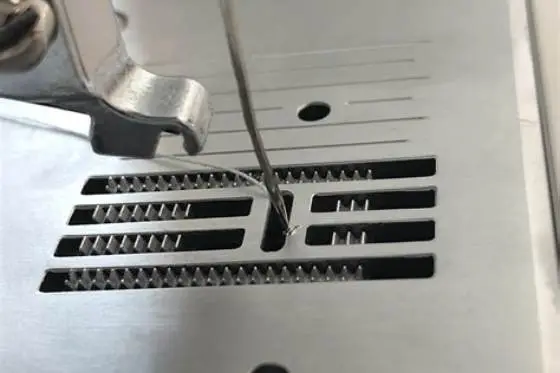
Spot it without taking the machine apart. Remove fabric, bobbin and case, then turn the hand wheel slowly and watch the hook pass the needle. The hook point should slide just behind the scarf without touching. If the needle flexes or pings, stop. Clean lint, re-seat the case until it clicks, and try a fresh 80/12 universal again on scrap.
You can fix lint, a mis-seated case, a bent needle and a wrong foot at home. You cannot reset hook timing or bent needle bar with home tools. If a new centred needle still strikes the hook on a slow hand turn, or the feed dogs nick the needle when you change stitch length, book a service. For a quick visual check, the Sewing Machine Doctor lets you spin the machine in 3D and click the hook area to see the clearance you are looking for.
| Strike point | Sound and look | Likely cause |
|---|---|---|
| Throat plate edge | Light tick, tip bent sideways | Needle bent, not centred, or pulling fabric |
| Presser foot | Tick on zigzag, tip chipped | Wrong foot or width too wide |
| Bobbin case / hook | Hard knock, snap at eye | Case not seated, lint, or timing off |
Not the same fault: needle breaking versus thread breaking, unthreading or a loose needle
A needle break leaves a short, sharp stump in the clamp and often a tip on the plate. Thread breaking leaves the needle intact but the top thread snapped or shredded near the eye. Unthreading leaves the needle threaded then empty after a few stitches, with no snap.
Tell them apart in ten seconds. If the needle is broken you will see a missing tip and hear a snap. If the thread is breaking you will see fraying, the thread tails pulled tight, and the hand wheel still turns freely. If the needle falls out the clamp screw was loose or the needle was not pushed fully home, so it slides down and then jams.
A needle that does not move at all is different again. The hand wheel turns but the needle bar stays still, often after a jam. Check that the bobbin winder is not engaged and the hand wheel clutch, if you have one, is tight. If the bar still does not rise and fall, do not force the pedal. That is a mechanical bind for the shop.
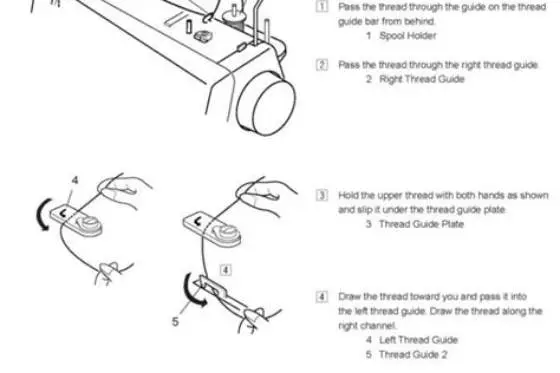
Fix the right fault and you save needles. Re-thread with the presser foot up so the tension discs open, seat the thread in the take-up lever, and use the correct bobbin for your machine. A bobbin that is a fraction tall lifts the case into the needle path and mimics a timing hit.
- Needle break: snap sound, tip missing, often hits metal
- Thread break: fray at eye, tension or burr, needle intact
- Unthreading: missed take-up lever or presser foot down while threading
- Needle falls out: loose screw or needle not fully up
- Needle not moving: winder engaged, clutch loose, or jam
Replace and test: how to change the needle and free a broken tip safely
A fresh needle fixes most repeat breaks, but only if you test clearance before you sew. Expect a new 80/12 to slide through cotton without bowing and to leave a clean hole. If it still ticks metal on a slow turn, do not press the pedal.
Change it in a clean sequence so you do not trap the tip. Turn off the machine, raise the needle with the hand wheel, then raise the presser foot. Loosen the needle clamp screw, pull the needle straight down, and drop it in a sharps container. Push the new needle flat to the back fully home, tighten the screw, and re-thread with the foot up.
Free a stuck tip before you sew. Remove the throat plate and the bobbin case, tip the machine so light falls into the hook race, and lift the fragment with tweezers or a small magnet. Brush lint from the feed dogs and hook area, then re-seat the case until it clicks. Turn the hand wheel two full stitches with no thread to confirm no tap.
Test on scrap that matches your project, same layers and same stitch. Sew 15 to 20 stitches at slow speed, then inspect the underside. Even stitches and no tick means you are good to continue. If the needle still snaps on the test, stop and book a service rather than bending another needle into the hook.
- Power off, raise needle and presser foot, remove fabric and bobbin.
- Loosen clamp screw, pull old needle down, dispose safely.
- Push new needle flat to back fully up, tighten screw firmly.
- Re-thread with presser foot up, seat thread in take-up lever.
- Clean lint, re-seat bobbin case and throat plate.
- Hand turn two full stitches, listen and watch for centre clearance.
- Sew 15-20 stitches on scrap, check for ticks or skipped stitches.
Still wondering?
Can a slightly bent needle still sew?
No. Even a bend you cannot see makes the needle miss the hole and hit the throat plate or hook. If it touched a pin or made a tick sound, put in a new needle. Check the tip with your nail; a burr means it is done.
What size needle should I start with for quilting cotton?
Start with a universal 80/12 and 50 wt thread. It pierces two layers of cotton without deflection and leaves a neat stitch. Go to 70/10 for fine lawn, or 90/14 if you add wadding and backing.
Why does my needle break only on thick seams?
The needle flexes as it climbs the hump and then hits the plate. Slow right down, hold the fabric level with a hump jumper or folded scrap behind the foot, and use a jeans 90/14. Do not pull the fabric to help it through.
How do I get a broken tip out from under the throat plate?
Power off, remove the plate and bobbin case, then lift the tip with tweezers. A small magnet helps if the tip slipped into the hook race. Brush lint away before you re-seat the case until it clicks.
When is a needle break a timing problem?
When a new, centred needle still knocks the hook on a slow hand turn with no fabric. You will also see skipped stitches and jams. Cleaning and re-seating the case does not fix it. That needs a shop to reset hook timing.