How to Sew a Scrunchie in 20 Minutes: Easy Beginner Project
Sew a scrunchie by turning a 4 by 18 inch fabric strip into a tube, threading 7 to 8 inches of 1/4 inch elastic through it, and closing the gap. Join the short ends first, stitch the long edge with a 1/4 inch seam, leave a 1 1/2 inch turning gap, join the elastic with a 1/2 inch overlap, and stitch the gap shut.
On this page (8 sections)
Part of our guide on sewing machine buttonhole
Key figures
- Fabric strip
- 4 x 18 in (10 x 46 cm)
- Elastic length
- 7 to 8 in (18 to 20 cm)
- Elastic width
- 1/4 in (6 mm)
- Seam allowance
- 1/4 in (6 mm)
- Turning gap
- 1 1/2 in (4 cm)
- Needle
- 80/12 universal
- Thread
- 50 wt all-purpose
The short version
- The standard size is a 4 by 18 inch strip with 7 to 8 inches of elastic.
- Stitch the long edge with a 1/4 inch seam and leave a 1 1/2 inch turning gap.
- Join the elastic with a 1/2 inch overlap and two rows of stitching.
- Test the fit on your wrist before you close the gap.
- Quilting cotton holds best; slippery satin slides out of fine hair.
How to sew a scrunchie: the quick version
Gather the tools before you start. You need sharp fabric scissors or a rotary cutter, pins, a large safety pin, an iron and a pencil or chopstick for turning. A seam ripper stays nearby for the odd mistake, and a ruler keeps the strip straight. Good light helps more than any gadget, since the seam is only a quarter inch wide.
Lock both ends of the long seam with backstitches, since the elastic pulls at the seam each time the scrunchie stretches. If the seam opens at an end, the elastic works its way out, and a finished scrunchie is slow to repair. Flatten the turned tube with the iron, keeping the seam to one side, so the ring sits evenly.
For quilting cotton, the usual pair is a new 80/12 universal needle and 50 wt all-purpose thread. A straight stitch at 2.5 mm holds the seam without puckering. Swap in a fresh needle after a project or two, since a dull point snags and skips instead of sewing cleanly. Test the stitching on a scrap of the same cotton first, so the tension is right before the real seam.
Sizes: the strip and elastic that fit your hair
Measure the elastic against your wrist before you cut it, since that loop is close to the loop the scrunchie makes round a ponytail. For most hair, the standard adult size works: a 4 by 18 inch strip with elastic cut 7 to 8 inches long. It suits everyday wear. Shorten the elastic by an inch for a tighter grip on fine hair. Lengthen it by an inch for thick hair or a loose, soft hold. It helps to understand how to sew an elastic waistband before going further.
Thick hair needs more grip, so a 3/8 inch wide elastic suits heavy ponytails better than the usual 1/4 inch width. The wider tape spreads the pressure and holds without digging in, while the narrower tape can cut into a thick ponytail and slip. Thin or fine hair goes the other way: the 1/4 inch tape grips enough, and a wider tape can feel bulky under the fabric.
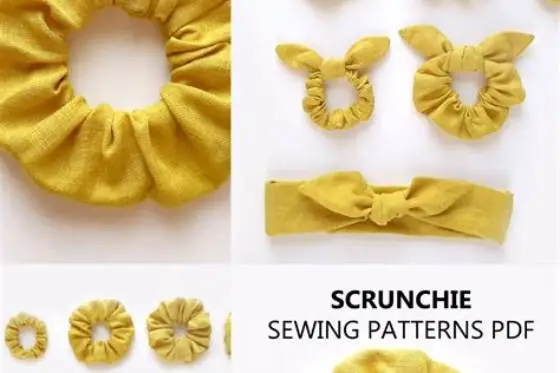
Kids need a smaller ring, so cut a 3 by 14 inch strip with 6 to 7 inches of elastic for a child. An oversized scrunchie takes a 6 by 22 to 24 inch strip with 8 to 9 inches of elastic. The extra fabric gives the big, soft gathers people buy them for. The table below lists the three common sizes, and each one uses the same steps as the standard. Buy elastic by the yard when you sew a batch. One 3 yard pack covers many scrunchies, and you cut each piece to length as you go.
| Size | Fabric strip | Elastic length | Best for |
|---|---|---|---|
| Kids | 3 x 14 in (8 x 36 cm) | 6 to 7 in (15 to 18 cm) | Smaller ponytails |
| Standard adult | 4 x 18 in (10 x 46 cm) | 7 to 8 in (18 to 20 cm) | Everyday use |
| Oversized | 6 x 22 to 24 in (15 x 56 to 61 cm) | 8 to 9 in (20 to 23 cm) | Big, soft gathers |

Dritz Non-Roll Knit Elastic 1/4 Inch x 3 Yards
Gives you a 1/4 inch wide knit strip that keeps its width under tension, with 3 yards on the roll - enough for several scrunchies without the elastic rolling or going slack in the casing.
Fabric: what works, what slides, what to skip
Quilting cotton is the easiest fabric for a first scrunchie. It holds a crease, feeds evenly under the foot, and hides small stitch wobbles in its print. Medium-weight cotton gathers into soft folds and keeps its shape after washing, which is why most tutorials start there. Wash a finished scrunchie in a laundry bag on a cool cycle, and let it dry flat so the elastic keeps its spring. It helps to understand how to bias tape before going further.
Velvet gives a rich, soft scrunchie, but its nap slides under the foot and the pile marks where the iron touches it. Cut velvet with the nap running the same way on the whole strip. Pin more often than cotton needs, and press from the wrong side with a cloth between iron and fabric. A walking foot helps if your machine has one, since it feeds both layers together instead of letting the top layer creep.
Silk and satin look lovely in the shop and slide straight out of fine hair on the first wear. The fabric is so smooth that the ring cannot grip, and the slippery surface also shifts while you stitch it. A scrunchie in these fabrics works better over a plain hair tie, with the tie doing the holding and the fabric doing the showing. Fraying fabrics need their raw edges finished with a zigzag stitch before the tube is sewn, or the inside will shed threads into the gathers.
- Cotton: the safe first choice, easy to sew and wash.
- Velvet: soft and rich, but pin well and mind the nap.
- Satin: pretty, but slips out of fine hair on its own.
The elastic does the holding and the fabric does the showing off, so a scrunchie that slips was cut wrong, not sewn wrong.
Stitching: the tube, the turn and the join
The seam allowance sets how much fabric the gathers can hide. A 1/4 inch seam leaves the tube roomy enough to turn. A wider seam would stiffen the ring and show as a ridge under the folds. Pin every few inches along the long edge, since the layers creep as the machine feeds them. Remove each pin just before the needle reaches it, so the needle never strikes steel.
The gap is the only opening the tube ever has, so its size is a trade-off. An opening of 1 1/2 inches lets a finger reach in to turn the tube, while a smaller gap makes turning a fight. A wider gap leaves a longer closing seam to hide. Keep it near the middle of the long edge, where the gathers disguise it best. Stitch slowly where the layers double at the short seam, since the extra thickness can push the needle off line.
Turning needs patience more than force. Work the tube gently while turning, since a hard pull opens the stitches at the gap ends. A chopstick or the blunt end of a pencil eases the short seam out without poking through. A flat tube with the seam to one side gives an even ring.
- Cut the fabric and elastic to the standard measurements in the sizes table.
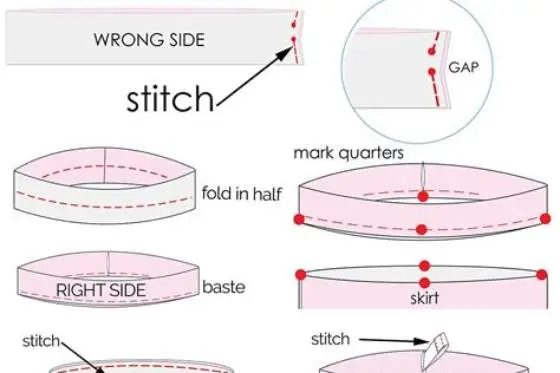
- Match the two short ends, right sides facing, and sew across at a quarter inch.
- Crease the loop down its length with right sides in, sew the long side, and stop to leave a gap of 1 1/2 inches.
- Reach in, pull the fabric through, and press the tube once the right side is out.
- Hook a bodkin onto the elastic end and work it all the way round the tube.
- Cross the ends by half an inch and run two rows of stitching through both layers.
- Turn the raw gap edges under and sew the opening shut near the fold.
Threading the elastic and closing the gap
Clip a big safety pin onto one elastic end, keep hold of the other end, and guide the pin through the gap. Push the pin along inside the tube, bunching the fabric back over it as you go, until it comes out of the gap again. A small safety pin slips open inside the tube, so use the largest pin you own or a bodkin made for the job.
Bring the two elastic ends together with a 1/2 inch overlap. Run two rows of stitching through both layers, one straight and one short zigzag. The zigzag lets the join stretch a little without snapping the thread, which matters every time the scrunchie stretches round a ponytail. Test the join by pulling it firmly before it disappears inside the tube.
Turn the raw edges of the opening under, fold to fold, and sew it shut near the edge. A ladder stitch by hand hides the closing completely, while a machine topstitch close to the fold is faster and nearly as neat. Spread the gathers evenly round the ring and test the scrunchie on your wrist before you call it done.
Fixes: scrunchies that flop, twist or fall apart
Floppy scrunchies usually trace back to elastic that is too long for the hair it holds. Shorten the elastic by an inch and test again, since an inch off the elastic changes the grip more than an inch off the fabric. If the elastic has lost its spring, replace the piece rather than restitching the opening.
Twisting comes from a tube that turned unevenly, with the long seam spiralling round the ring instead of sitting along one edge. Open the gap, smooth the seam back to one edge all the way round, and close the gap again. Pressing the tube flat after turning stops most twisting before it starts.
Test every scrunchie on your wrist and in your hair before you make a batch of them. The wrist test shows the grip in seconds: the ring should slide on with a little resistance and sit without sliding down. A batch cut from one wrong measurement wastes the whole fat quarter, while a single test piece costs one strip. Keep the first scrunchie as your pattern, and cut the rest to match it.
Still wondering?
How much fabric do I need for one scrunchie?
One strip 4 by 18 inches, which is about 1/8 yard of 44 inch wide quilting cotton. A fat quarter covers two or three scrunchies, depending on the size you cut. Scraps at least 18 inches long work too.
Can I sew a scrunchie by hand?
Yes, with small running stitches along the long edge and a ladder stitch to close the gap. Hand sewing takes longer, about 30 minutes, and the stitches need to be small and even to hold the gathers.
What elastic is best for a scrunchie?
A 1/4 inch wide braided or knit elastic suits most hair, with 3/8 inch for thick ponytails. Braided elastic is firm and cheap, while knit elastic stays soft and keeps its width when stretched.
Why does my scrunchie keep falling out of my hair?
The elastic is usually too long, or the fabric is too slippery for your hair type. Shorten the elastic by an inch and test it on your wrist first. Satin and silk slide out of fine hair, so switch to cotton if the ring keeps slipping.
How do I make a scrunchie bigger or smaller?
Change the fabric strip for fullness and the elastic for grip, one at a time. A longer strip makes a fuller ring, while a shorter elastic makes a tighter one. The size table above lists the three common sizes, so start from the row that matches your hair.