How to Reupholster a Bar Stool With Vinyl in an Afternoon
To reupholster a bar stool with vinyl, take the seat off the stool, pull the old vinyl and staples, check the foam, then cut new marine vinyl 3 to 5 in wider than the seat all round, centre the seat on it, and staple it underneath, corners last. A straightforward single seat takes 30 to 90 minutes with basic tools.
On this page (8 sections)
- The short version
- The seat first: what to check before you buy vinyl
- Vinyl choice: the weight and width that last
- How to reupholster a bar stool with vinyl, step by step
- Corners and curves: where a stool seat goes wrong
- Foam and batting: when to replace the cushion
- Finishing and care: the seat that stays tight
- Still wondering?
Part of our guide on upholstery sewing machine
Key figures
- Vinyl width
- 54 in (137 cm)
- Extra vinyl each side
- 3-5 in (8-13 cm)
- New foam
- 1-2 in (2.5-5 cm)
- Staples
- T50, leg to suit base
- Time per seat
- 30-90 minutes
- Yard math
- 15 in seat, 23 in square
The short version
- Measure the seat, then add 3 to 5 in on every side before you cut the vinyl.
- Staple opposite sides first, then work toward the corners in pairs.
- Replace foam that is flat, torn or crumbling; 1 to 2 in of new foam lifts the seat.
- Marine vinyl wipes clean and resists spills; pick a 54 in wide cut sold by the yard.
The seat first: what to check before you buy vinyl
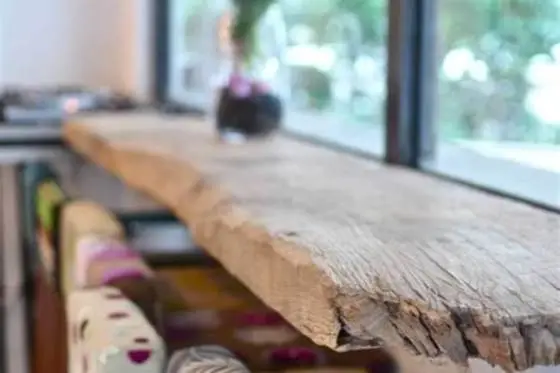
Start with the seat, not the fabric shop. Turn the stool upside down and look at how the seat joins the frame. Most hold the seat with four screws through a wooden base, and those come out with a screwdriver in a minute. If the frame wobbles or a leg joint moves, fix that first. New vinyl on a loose stool only hides the problem for a week.
Pull the old cover off next, and keep it whole if you can. Lift the staples with a flat screwdriver and pliers, and the old vinyl then lifts away in one piece. Lay it flat and look at the foam under it. Keep foam that springs back when you press it. Dented foam that crumbles at the edges or smells damp has to go. You can staple over an old cloth cover when the foam under it is sound. Vinyl and leather covers always come off first.
Measure the seat before you buy anything. Measure across the widest point, then add 3 to 5 in (8 to 13 cm) on every side for the wrap. A 15 in (38 cm) round seat with 4 in of overhang needs a piece about 23 in (58 cm) square. A 36 by 54 in yard holds two such squares side by side, so one yard covers two seats of this size. Measure your own seat first, since a larger seat needs more vinyl.
- Vinyl: marine vinyl, 54 in wide, sold by the yard
- Foam: 1 or 2 in upholstery foam, if the old foam failed
- Batting: a layer of polyester batting to round the edge
- Staple gun: a heavy duty gun that takes T50 staples
- Staples: T50, tested on a scrap of your seat base first
- Tools: screwdriver, pliers, sharp scissors
Vinyl choice: the weight and width that last
Buy marine vinyl, not the thin vinyl sold for tablecloths. Marine vinyl has a woven backing that stops it tearing at the staples, and its surface wipes clean after a spill. Look for a listing that says waterproof and UV resistant, with a cut 54 in (137 cm) wide. Thin vinyl without a backing splits at the first staple. It helps to understand sewing machine needle bar issues before going further.
Colour matters more than most people think. A dark vinyl hides scuffs and food stains, while a pale one shows every mark a kitchen can make. Hold a sample against the stool legs in daylight before you commit. It has almost no stretch, so a pattern that fits the old cover exactly will pull tight. Cut your new piece a little larger than the old one and trim later. Vinyl with a directional print needs extra length, so the pattern runs the same way on every stool.
Vinyl wins on cleaning and price, fabric wins on comfort and colour range, and leather wins on looks while costing the most. Your stool decides the winner. Kitchen stools that take breakfast, homework and spilled drinks want vinyl.
| Material | Wipes clean | Stretch | Best for |
|---|---|---|---|
| Marine vinyl | Yes, damp cloth | Very little | Kitchens, kids, daily use |
| Upholstery fabric | No, spot clean | Some | Bedrooms, light use |
| Leather | Yes, condition it | Very little | A showpiece stool |

Arrow T50 Heavy-Duty Staple Gun
Drives T50 staples including the required 1/4", 3/8" and 1/2" lengths (lists 1/4", 5/16", 3/8", 1/2", 9/16").
How to reupholster a bar stool with vinyl, step by step
Work on a table or the floor, with the vinyl face down. Lay the seat upside down in the middle, foam side down, and check the overhang is even on all four sides. Pull the vinyl up over one edge and put the first staple in the middle of the back edge, not a corner. Corners come last, and starting in the middle keeps the vinyl square on the seat. Wear eye protection when you staple, and keep your free hand clear of the staple path. The other half of this decision is zigzag stitch for applique edges.
Move to the opposite side and pull the vinyl snug before you staple. Keep the pull even on both sides, then staple. Work round the seat in pairs, one staple on each side, until only the corners are left. Check the top after every few staples. Catch a wrinkle early and it pulls out with one staple removed.
Corners take patience, not force. Fold one side in flat, then fold the other over it like a hospital corner on a bed, and staple through the fold. Round seats want small even pleats, spaced by eye, with each pleat stapled flat. Trim the extra vinyl to about 1 in (2.5 cm) past the staples when the corners sit flat.
- Unscrew the seat from the stool frame and set the screws aside.
- Pull the old staples with pliers and lift the old cover away.
- Check the foam and replace it if it stays dented or crumbles.
- Cut the new vinyl 3 to 5 in (8 to 13 cm) larger than the seat on every side.
- Lay the vinyl face down and centre the seat on it, foam side down.
- Staple the middle of the back edge, then the middle of the front edge.
- Staple the middles of the two side edges, pulling the vinyl snug.
- Work round in pairs toward the corners, checking the top often.
- Fold each corner flat, staple through the fold, and trim the extra vinyl.
- Staple a dust cover over the bottom and screw the seat back on.
A wobbly, cracked bar stool seat is an afternoon's work away from looking new again.
Corners and curves: where a stool seat goes wrong
A corner goes wrong when one side gets pulled harder than the other. It slides a little with each staple, and the pattern drifts off centre by the corner. Check the top before you touch a corner. Seats that look straight at the middles stay straight at the corners.
Round seats wrinkle because vinyl does not stretch round a curve. Small pleats solve it, and the pleats should all run the same way, like the folds of a fan. Press each pleat flat with your thumb before you staple it. Pleats that stand up catch on clothes and wear through first, so flat matters more than neat.
Square seats have their own trap. The corner of the wood base is sharp, and vinyl pulled hard over it thins and splits within months. Ease the pull at the corner and let the fold take the turn instead. If a corner still will not lie flat, cut a small V in the extra vinyl behind the fold. Keep the cut well clear of the staples, and the fold will sit down. A small cut behind the fold never shows from above.
Foam and batting: when to replace the cushion
Foam decides how the seat feels, and old foam is the usual reason a recovered stool still feels tired. Press it with your palm and watch. Good foam springs back in a second or two. Dented foam that flakes at the edges or has gone hard with age needs replacing, and no amount of new vinyl fixes it.
Cut the new foam from the seat base, not from the old foam. Old foam has been squashed smaller by years of sitting, and copying it copies the sag. Trace the wooden base onto 1 in or 2 in (2.5 or 5 cm) upholstery foam. Cut it with a long serrated knife or an electric carving knife. One inch suits a firm seat, while 2 in gives a softer sit that still holds its shape.
Lay a layer of polyester batting over the foam to round the edge and stop the vinyl creasing over a sharp foam corner. Smooth the batting down and trim it flush with the base before the vinyl goes on. Fix the foam to the base with spray adhesive made for foam, or a line of hot glue. That stops it shifting while you staple. Work with a window open when you use spray adhesive, and let it turn tacky before you press the foam down. Press the seat all round when you finish; it should feel even everywhere.
Finishing and care: the seat that stays tight
Trim the extra vinyl to about 1 in (2.5 cm) past the staples. Cut it in a straight line so the bottom looks tidy. Finish with a dust cover of thin black cambric or lining fabric. Cut it to the seat shape plus 1 in, and staple it over the bottom, edges turned under. It hides the staples and stops dust falling out of the seat.
Screw the seat back onto the frame and sit on it. It should feel firm at the edges and even across the middle, with no staple you can feel through the vinyl. Tighten the screws a quarter turn at a time, and check the stool does not rock. Rocking after recovering usually means one screw missed the frame, not a problem with the vinyl.
Vinyl asks for little care. Wipe spills with a damp cloth and a drop of mild soap, then dry it. Harsh cleaners and solvents dry the surface out and make it crack, so keep them away from the stool. Check the staples after the first week of use. Replace a loose staple before the vinyl starts to slip. Bag the old vinyl for the bin, and drop the pulled staples in a jar first so they cannot cut anyone.
Still wondering?
Can I reupholster a bar stool over the old vinyl?
Only when the old cover is cloth and the foam under it is sound. Two layers of vinyl or leather trap moisture, and the seat ends up lumpy and damp. Pull the old vinyl off when the seat is vinyl or leather, or when the foam needs replacing.
How much vinyl do I need for four bar stools?
Measure the widest seat and add 3 to 5 in (8 to 13 cm) on every side. Work out one seat, then multiply by the number of seats, adding 10 to 20 percent for mistakes and pattern matching. Buy one extra yard for large seats or a pattern to match.
Do I need a sewing machine to reupholster a bar stool?
No, not for most stools. The cover is pulled round the seat and stapled underneath, so no stitching is involved. You only need a machine when the seat has sewn corners or a piped edge you want to copy.
What size staples hold vinyl on a stool seat?
Match the staple leg to your seat base, so the point cannot poke through the top. Test one staple on a scrap of the same base first. Start with a 3/8 in (10 mm) leg on plywood, and a 1/4 in (6 mm) leg when the base is thin.
Why does my vinyl wrinkle at the corners?
The vinyl was pulled harder on one side than the other, so it drifted off centre as you stapled. Take the staples out of the worst corner and redo it from the middle out. Small even pleats on a round seat beat one big fold every time.