Yarn Weights UK vs US: Conversion Chart and Traps
Yarn weights in the UK vs the US use different names for the same yarn: UK Aran is US worsted, UK DK is US DK, and Australian 8 ply is DK, not worsted. When present, the Craft Yarn Council (CYC) number, commonly 0 to 7, is the most consistent indicator across many modern brands. If the CYC number is not printed, use WPI and a swatch.
On this page (9 sections)
Part of our guide on easier crochet or knitting
| Product | sizing systems printed | Verdict | |
|---|---|---|---|
| Clover Swatch Ruler & Needle Gauge Clover | 3 sizing systems printed (US, metric, Japanese) vs need 3 systems: meets threshold. | Meets it | View on Amazon |
| BeKnitting Knitting Needle Gauge Sizer Tool for Knitting Needles & BeKnitting | 2 sizing systems printed (US and millimetre) vs need 3 systems: short by 33%; fallback shows 18 calibrated gauges (meets 18 sizes). | Short by 33% | View on Amazon |
Key figures
- UK Aran =
- US worsted (CYC 4)
- UK DK =
- US DK (CYC 3)
- AU 8 ply =
- DK (CYC 3)
- AU 10 ply =
- worsted (CYC 4)
- Most reliable check
- ball-band gauge
- WPI, DK
- 12-14 wraps
- WPI, worsted
- 9-11 wraps
The short version
- UK Aran is US worsted, UK DK is US DK, and Australian 8 ply is DK.
- The CYC number, 0 to 7, is the steadiest guide when the band prints one.
- Ply counts strands, not thickness: two balls labelled 8 ply can knit differently.
- When the label is gone, wraps per inch plus a swatch name the weight.
Yarn weights UK vs US: the short answer
Yarn weights in the UK vs the US use three names for the same yarn, and the names collide exactly where a substitution goes wrong. Read the number before the name when the band prints one.
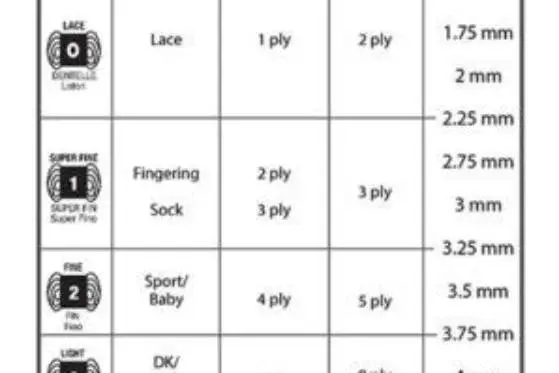
The chart below lines up all eight weights with their US, UK and Australian names, plus the needle sizes each one takes. Use it when a pattern says Aran and your yarn says worsted, or when an Australian pattern says 10 ply and your shop sells worsted. If the two names sit on the same row, they are the same weight.
Names still trip people up, because two of them look like matches and are not. According to common CYC categorisation, UK Aran is typically placed in category 4 (worsted/aran). Individual yarns labelled Aran can vary, so always check the banded CYC number and swatch. The traps section below covers each one, with what to do instead of guessing.
When the label is gone, the weight is still measurable. Wraps per inch and a gauge swatch tell you what a ball is, whatever country printed it. A small gauge tool does both jobs in one place, and the pick below prints all three sizing systems on one card. There is more on what numbers 0 to 7 mean in a separate guide.

The full conversion chart: CYC 0 to 7
The Craft Yarn Council numbers yarn from 0 (lace) to 7 (jumbo), and most modern ball bands print the number inside a small skein icon. That number is the steadiest guide on the label. Match it first, then check the gauge.
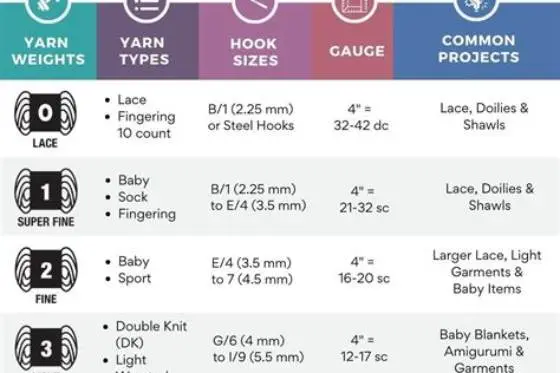
Needle and hook sizes follow the number, not the name. A DK yarn takes 3.75 to 4.5 mm needles and a 4.5 to 5.5 mm hook. That holds whether the band says DK, light worsted or 8 ply. A worsted yarn takes 4.5 to 5.5 mm needles and a 5.5 to 6.5 mm hook. That holds whether it says worsted, Aran or 10 ply.
Gauge is the figure that proves a match. Commonly cited ranges (per Craft Yarn Council): DK around 21 to 24 stitches per 4 in, and worsted around 16 to 20. Still, check the band and swatch. The band prints separate gauges for knitting and crochet, because the same yarn behaves differently in each craft; use the one for your craft.
Jumbo, category 7, has no standard UK ply name and sits above super bulky. It is rare in patterns, and most shops sell it for arm knitting and chunky blankets. The chart below stops at super bulky for that reason; jumbo is the row above it, with needles above 12 mm.
| CYC | US name | UK name | AU ply | Needles (mm) |
|---|---|---|---|---|
| 0 | Lace | 1-ply / 2-ply | 1-ply / 2-ply | 1.5-2.25 |
| 1 | Fingering / sock | 4-ply | 4-ply | 2.25-3.25 |
| 2 | Sport / baby | 5-ply | 5-ply | 3.25-3.75 |
| 3 | DK / light worsted | DK | 8-ply | 3.75-4.5 |
| 4 | Worsted / aran | Aran | 10-ply | 4.5-5.5 |
| 5 | Bulky / chunky | Chunky | 12-ply | 5.5-8 |
| 6 | Super bulky | Super chunky | 14-ply+ | 8-12 |
The three traps: Aran, 8 ply and DK
UK Aran and US worsted share category 4, but they are not the same yarn. Many manufacturers label Aran as category 4, but some Aran-labelled yarns measure closer to category 5 on WPI or gauge. Verify by checking the CYC number, WPI, and swatching. Substituting aran into a US worsted pattern without re-swatching can make a garment roughly one size too big. Let the gauge decide, not the front of the band.
Australian 8 ply is the expensive mix-up. It means DK, category 3, not worsted. A knitter who buys 8 ply for a worsted pattern ends up with a finer yarn. More stitches per inch means a garment that comes out small. Australian 10 ply is the worsted equivalent. Read the ply number as a name, not a weight.
DK and light worsted overlap without matching. Both sit in category 3. UK DK is the narrower, older definition, and it usually knits slightly finer than a yarn US mills label light worsted. A pattern written for one can still work with the other, but test a swatch first when the fit matters.
Ply itself is not a weight. Ply counts the strands twisted together, and a loosely spun 8 ply can be thicker than a tightly spun 10 ply. Brands also use ply names loosely, so two balls labelled 8 ply can knit differently. Trust the gauge; treat ply as a hint.
Three countries, three names, one ball of yarn: the number on the band is the only one that never lies.
How to tell the weight of any yarn: gauge and WPI
Start with the ball band. It prints the CYC number, the recommended needle size and the gauge in stitches per 10 cm. Two yarns with the same gauge number are the same weight, whatever country printed the label. That one check settles most arguments before they start.
No band? Count wraps per inch. Wrap the yarn around a ruler for one inch, with the strands touching but not squashed, and count them. Typical WPI ranges reported in published WPI tables are approximately: DK 12 to 14, worsted 9 to 11, fingering 19 to 22. Treat WPI as a guide and confirm with a swatch.
Confirm with a swatch. Knit or crochet a 4 in (10 cm) square on the recommended needle or hook. Count the stitches across it and compare with the pattern gauge. Block the swatch the way you will wash the finished piece, since gauge can shift after washing. A swatch takes twenty minutes and answers the question the label cannot. It is the only check that accounts for your tension.
A gauge tool speeds up both checks. It measures needle and hook sizes in US, metric and Japanese numbers. The better ones print a WPI scale and a yarn weight chart on the back. A steel gauge is more durable than plastic and resists wear; consider one if you want longevity.
- Wrap the yarn snugly around a ruler for 1 in, strands touching.
- Count the wraps and match the number to the WPI ranges above.
- Check the gauge on the ball band, or knit a 4 in swatch.
- Pick the CYC number that matches both checks.
Clover Swatch Ruler: the pick for converting on the spot
A commonly recommended gauge tool is the Clover Swatch Ruler and Needle Gauge. The maker lists needle and hook sizing in metric, US and Japanese standards. One tool reads a needle in any of the three systems, so a US pattern and a UK pattern stop arguing. It also carries a 4 in (10 cm) window for measuring a swatch gauge.
The three systems matter because patterns mix them freely. A British pattern says 4 mm, an American pattern says US 6, and a Japanese pattern says 7/0. All three can mean the same hook. The Clover card prints all three beside each hole, so you read the size once and move on.
Two parts make it more than a size checker. The square with the holes measures needles and hooks, and the slotted square measures crochet hooks and sits inside the window to lay flat. Together they cover the two jobs a conversion needs: naming the tool and checking the gauge.
The honest limit is the material. The card is light plastic, and heavy use in a crowded bag can flex it. It also measures the common sizes only, so very fine steel hooks and jumbo needles fall outside it. Neither matters for everyday DK and worsted work, which is where most conversions happen.
| Tool | Sizing systems | Extras |
|---|---|---|
| Clover Swatch Ruler (pick) | Metric, US, Japanese | 4 in gauge window |
| BeKnitting (upgrade) | Millimetres, US needle, US hook | WPI scale, weight chart, steel |
- three sizing systems on one card
- 4 in gauge window included
- light and pocket-sized
- light plastic flexes in a crowded bag
- common sizes only
BeKnitting: the upgrade that lasts
A higher-end example is the BeKnitting Needle Gauge, a steel card the maker lists with 18 calibrated gauges for needles and hooks. Each hole is labelled in millimetres, US needle sizes and US hook sizes. The back prints a chart of yarn weights, wraps per inch, knitting gauge and recommended needle sizes.
Steel is the reason to choose it. Plastic gauges wear at the holes and printed numbers fade; steel keeps its edges and its markings. Some steel gauges are sold with lengthy or lifetime warranties; check the manufacturer's listing for details.
The WPI tool on the front settles unlabelled yarn. Wind the yarn around the gauge until it fills the marked space, count the wraps, and read the weight off the chart on the back. It is the same method as the ruler trick, with the chart built in.
Cost is the limit, and so is scope. The gauge prints millimetres and US sizes, not Japanese sizes, so a Japanese pattern still needs the chart in section 2. It also covers the common sizes only. If you convert between US and metric patterns every week, it earns its place. If you knit from one country's patterns, the chart above is enough.
- steel body, lifetime warranty
- WPI scale and chart on the back
- 18 calibrated gauges
- no Japanese sizes printed
- common sizes only
Read the CYC number, not the name, and keep a gauge in your bag for the yarns that have no label.
Still wondering?
Is UK Aran the same as US worsted?
Nearly, but not exactly. Both sit in CYC category 4, yet some Aran-labelled yarns measure closer to category 5 on WPI or gauge. Swapping aran into a US worsted pattern without a swatch can leave a garment roughly one size too big. Match the gauge first.
Is Australian 8 ply the same as worsted?
No. Australian 8 ply is DK weight, category 3, while worsted is Australian 10 ply. A knitter who buys 8 ply for a worsted pattern ends up with a finer yarn and a garment that comes out small. Treat the ply number as a name, not a weight.
What does DK mean in yarn weights?
DK means double knitting. It is CYC category 3, the weight most often used for light sweaters and baby clothes. It knits at 21 to 24 stitches per 4 in (10 cm) on 3.75 to 4.5 mm needles. It takes a 4.5 to 5.5 mm crochet hook.
How do I find the weight of yarn with no label?
Wrap the yarn snugly around a ruler for one inch, strands touching but not squashed, and count the wraps. Expect about 12 to 14 wraps for DK, 9 to 11 for worsted, and 19 to 22 for fingering. Then knit a swatch to confirm, since published WPI tables disagree by a few wraps.
Do I need a needle gauge to convert yarn weights?
Only if you convert often or own unlabelled needles. A gauge prints US, metric and Japanese sizes on one card, so a pattern from any country reads straight off it. If you knit from one country's patterns, the chart in this article and the gauge on the ball band do the job.