Fingering yarn on double-pointed needles: which size fits
Fingering yarn works on double-pointed needles from roughly 2.25 mm to 3.25 mm (US 1-3). Socks want the small end, around 2.25-2.5 mm, for a dense wear-resistant fabric, while mittens and hats can take 3-3.5 mm for a softer, quicker result.
On this page (9 sections)
- Fit check
- The short version
- The typical needle range for fingering weight
- What size double pointed needles for fingering yarn
- Do 3.5 mm needles work for fingering mittens
- Why stitch count and gauge beat the yarn label
- When your fingering yarn is not average fingering
- Choosing double-pointed needles for small projects
- Still wondering?
Part of our guide on getting smooth stretchy seams on knits

Knit Picks Double Pointed Wood Knitting Needles Set
Gives you both 2.25 mm and 2.5 mm needles for 8-stitches-per-inch sock fabric, plus every size up to 3.5 mm
Check it on Amazon
woshilaoDS 35pcs Double Pointed Knitting Needle Sets
Slick stainless steel needles in exact 2.5 mm size for fast 8-stitches-per-inch sock knitting, better once
See this alternative
Aeelike Double Pointed Knitting Needles Set
Hollow stainless steel needles down to 2.5 mm keep hand fatigue low on long sock tubes while still holding an
See this alternative| Product | needle size (mm) | Verdict | |
|---|---|---|---|
| Knit Picks Double Pointed Wood Knitting Needles Set Knit Picks | Smallest needle 2 mm, includes 2.25 mm and 2.5 mm - within the 2.5 mm ceiling | Meets it | View on Amazon |
| woshilaoDS 35pcs Double Pointed Knitting Needle Sets woshilaoDS | Includes 2.0 mm and 2.5 mm sizes - within the 2.5 mm ceiling | Meets it | View on Amazon |
| Aeelike Double Pointed Knitting Needles Set Aeelike | Sizes run 2.0-6.5 mm including 2.5 mm - within the 2.5 mm ceiling | Meets it | View on Amazon |
| Aeelike Double Pointed Knitting Needles Set Aeelike | Sizes run 2.0-5.0 mm including 2.5 mm - within the 2.5 mm ceiling | Meets it | View on Amazon |
| Double Pointed Knitting Needles Set,75 Pcs Wooden Bamboo Knitting Boliyoooki | Size list runs 2.0, 2.25, 2.75... - 2.25 mm is at the ceiling, no 2.5 mm | Meets it | View on Amazon |
Key figures
- Fingering range
- 2.25-3.25 mm (US 1-3)
- Sock sweet spot
- 2.25-2.5 mm (US 1-2)
- Mitten size
- 3-3.5 mm (US 2.5-4)
- Yarn weight
- Fingering, about 4 ply
- Typical sock gauge
- 8 stitches per inch
- Swatch before sizing
- Yes, always
The short version
- Fingering yarn's working range on DPNs is about 2.25-3.25 mm (US 1-3).
- Socks want 2.25-2.5 mm so the fabric stands up to wear.
- Mittens on 3.5 mm are legitimate - the fabric just gets lighter and airier.
- Your gauge swatch, not the yarn label, settles the final needle size.
- Bamboo DPNs grip sticky sock yarn; metal ones speed up smooth superwash.
The typical needle range for fingering weight
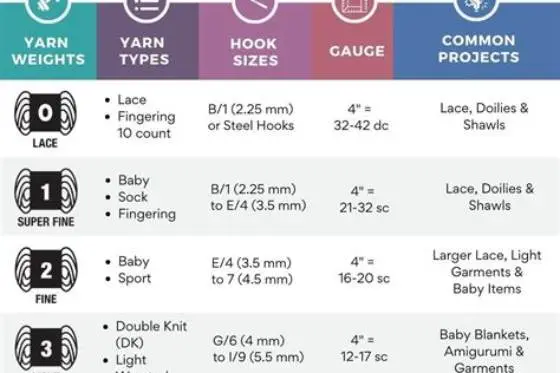
Fingering yarn sits near the bottom of the yarn weight scale - it is what most of us call 4 ply in the UK and Australia, roughly a US 1 sock yarn. Ball bands usually suggest 2.25 mm to 3.25 mm needles (US 1-3), and that spread is not a typo. It exists because fingering yarn is a category, not a single thickness, and because the fabric you want changes with the project.
At 2.25 mm, fingering yarn packs into a dense, firm fabric where every loop counts - exactly what a heel that spends its life inside a shoe needs. Slide up to 3.25 mm and the same yarn opens into a softer, drapier cloth with visible air between the stitches. Neither is wrong; they are simply different fabrics from one ball of yarn.
So treat the range as a menu rather than a rule. The ball band's suggestion is calibrated for a medium fabric at a middling gauge, which is a fine starting guess for a hat or a lightweight sweater body. What it cannot know is whether you are knitting socks, mittens or a shawl - and that is where the project takes over from the label.
| Needle size | US size | Fabric result | Best for |
|---|---|---|---|
| 2.25 mm | US 1 | Very dense, firm | Sock heels, soles, hard-wear items |
| 2.5 mm | US 1.5 | Dense but flexible | Most socks, baby clothes |
| 3 mm | US 2.5 | Balanced, soft | Hats, lightweight sweaters |
| 3.25 mm | US 3 | Airy, drapy | Shawls, loose mittens |
What size double pointed needles for fingering yarn
Double-pointed needles add one more consideration: the yarn is held on four or five short sticks, and every transfer between them is a chance for a loose stitch. Slightly grippier needles and a slightly tighter fabric both help, which is why DPN projects tend to sit at the small end of the fingering range. There is more on yarn weight chart explained in a separate guide.
For socks, start at 2.5 mm (US 1.5) and drop to 2.25 mm if your swatch comes out loose. Most sock patterns assume a gauge near 8 stitches per inch, and 2.5 mm with a typical fingering sock yarn gets many knitters close. For mittens, 3 mm to 3.5 mm (US 2.5-4) is comfortable, and for a hat brim worked double-stranded you might even reach for 3.25 mm.
Needle length matters too. A 6 inch (15 cm) DPN suits most sock and mitten circumferences; 8 inch (20 cm) needles are easier on the hands but awkward on a 64-stitch sock leg. If your stitches keep sliding off the tips, that is the fabric telling you the needle is either too big or too slick for this yarn.
Knit Picks Double Pointed Wood Knitting Needles Set
Gives you both 2.25 mm and 2.5 mm needles for 8-stitches-per-inch sock fabric, plus every size up to 3.5 mm for looser mitten and hat gauges, in one wooden set.
- Size 4"
- Height 0.6 inches
- Length 4.8 inches
Do 3.5 mm needles work for fingering mittens
Yes, and the fabric tells you why. Mittens live a different life from socks: they stretch over a hand, they are not ground against a shoe, and a little air in the cloth is a feature, not a flaw. At 3.5 mm, fingering yarn makes a lighter, more flexible mitten that knits up noticeably faster - a welcome thing when you are knitting a pair. There is more on needle sizes for sock knitting in a separate guide.
What you give up is durability and wind resistance. An airy mitten fabric fuzzes faster at the fingertips and lets cold air through more readily than a dense one. If the mittens are for a toddler who will outgrow them before they wear out, that trade is easy. If they are for daily winter dog walks, work at 3 mm and accept the extra evening.
The honest test is the swatch again. Cast on 24 stitches on 3.5 mm, work an inch in the round, and look at it: if the fabric feels like something you would want around your fingers, the size is right for this yarn and this pair. If it looks like a fishing net, come down half a millimetre.
- Knits up faster than sock-gauge fabric
- Soft, flexible mitten with good stretch
- Uses less yarn per mitten
- Less wind-resistant than dense fabric
- Fuzzs and pills sooner at fingertips
- Pattern stitch counts may need adjusting
woshilaoDS 35pcs Double Pointed Knitting Needle Sets
Slick stainless steel needles in exact 2.5 mm size for fast 8-stitches-per-inch sock knitting, better once your tension is established and stitches should glide.
- Height 0.19 inches
- Length 7.87 inches
- Width 0.19 inches
The chart says 2.25 to 3.25 mm for fingering, but your socks, mittens and gauge each pull that number somewhere different - here is where it lands.
Why stitch count and gauge beat the yarn label
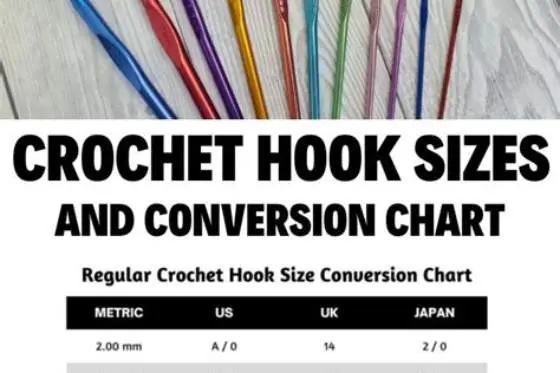
Here is the part the ranking pages skip: the needle size is downstream of the stitch count, not the other way round. A sock pattern might call for 64 stitches around. Your foot does not care what needle you used - it cares that the finished tube measures about 8 inches (20 cm) in circumference. 64 stitches divided by 8 inches is 8 stitches per inch, and whatever needle gets your hands to that number is the right needle. The other half of this decision is crochet hook measurements.
This is why two knitters can follow the same pattern with different sizes and both succeed. If your natural gauge is tight, you may need 2.75 mm to hit 8 stitches per inch on the same yarn a loose knitter works at 2.25 mm. The label on the yarn never enters this arithmetic.
The practical routine is short. Cast on 32 stitches on a middle-of-the-range needle, join in the round, knit an inch or two, and measure over 4 inches (10 cm). Divide your stitch count by the inches measured. Too many stitches per inch means go up a size; too few means go down. Ten minutes of swatching saves a sock that fits nobody.
- Cast on 32 stitches in the round on a mid-range needle (2.5 mm).
- Knit about 2 inches (5 cm) without changing anything.
- Measure 4 inches (10 cm) across the fabric and count the stitches.
- Divide stitches by inches to get your gauge.
- Move up or down a needle size until you hit the pattern's number.
| Pattern gauge | Stitches you got on 4 inches | Move to |
|---|---|---|
| 8 st/in | 9 or more | Larger needle |
| 8 st/in | 8 | Stay on this size |
| 8 st/in | 7 or fewer | Smaller needle |
Aeelike Double Pointed Knitting Needles Set
Hollow stainless steel needles down to 2.5 mm keep hand fatigue low on long sock tubes while still holding an 8-stitch-per-inch fabric.
- Size 2mm - 6.5mm
- Height 0.39 inches
- Length 2.36 inches
When your fingering yarn is not average fingering
Fingering is a band, and some yarns sit near its edges. Heavy fingering - the slightly plump end, sometimes sold between fingering and DK - behaves almost like a light DK and often wants 3 mm to 3.5 mm even for socks, or 2.75 mm if you like a firm fabric. Light fingering leans toward lace weight and frequently drops to 2 mm or 2.25 mm, especially for socks, to keep the fabric from becoming gauzy.
You cannot reliably read this from the label, because two yarns with identical listed yardage can differ in plumpness. Instead, look at the pattern's gauge requirement and at the yarn itself: twist the strand between your fingers against another fingering yarn you know. Plumper strands, more plies, or a lower yards-per-gram figure all hint that you should start a half size up.
The swatch absorbs all of this uncertainty, which is its real job. Start at the middle of the range, measure honestly, and let the result - not the category name - pick the needle. A heavy fingering swatch at 2.5 mm that comes out at 9 stitches per inch is simply telling you to reach for the 2.75 mm pair.

Aeelike Double Pointed Knitting Needles Set
Seven steel sizes including 2.5 mm with separate storage pockets per size, so you can knit socks at gauge and still have 3.5 mm pairs for looser hats.
- Size 2mm-5mm
- Height 0.39 inches
- Length 2.36 inches
Choosing double-pointed needles for small projects
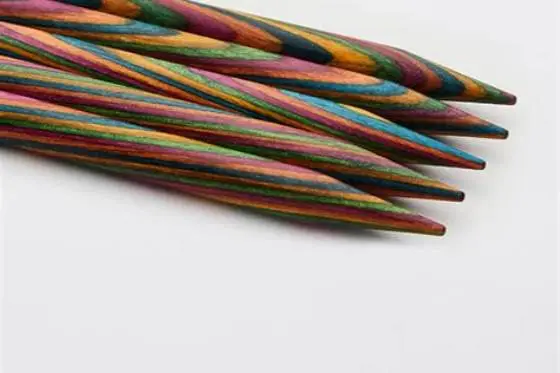
Once you know your size, the material of the needle becomes the next decision, and it is a real one for small work. Bamboo and wooden DPNs grip the yarn, which stops stitches sliding off between needles - a blessing for beginners, slippery superwash sock yarns and anyone knitting on a train. Metal needles are slicker and faster, which experienced sock knitters often prefer for long stretches of plain rounds, but they will drop loose stitches if your tension is relaxed.
For a first sock project, a bamboo set covering 2 mm to 3.5 mm gives you every fingering size in one purchase and costs about what you would expect for a mid-range set of notions. If you already knit at a firm tension and finish socks quickly, individual metal needles in 2.25 mm and 2.5 mm do the same job for less. Carbon-fibre and wood-tipped metal needles split the difference, offering grip at the tip with speed along the shaft.
Whichever you choose, buy the length that matches the project: 6 inch (15 cm) needles for socks and mittens, 8 inch (20 cm) for hats and sleeves. Our Needle & Thread Finder tool sorts out fabric-and-needle pairings for sewing, and the same habit of matching tool to material applies here - the yarn you are holding should pick the needle, not habit.
| Material | Grip | Speed | Best for |
|---|---|---|---|
| Bamboo | High | Slower | Beginners, slippery superwash yarns |
| Metal | Low | Fast | Confident knitters, long plain rounds |
| Carbon / wood-tip | Medium | Medium | Long-term sock knitters wanting both |
- Bamboo grips slippery yarn and forgives loose tension
- Metal needles speed up long stockinette rounds
- A sized set covers every fingering project at once
- Bamboo tips can snap under firm tension
- Metal drops stitches from relaxed knitters
- Sets cost more upfront than single pairs
For fingering on DPNs, let the project pick the end of the 2.25-3.25 mm range and let the swatch make the final call.
Still wondering?
Can I knit fingering socks on 3 mm needles?
You can, but expect a looser, less durable fabric unless your gauge is naturally tight. Check whether you still reach the pattern's stitch count - many knitters need a larger foot circumference to make 3 mm work for socks.
How many double-pointed needles do I need for socks?
Most knitters use four or five: three or four holding the stitches and one working needle. Five-needle sets distribute stitches more evenly and reduce the loose column of stitches that four-needle knitting can leave.
What length double-pointed needles for socks?
6 inches (15 cm) is the standard for adult socks and mittens. The 8 inch (20 cm) length suits hats and wider tubes but gets cramped on a 64-stitch sock circumference.
My swatch gauge is between two needle sizes. Which do I pick?
For socks, pick the smaller size - a slightly dense sock wears better than a loose one. For mittens or hats, the larger size gives a softer fabric and you can always felt or block lightly.
Do I need different needles for the cuff and the body?
Many sock patterns use a smaller needle for the ribbed cuff to keep it snug, then switch up half a millimetre for the leg. This is a pattern choice, not a rule, and it applies to any fingering project with ribbing.