Crochet hook sizes in mm and US letters: which your pattern means
If you need a crochet hook sizes chart, use mm as the true size. US letters and numbers and UK numbers all point to the same mm, but makers vary a little. Circle the mm on your pattern and match that number for gauge.
On this page (8 sections)
- The short version
- Crochet hook sizes chart: US letters and numbers to mm to UK
- Steel hooks vs regular hooks: why the same mm shows up twice
- Reading the stamp: how to tell what size your hook really is
- Choosing the right hook: matching mm to yarn weight and gauge
- Going up or down a size: what actually changes in your fabric
- When labels conflict: getting gauge when yarn and hook disagree
- Still wondering?
Part of our guide on best serger for knits
Key figures
- Common hook
- H-8 = 5.0 mm
- Yarn + hook
- Worsted usually 5.5-6.5 mm
- Steel range
- 0.6 mm to 1.75 mm
- Gauge shift
- Varies by yarn and stitch; swatch to confirm
- Unmarked check
- Use mm gauge plate
- UK numbers
- Higher number = smaller hook
The short version
- Translate every pattern to mm first, then shop by mm not by letter.
- Steel hooks and regular hooks overlap in mm but serve different yarns.
- An unmarked hook needs a gauge plate, not guessing by eye.
- One mm step changes stitch height and drape more than yarn brand does.
Crochet hook sizes chart: US letters and numbers to mm to UK
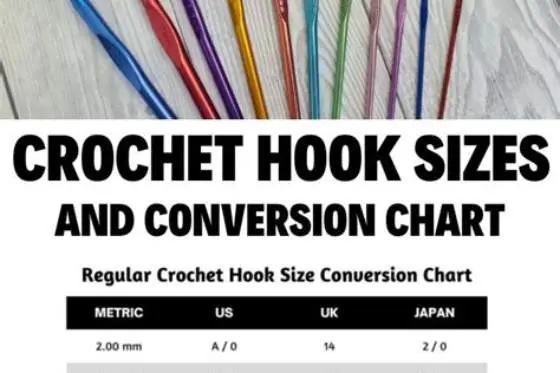
Your crochet hook sizes chart starts with mm. US letters like J, US numbers like 7, and UK numbers all indicate the shaft diameter in mm. If you match the mm you match the stitch size. A US H-8 is 5.0 mm and a UK 6 is also 5.0 mm. US letters run A upwards, UK numbers run 14 down to 0 and bigger number means smaller hook.
Patterns from the US usually give a letter, older UK patterns give a number, and modern patterns give mm. When they conflict, trust the mm. Two hooks both marked 4 mm can differ slightly, so measure if gauge matters. Keep a printed chart in your notions pouch and circle the hooks you own. That saves you buying a duplicate.
Yarn labels suggest a hook, but the pattern gauge decides. If your pattern says US I-9, look up 5.5 mm, then find that mm on your hook or gauge. UK 5 is also 5.5 mm. Steel hooks start at 0.6 mm and overlap in numbers, so check the material line on the chart before you assume. The table below is the conversion most US and UK makers follow today, based on Craft Yarn Council standards. Note that some brands like Boye, Susan Bates, and Clover vary by about 0.25 mm on some letter sizes.
The chart covers common sizes from A-1 (2.25 mm) up to Q (15.75 mm), and steel hooks from size 14 (0.6 mm) to 0 (2.0 mm). Some sizes like D-3 (3.25 mm), F-5 (3.75 mm), and L-11 (8.0 mm) are included, but G-6 varies by brand between 4.0 and 4.25 mm. Always verify your hook size with a gauge plate. We cover best knitting loom for beginners in its own article.
| US Letter/Number | UK Number | Metric (mm) | Hook Type | Brand Variance Notes |
|---|---|---|---|---|
| B-1 | 13 | 2.25 | Regular | Standard |
| C-2 | 12 | 2.75 | Regular | Standard |
| D-3 | 11 | 3.25 | Regular | Included |
| E-4 | 9 | 3.5 | Regular | Standard |
| F-5 | 7 | 3.75 | Regular | Included |
| G-6 | 8 | 4.0 - 4.25 | Regular | Varies by brand |
| H-8 | 6 | 5.0 | Regular | Standard |
| I-9 | 5 | 5.5 | Regular | Standard |
| J-10 | 4 | 6.0 | Regular | Standard |
| K-10.5 | 2 | 6.5 | Regular | Standard |
| L-11 | 1 | 8.0 | Regular | Included |
| M | - | 9.0 | Regular | Standard |
| N | - | 10.0 | Regular | Standard |
| O | - | 12.0 | Regular | Standard |
| P | - | 15.0 | Regular | Standard |
| Q | - | 15.75 | Regular | Standard |
| 14 Steel | - | 0.6 | Steel | Standard |
| 13 Steel | - | 0.75 | Steel | Standard |
| 12 Steel | - | 0.9 | Steel | Standard |
| 11 Steel | - | 1.0 | Steel | Standard |
| 10 Steel | - | 1.15 | Steel | Standard |
| 9 Steel | - | 1.25 | Steel | Standard |
| 8 Steel | - | 1.5 | Steel | Standard |
| 7 Steel | - | 1.65 | Steel | Standard |
| 6 Steel | - | 1.75 | Steel | Standard |
| 5 Steel | - | 2.0 | Steel | Standard |
| 4 Steel | - | 2.25 | Steel | Standard |
| 3 Steel | - | 2.5 | Steel | Standard |
| 2 Steel | - | 2.75 | Steel | Standard |
| 1 Steel | - | 3.0 | Steel | Standard |
Steel hooks vs regular hooks: why the same mm shows up twice
Steel hooks look skinny and regular hooks look chunkier, yet both list 2.75 mm in some charts. The difference is use, not size. Steel hooks are made for thread and lace, with a small throat and sharp tip. Regular hooks are made for yarn, with a deeper throat and rounded head. This overlap from about 2.0 to 3.5 mm causes confusion.
Choose by fibre, not just mm. If you crochet with size 10 thread, you want steel hooks, often 1.0 to 1.75 mm. If you crochet with sock yarn or DK, you want a regular hook, even if it also says 2.75 mm. The handle and throat shape change how the yarn slides. Steel can feel scratchy with wool, regular hooks awkward with thread.
Check your pattern wording carefully. When it says steel size 6 it means about 1.8 mm, not the regular 6 mm used for bulky yarn. When it says US 6 or G-6 it means regular 4.0 mm. If the pattern only says size 6, look at the yarn called for. Thread means steel, yarn means regular. This prevents buying the wrong hook entirely. It helps to understand beginner crochet yarn before going further.
- steel hooks: precise for thread, firm gauge
- regular hooks: comfortable for yarn, many grips
- steel hooks: hand fatigue with yarn
- regular hooks: too blunt for fine thread

Clover Swatch Ruler & Needle Gauge
Does not list drilled holes marked in 0.25 mm steps from 0.6 mm to 12 mm, only states metric sizes generally
Reading the stamp: how to tell what size your hook really is
Most hooks stamp the size on the flat thumb rest or the shaft. You will see mm first, sometimes with a US letter in parentheses, like 5.0 mm (H). Some older hooks show only the letter, like H or 7, or only the UK number. Ink wears off, especially on wood and bamboo. If you can read the mm, you are done.
Unmarked hooks need measuring. Your eyes cannot tell 4.0 mm from 4.5 mm, but your gauge can. A hook gauge plate is a flat card with drilled holes labelled in mm. Slide the shaft, not the throat, through the holes. The smallest hole it fits without forcing is its size. Measure twice and turn the hook a quarter turn.
Budget hooks vary ±0.2-0.3 mm by maker (Craft Yarn Council notes variance). Verify any stamped size with a mm gauge plate before swatching. Label each handle with a fine permanent marker after you check it. Keep the gauge in your case. It costs less than one skein and fixes the mystery of why two H hooks give different fabric.
- Clean the hook and read any stamp under good light with magnification.
- Slide the shaft through a mm hook gauge, find the hole that fits snug without wobble.
- Record the mm on the handle and on your personal chart for next time.
Most patterns fail not because you bought the wrong yarn, but because two hooks marked 4 mm can differ by a few tenths of a millimetre.
Choosing the right hook: matching mm to yarn weight and gauge
Yarn weight suggests a starting mm, but gauge decides the final choice. A typical starting point is lace thread with 0.6 to 1.5 mm steel, fingering with 3.5 to 4.0 mm, DK with 4.5 mm, worsted with 5.5 to 6.5 mm, bulky with 6.5 to 9.0 mm, super bulky with 10.0 mm and up. Those are ranges, not rules. Your hands and the fabric you want shift them.
Your pattern lists gauge like 16 stitches and 12 rows per 4 inches (10 cm) in double crochet. That gauge assumes a specific mm. Make a swatch about 6 inches (15 cm) square with the suggested mm. Wash and block it as you will the finished item. Count stitches over 4 inches. Too many stitches means your fabric is tight, go up 0.5 mm. Too few means it is loose, go down 0.5 mm.
Ball bands also list a hook, but they assume average tension. If you crochet tightly, you will need a larger mm than the band says to hit the same drape. If you crochet loosely, you will need smaller. For amigurumi you often go down 0.5 to 1.0 mm from the band to close gaps. For drapey shawls you go up 0.5 to 1.0 mm to open the fabric. Let gauge and feel decide, not the label alone.
- Lace/thread: 0.6-1.75 mm steel, tight fabric, sharp stitch definition
- Fingering/DK: 3.5-5.0 mm regular, balanced drape for garments
- Worsted/bulky: 5.5-9.0 mm regular, quick fabric, softer hand
Going up or down a size: what actually changes in your fabric
Moving 0.5 mm changes more than you expect. It raises stitch height, widens width, softens drape, and uses a little more yarn per row. In blocked double-crochet swatches in medium worsted weight at average tension, stitch count can drop roughly 1 to 2 stitches per 4 inches (10 cm) per 0.5 mm. Results vary with stitch pattern and tension: always swatch your pattern.
You change size for three reasons. One, to hit gauge without changing how you hold yarn. Two, to adjust hand feel when gauge is not critical, like scarves or blankets. Three, to fix a problem like stuffing showing through amigurumi or a stiff dishcloth. Go down to tighten and hide stuffing, go up to soften and add drape. Change only one step at a time and re-swatch.
Stick with 5.0 mm for tight amigurumi in worsted and move to 6.0 mm for a relaxed blanket in the same yarn. Same yarn, different job. If you jump more than 1.0 mm, check your row count too. Height grows faster than width, so armholes and stripe spacing shift. A simple rule helps: half a mm for fit, full mm for feel. Keep changes intentional.
- going up: softer drape, faster work
- going down: firmer fabric, neater stitches
- going up: can look gappy, uses more yarn
- going down: hand fatigue, stiff fabric
When labels conflict: getting gauge when yarn and hook disagree
Labels conflict all the time. Your yarn says 5.5 mm, your US pattern says J-10 (6.0 mm), and your UK friend says use a 4. Start with the pattern's mm, because the designer calculated shaping from that gauge. Make the swatch with 6.0 mm first. If you like the fabric but miss gauge, change mm rather than forcing tension. Your hands will thank you.
Unmarked or vintage hooks add another conflict. You may have a hook with no stamp that feels like a J. Do not guess. Gauge it, mark it, then swatch. If you have two hooks both labelled 6.0 mm that give different gauge, keep the one that hits gauge and label the other with its true size. Makers vary, especially at lower price points, so your gauge plate is the referee.
When you must substitute yarn, match gauge, not weight name. A heavy DK and a light worsted both claim 5.0 mm on the band. Swatch both with 5.0 mm and 5.5 mm and see which hits the pattern count after blocking. Choose the mm that gives the count and the drape you want. If you cannot hit both stitch and row gauge, match stitch gauge first. You can adjust rows by adding repeats, but width is harder to fix.
- Pattern gauge beats ball band suggestion every time
- True mm beats letter or number when stamps differ
- Blocked swatch beats fresh-off-hook count for fit
Still wondering?
Is a US H-8 always 5.0 mm?
Usually yes, but not every maker is exact. Most US H-8 hooks are sold as 5.0 mm. Check the shaft with a mm gauge. If it measures 4.8 or 5.1 mm, use the measured mm for gauge decisions.
Why does my 4 mm steel hook look nothing like my 4 mm aluminum hook?
They are different tools for different fibres. Steel 4 would be huge for thread, regular 4.0 mm is mid-size for yarn. The mm matches, but the shape and use differ. Use steel for thread, regular for yarn.
How do I measure a hook with no size on it?
Slide the straight shaft through a hook gauge plate. The smallest hole it enters without forcing is its mm. Measure the shaft, not the throat, and mark the handle so you do not remeasure next time.
What hook should I use if my yarn label and pattern disagree?
Start with the pattern's mm and swatch. Adjust up or down by 0.5 mm until you hit the pattern gauge after blocking. Ball band numbers are starting points; gauge is the rule.
How much does changing hook size affect gauge?
In blocked medium worsted double crochet swatches at average tension, stitch count changes roughly 1 to 2 stitches per 4 inches (10 cm) per 0.5 mm. This varies by yarn, stitch, and tension. Always swatch your pattern to confirm.