Why a walking foot drags on thick quilting, and what fixes it
A standard walking foot struggles with very thick quilts. Adjust needle size, stitch length, and consider a high-shank foot for smoother feeding.
On this page (8 sections)
- The short version
- Thickness Limits: Why a Walking Foot Drags on Thick Quilting
- Needle Size: Clearing Dense Layers
- Stitch Length: Balancing Feed and Strength
- Foot Types: When High-Shank Helps
- Alternatives: When Hand Tying, Quilt-as-You-Go, or Long-Arm is Better
- Putting it together: a thick-quilt checklist
- Still wondering?
Part of our guide on sewing machine for beginners
Key figures
- Thick quilts
- Test on a scrap first
- Ideal Needle
- 90/14
- Stitch Length
- 3-4 mm
- Foot Type
- High-shank, open-toe
The short version
- Very thick quilts are the limit for a standard walking foot.
- Use a 90/14 needle for dense layers to avoid skipped stitches.
- Set stitch length to 3-4 mm for better feed over bulk.
- High-shank or open-toe feet improve visibility and control.
- Hand tying or a long-arm machine is ideal for very thick quilts.
Thickness Limits: Why a Walking Foot Drags on Thick Quilting
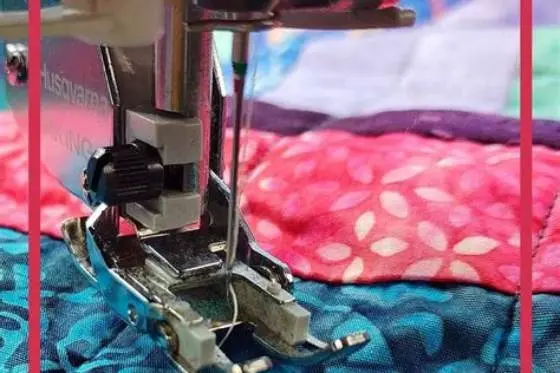
When the foot can no longer ride level over the layers, the feed stalls. Some home machines struggle as bulk increases; test your machine on a scrap sandwich to find its limit. Test on scrap rather than relying on a fixed number. The thicker the layers, the harder it is to maintain even pressure across the throat plate. Measure your quilt's total thickness including batting and fabric before you baste.
Batting loft drives most of the bulk. A high-loft polyester batt can puff up thick on its own, and two layers of cotton fabric add still more bulk. Low-loft cotton or 80/20 cotton-poly batts stay much flatter and feed far more smoothly under a walking foot. Check the batting package for the finished loft measurement. Choose thin batting for home machine quilting and save the cloud-soft stuff for tied quilts.
Seam bulk adds height at every join. Four seam allowances pressed to one side create a ridge the foot has to climb. Press seam allowances open on thick quilts and you cut the ridge height in half. The foot rides level and the feed dogs grip evenly.
Lower the presser foot on your basted quilt sandwich and try to pull the fabric forward with the needle up. It should move but feel slightly sticky. If it won't budge, the foot is clamped too tight to feed at all. If it slides freely, the pressure is too light and the quilt will shift sideways during stitching. There is more on best computerized sewing machine for quilting in a separate guide.
Most machines have a presser-foot pressure dial or a digital setting. Drop the pressure by a notch or two for thick quilts and the layers slide instead of sticking. Too light and the top layer creeps ahead of the backing. Test the setting on a scrap sandwich before you commit to a seam.
Some machines let you adjust feed-dog height, and a knee lift frees your hands to ease the quilt under the foot at bulky intersections. Raise the feed dogs one notch for thick work and they bite harder into the batting. Check your manual for both settings.
Needle Size: Clearing Dense Layers
A 90/14 is a common next step from 80/12 for dense layers. For very dense denim or canvas, consider a 100/16 or a topstitch or jeans needle. Thicker needles pierce heavy fabric and batting more easily. A standard 80/12 needle may bend or break under the pressure of thick quilts. It helps to understand 4x4 embroidery sewing combo before going further.
A 90/14 needle has a stronger shaft to withstand the extra force. It creates a larger hole in the fabric, allowing the thread to pass through cleanly. This reduces friction and ensures a smoother feed. Always match the needle to the fabric density.
If you notice skipped stitches or thread breakage, try the next needle size up.
Thread choice works with the needle, not against it. A 40-weight quilting thread has more body than a 50-weight and feeds through a 90/14 eye with less friction. A thick thread in a thin needle shreds, and a thin thread in a 90/14 eye can slip and cause tension problems. Before you commit to anything, it is worth looking at cs6000i walking foot.
Watch your needle life. Dense batting dulls a needle far faster than plain cotton fabric does. Change the needle often when quilting dense layers, or sooner if you hear a popping sound as it pierces the layers.
Topstitch needles are worth trying on very dense sandwiches. They have a larger eye and a deeper groove on the front, which gives the thread more room to ride. A 90/14 topstitch needle solves many breakage problems that a standard 90/14 won't.
Stitch Length: Balancing Feed and Strength
Start around 3 mm and increase as needed; test on a scrap to find the best length for your machine and design. Longer stitches provide better feed over bulk while maintaining strength. Shorter stitches struggle to penetrate dense layers, leading to skipped stitches and uneven tension.
A longer stitch length lets the walking foot move more fabric with each stitch. That takes pressure off the feed mechanism and prevents stalling. Try different lengths to find the best setting for your project.
The stitch length affects how the quilting looks. Longer stitches are less noticeable on thick quilts. They also reduce the risk of puckering and bunching. Aim for a balance between feed efficiency and aesthetic appeal.
Here's a quick way to see the difference. Quilt two 6-inch lines on a scrap with the same batting. Set one at 2 mm and one at 3.5 mm. Measure 10 stitches on each with a ruler. The short line will usually show skipped or uneven stitches where the bulk was thickest.
Straight-line quilting tolerates a longer stitch better than dense free-motion work does. If you're stitching 1/4-inch grid lines, 4 mm looks fine. Tight curves at 4 mm can look gappy, so drop to 3 mm there.
Watch the hand-wheel resistance as you sew. If it takes real effort to turn through a seam crossing, your stitch length is too short for the bulk. Lengthen it one step and feel again. The wheel should turn with steady, moderate force.
Foot Types: When High-Shank Helps
Consider a high-shank or open-toe walking foot for very thick quilts. These feet offer better clearance and visibility. A high-shank foot can handle more bulk without dragging. An open-toe design lets you see the stitching line clearly, improving accuracy.
A high-shank walking foot is built for a high-shank machine, where the foot sits higher above the needle plate. That extra room helps on quilts with high-loft batting or multiple layers, where a standard foot can catch on seams. Match the foot to your machine's shank type before buying.
Open-toe feet are ideal for intricate designs. They allow you to see exactly where the needle is entering the fabric. That matters for detailed quilting patterns. Choose the foot type that best suits your project's needs and complexity.
Check your machine's manual or the maker's spec for its shank type before buying anything. As a rough guide only, a taller gap from the needle plate to the foot screw usually means high shank; verify it against the manual. Most domestic machines are low shank, so don't assume.
Some walking foot brands sell a thick-fabric version with taller side walls and stronger springs. These hold more bulk under the sole without tipping. If your current foot rocks from side to side over seam crossings, a sturdier foot will stop the wobble.
Sewing slowly helps any foot. Run at half speed through thick crossings and let the feed teeth do their work. Racing over a seam ridge is what bends needles.
| Foot Type | Clearance | Visibility | Best For |
|---|---|---|---|
| Standard | Low | Limited | Thin to medium quilts |
| High-Shank | High | Moderate | Very thick quilts |
| Open-Toe | Moderate | Excellent | Detailed quilting |
Alternatives: When Hand Tying, Quilt-as-You-Go, or Long-Arm is Better
For quilts over 1 inch thick or larger than a throw, consider hand tying, quilt-as-you-go, or renting a long-arm machine. These methods handle bulk without fighting your domestic machine. Hand tying is the simplest and needs no special equipment. Quilt-as-you-go lets you finish one block at a time on your home machine. Long-arm machines offer professional results but cost rental time or a service fee.
Hand tying secures the layers with knots in a grid. Take a curved needle through all three layers, leave a 3-inch tail, and tie a square knot. Snip the tails to about 3/4 inch so they fluff into a soft tuft. Check the quilting spacing on the batting package and follow its guidance, so the batting cannot shift in the wash.
Quilt-as-you-go means you baste, quilt, and bind one block or row at a time, then join the finished sections. Each piece is small enough to fit under a walking foot without bulk. You quilt a lap-size sandwich instead of a queen, and the seams between sections hide under narrow sashing or a decorative join. This method works beautifully for thick batts and large quilts on a domestic machine.
Long-arm machines have a wider throat space and a stronger feed mechanism built for thick quilts. Renting time is cheaper than buying. Long-arm services are billed by time or by quilt, so call local shops for their pricing policies. You bring the finished quilt top, batting, and backing, and quilt it yourself after a short lesson. Many shops also offer edge-to-edge quilting services where they stitch a pattern for you.
If you're quilting thick layers at home, sectioning the quilt gives you the control of a walking foot without the bulk. Finish each block, then join them with a simple stitch-in-the-ditch seam. The joins are barely visible and the quilt stays flat.
Putting it together: a thick-quilt checklist
Start with the batting. A low-loft batt feeds far better under a walking foot than a high-loft one, and it still quilts warm. If the quilt is already basted with a thick batt, press the seam allowances open. The foot then meets less of a ridge at every join.
Then set the machine for bulk. Lower the presser-foot pressure a notch or two, fit a fresh 90/14 needle, and lengthen the stitch to around 3 to 4 mm. Run a test sandwich through first, with the same batting and backing, and check the stitches on both sides before you commit to the quilt. Note what each change does, so you know which one fixed it.
If the foot still drags, stalls, or skips, stop and change one thing at a time: pressure, needle, stitch length, or foot. When none of those fixes it, the quilt has outgrown the home machine, and tying, quilt-as-you-go, or a rented long-arm will finish it better. Keep the test sandwich beside the machine for the next thick quilt. Write down the settings that worked, so the next thick quilt starts from a known good setup.
Adjustments to needle, stitch length, and foot type ensure smooth quilting over thick layers.
Still wondering?
Can I use a regular walking foot on very thick quilts?
Not recommended. A regular foot struggles with thick layers, causing dragging and skipped stitches. Opt for a high-shank or open-toe foot for better performance.
How do I know if my needle is too thin for my quilt?
If you experience skipped stitches or thread breakage, the needle is likely too thin. Switch to a 90/14 needle.
Is stitch length the only factor affecting feed over bulk?
No, needle size and foot type matter just as much. Adjust all three for optimal feed over thick quilts.
When should I consider a long-arm quilting machine?
For very thick or large quilts, a long-arm machine offers better control and results. Consider it if you frequently work on complex or bulky projects.