Rotary Cutter Blades 45mm: When to Change Yours and What Fits
45mm is the common standard for quilting cutters, and brands such as Olfa, Fiskars, TrueCut and Martelli all offer 45mm blades. Many but not all 45mm blades swap between handles, so check your handle's carrier and manual before you buy. Change the blade when it skips threads, frays edges or needs extra pressure.
On this page (8 sections)
- The short version
- Rotary cutter blades 45mm: what the number means
- 45mm vs 28mm and 60mm: which size suits your cutting
- Signs your 45mm blade is dull: skipped threads and frayed edges
- How to change a 45mm rotary cutter blade: step by step
- Sharpen or replace: what a dull 45mm blade is worth
- Buying 45mm blades: what to check before you pay
- Still wondering?
Part of our guide on reviews of fabric scissors
Key figures
- Blade size
- 45mm across, the quilting standard
- Layers per pass
- 4 to 6 layers of quilting cotton
- Fits
- any 45mm handle, most brands
- Change it when
- it skips, frays or drags
- Handle by
- the centre hole only
The short version
- Match the diameter: a 45mm blade only fits a 45mm cutter, whatever the brand.
- Skipped threads, frayed edges and extra pressure mean the blade is done.
- Keep a spare blade beside the mat, so a dull edge never stalls a project.
- Handle every blade by its centre hole, never by the rim.
- A scarred mat dulls blades fast, so cut only on a flat, self-healing mat.
Rotary cutter blades 45mm: what the number means
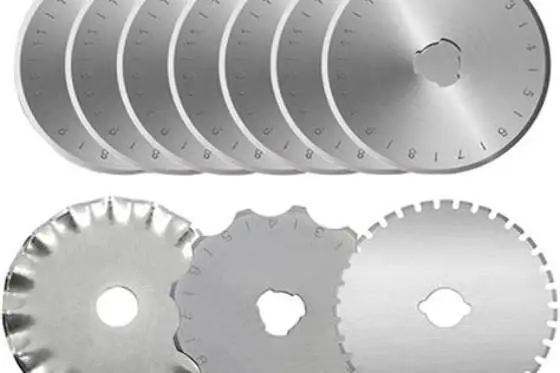
That 45mm on the pack is the diameter of the cutting wheel. It measures about 1 3/4 in (4.5 cm) across, and it matches the handles sold for quilting. Olfa, Fiskars, TrueCut, Martelli, Dritz and Clover all sell 45mm handles. Many 45mm blades swap between brands, but some handles need their own carrier, so check the manual before you buy. That number says nothing about sharpness or quality, only which handles the blade fits.
For most home sewists, the 45mm blade suits the work they do. It rolls far enough along a ruler to cut long strips in one pass, yet it still turns around gentle curves on a pattern piece. A fresh 45mm blade will usually slice through a couple of layers of quilting cotton in one light pass. Heavier fabric or a thicker stack will cut less. Smaller wheels turn tighter curves. Larger wheels push through more layers. The 45mm wheel sits between them.
Check your handle before you buy. The size is printed on the handle or on the blade it came with. A 60mm blade will not fit a 45mm cutter, and the smaller blade rattles loose in a 60mm one. Some handles take only their own brand of blade carrier, so read the manual when the pack says universal. When the diameter and the carrier both match, the blade spins true and cuts clean.
45mm vs 28mm and 60mm: which size suits your cutting
Blade size is a trade between turning and power. A small wheel turns tightly around curves but covers little ground, so long strips take many passes. A large wheel powers through thick stacks but turns like a bus around a corner. Your project decides which trade you want most. We cover quilting clips for thick layers in its own article.
Start with the 45mm cutter if you own only one. It cuts strips and squares, handles several layers of cotton at once, and still manages gentle curves. Add a 28mm cutter when tight curves and small pieces frustrate you, and add a 60mm when thick layers or long cuts do. One second size is a luxury, not a need.
Garment work shifts the answer. Necklines, armholes and small pattern pieces cut cleaner with a 28mm wheel, because the smaller circle follows the line without overshooting it. Heavy work shifts it the other way. Several layers of flannel for a rag quilt, or denim that dulls a small blade fast, both call for the 60mm wheel. Match the wheel to the job in front of you, not to the cutter on sale.
| Blade size | Best for | Watch out for |
|---|---|---|
| 18mm | Tight curves, applique, small templates | Too small for long strips |
| 28mm | Curves, small pieces, garment details | Slow on long straight cuts |
| 45mm | Strips, squares, quilting, general sewing | Awkward on very tight curves |
| 60mm | Long cuts, denim, canvas, many layers | Heavy, poor on curves |

OLFA 45mm Rotary Replacement Blades (RB45-5)
Stops skipped threads and frayed edges by giving you a 45mm diameter replacement blade that fits 45mm rotary cutter handles (pack of 5 for frequent changes).
Signs your 45mm blade is dull: skipped threads and frayed edges
Dullness shows in the cut before you see it on the metal. The first sign is a skipped thread: the wheel rolls past and one thread stays joined, so you run the same line twice. Then the edges turn fuzzy instead of crisp, and you start leaning on the handle to force the cut through. Each of these means the edge has lost its bite. We go through getting clean edges without shifting step by step elsewhere on the site.
Listen as well as look. Sharp blades make a soft slicing sound and need only light pressure. A worn edge drags instead, and sometimes you hear a crunch as it tears rather than cuts. Hold the blade under a strong light and turn it slowly. A healthy edge reflects almost nothing, while tiny flashes mark a flat spot or a nick. One nick catching at the same point on every turn is damage, not wear. No sharpening fixes it.
Rust, pitting and wobble are the other warnings. An uneven spin means the blade has bent, and a bent blade never tracks true again. Moisture in the sewing room speeds rust along, so a blade left on a damp table dulls faster than one kept in its case. When any of these signs shows up, stop cutting your project fabric and deal with the blade first.
- Skipped threads: the blade rolls over a thread without cutting it
- Frayed edges: the cut edge looks fuzzy instead of clean
- Extra pressure: you lean on the handle to get through cotton
- Second passes: the same line needs cutting twice
- Nicks or rust: visible damage on the rim, or a blade that wobbles
A 45mm blade should cut quilting cotton in one light pass. When it stops doing that, the blade is done, not your technique.
How to change a 45mm rotary cutter blade: step by step
Changing a blade takes two minutes and needs no tools beyond the cutter itself. Work on a clear table with good light, and keep your fingers away from the rim from start to finish. Its rim is the sharp part, and a fresh blade will cut skin as easily as it cuts cotton. Handle the blade only by the hole in its centre.
Keep the old blade safe until it is in the bin. Drop it straight into the case the new blade came in, or into a lidded tin kept for used blades. Never leave a loose blade on the table. Never wrap one in tissue and throw it in household rubbish, where it can cut whoever handles the bag. Use a blade bank or a taped-shut tin for a safe end.
Work with the guard closed whenever the cutter is not cutting. Many cutters lock the blade away with a slide or a squeeze handle, so close it before you set the cutter down. An open blade left on the table is the one that finds a finger. Get into the habit of closing it after every cut, and the change itself stays the calm part of the job.
- Close the blade guard and lay the cutter flat on the table.
- Unscrew the nut and lift off the washer, noting the order of the parts.
- Lift the old blade out by its centre hole and drop it straight into its case or a lidded tin.
- Set the new blade on the bolt, with the sharp edge facing down toward the mat.
- Replace the washer and nut, then tighten by hand until the blade spins freely without wobble.
- Test the new blade on a scrap of quilting cotton before you cut your project.
Sharpen or replace: what a dull 45mm blade is worth
Light dullness can be sharpened, and a blade sharpener or a sharpening stone will bring back the clean feel for a while. This works when the blade only drags and leaves a whisker or two, while the wheel still turns evenly and the rim still looks whole. Sharpen once and test it on a scrap. If the cut comes back clean, you have bought the blade more life.
Damage is a different matter. Any nick, bend, rust or flat spot means replacement, because no amount of honing makes a damaged rim track true again. Clicking or skipping at the same point on every turn means a defect in one spot. That defect lands in your fabric too. Replace it and protect the quilt from a bad cut.
Weigh the cost honestly. New blades cost less than the fabric a bad cut ruins, and less than the time you spend re-cutting strips that came out ragged. Heavy quilters go through blades fast, and a multi-pack brings the cost of each change down. When in doubt, change the blade. That fresh edge is the cheapest fix in the sewing room.
Buying 45mm blades: what to check before you pay
Look at the diameter and the carrier first. Make sure the pack says 45mm and the blade suits your handle. Most 45mm blades fit most 45mm handles, but check your cutter manual when the pack says universal. Major brands such as Olfa and Fiskars sell 45mm replacement blades. Check the package or the maker's site for the steel type and coating before you buy. Either brand is a safe first buy.
Pack size follows how much you cut. Two-packs suit an occasional sewist, while a five-pack suits a quilter who cuts most weeks. Budget multi-packs from lesser-known brands cost less per blade. Many quilters keep them as spares, but check the first blade on a scrap before you trust the pack. Send back any blade that arrives loose in its wrapping or shows rust on the rim.
Store spares flat in their case, away from damp, and keep one fresh blade beside the mat so a dull edge never stalls a project. Buy the blades before you need them, not after the quilt top is half cut. Shop for blades while your current one still cuts, because that is when you can judge the new pack calmly.
- Diameter: the pack must say 45mm, and your handle must take 45mm
- Carrier: the blade must suit your handle's bolt, washer and locking nut
- Manual: check the cutter manual when the pack says universal
Still wondering?
Will a Fiskars blade fit my Olfa cutter?
Yes, when both are 45mm and the carrier matches. Blade diameter is standard across brands, so a 45mm Fiskars blade fits a 45mm Olfa handle in most cases. Check your cutter manual first, because a few handles take only their own brand of blade carrier.
How long does a 45mm blade last?
There is no fixed time. Manufacturers generally recommend replacing blades based on performance rather than a fixed time period. Heavy use and thick fabric wear an edge faster, and many quilters put in a fresh blade at the start of each large project.
Can I sharpen a 45mm rotary blade?
Light dullness, yes. A blade sharpener or stone can restore a blade that only drags and leaves whiskers. Sharpening works as long as the rim is whole and the wheel turns evenly. Nicks, bends and rust mean replacement, because sharpening cannot repair a damaged rim.
Why does my new blade skip in one spot?
A nick in the rim is the usual cause, often from rolling over a pin or clipping the edge of a ruler. The nick misses the same threads on every turn. Replace the blade, and check the mat for a scar where the nick ran, because a damaged blade can score the mat.
Do I need a special mat for a rotary cutter?
Yes. Cut only on a self-healing rotary mat, on a flat table, with the whole cut line on the mat. A scarred or grooved mat dulls blades faster and lets the wheel wander, so a fresh blade still cuts badly on a worn mat.