Stiff petticoat layers: organza or tulle, and how many each needs
For stiff petticoat layers, choose crisp organza when you want shape from few layers, and stiff tulle when you want soft, springy fullness. Organza holds its shape on its own, while tulle needs several layers to reach the same lift.
On this page (9 sections)
- Fit check
- The short version
- Organza vs tulle for stiff petticoat layers: what each fabric does
- Layer counts: how many layers reach each fullness
- Tulle stiffness: why it varies between bolts
- Outer layer: when organza wins and when tulle wins
- Layering order and edges: building the petticoat
- Yardage: working out how much fabric to buy
- Still wondering?
Part of our guide on fabric for hot humid weather

DrWeave Sheer Organza Fabric by the Yard 59'' Off-White Tulle
At 59 in wide, one cut covers your full knee or midi skirt panel with no piecing, and the tight polyester
Check it on Amazon
DrWeave Sheer Organza Fabric by the Yard 59'' Pink Tulle Fabric
A 59 in wide pink polyester organza whose firm see-through body keeps bows and rents standing away from the
See this alternative
VACVELT Black Sheer Organza Fabric by The Yard 60" Wide (1 Yard)
A 60 in wide black organza that spans a full skirt panel in one piece, with a wrinkle-resistant finish that
See the budget option| Product | fabric width (in) | Verdict | |
|---|---|---|---|
| DrWeave Sheer Organza Fabric by the Yard 59'' Off-White Tulle Fabric DrWeave | No gsm printed; 59 in width falls back to the 54 in minimum and clears it. | Meets width fallback | View on Amazon |
| VACVELT Black Sheer Organza Fabric by The Yard 60" Wide (1 Yard) VACVELT | No gsm printed; 60 in width clears the 54 in fallback minimum. | Meets width fallback | View on Amazon |
| DrWeave Sheer Organza Fabric by the Yard 59'' Pink Tulle Fabric 1 Yard DrWeave | No gsm printed; 59 in width clears the 54 in fallback minimum. | Meets width fallback | View on Amazon |
Key figures
- Organza layers
- 1 to 2 for firm shape
- Soft tulle layers
- 4 to 6 for full lift
- Stiff tulle layers
- 3 to 5 for drama
- Weight to look for
- 30 gsm or more
- Common tulle width
- 54 in (137 cm)
- Needle for tulle
- Sharp 70/10 or 80/12
The short version
- Crisp organza gives structure in 1 to 2 layers; soft tulle needs 4 to 6 layers for a similar lift.
- Check fabric weight in gsm before you buy, and ask for a swatch when the listing gives no figure.
- Work from the stiffest inner layer to the softest outer layer for a smooth finish.
- Finish organza edges with a narrow rolled hem or French seam, and leave tulle edges raw or bind them with ribbon.
Organza vs tulle for stiff petticoat layers: what each fabric does
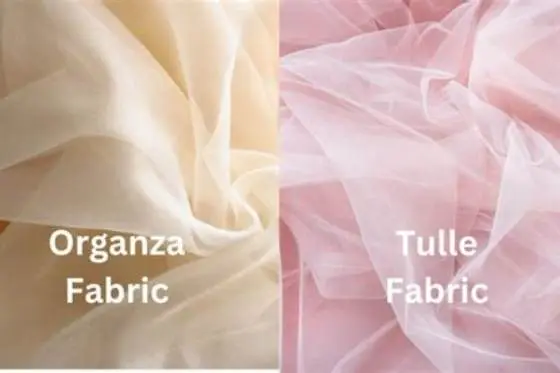
Organza is a plain weave fabric, made from fine, tightly twisted yarns in a simple over and under pattern. That weave gives it a crisp hand, so a single layer springs back when you scrunch it and holds a curve without help. Polyester organza is the usual choice for a petticoat, while silk organza costs more and needs gentler care.
Tulle is a net, not a woven cloth, with fine threads twisted and knotted into small hexagonal holes. Its volume comes from spring, not from stiffness in the cloth itself, so each layer bounces back after it is pressed down. Nylon tulle tends to feel crisper and holds its spring well, while polyester tulle can feel stiffer when new.
Your choice starts with the shape you want, not with the name on the bolt. Crisp organza gives a clean, firm line with a slight sheen, and it keeps that line when the skirt moves. Stiff tulle gives a cloud of soft volume that moves and settles, and it needs several layers to match one layer of organza. Weight tells you more than the word stiff. Tulle is sold in light, medium and heavy weights, so check the gsm on the listing rather than guessing from the word stiff. Shape first, name second.
- holds shape in 1 layer
- bright, smooth surface
- few layers, less bulk at waist
- can feel scratchy near skin
- raw edges fray fast
- creases stay until pressed
Layer counts: how many layers reach each fullness
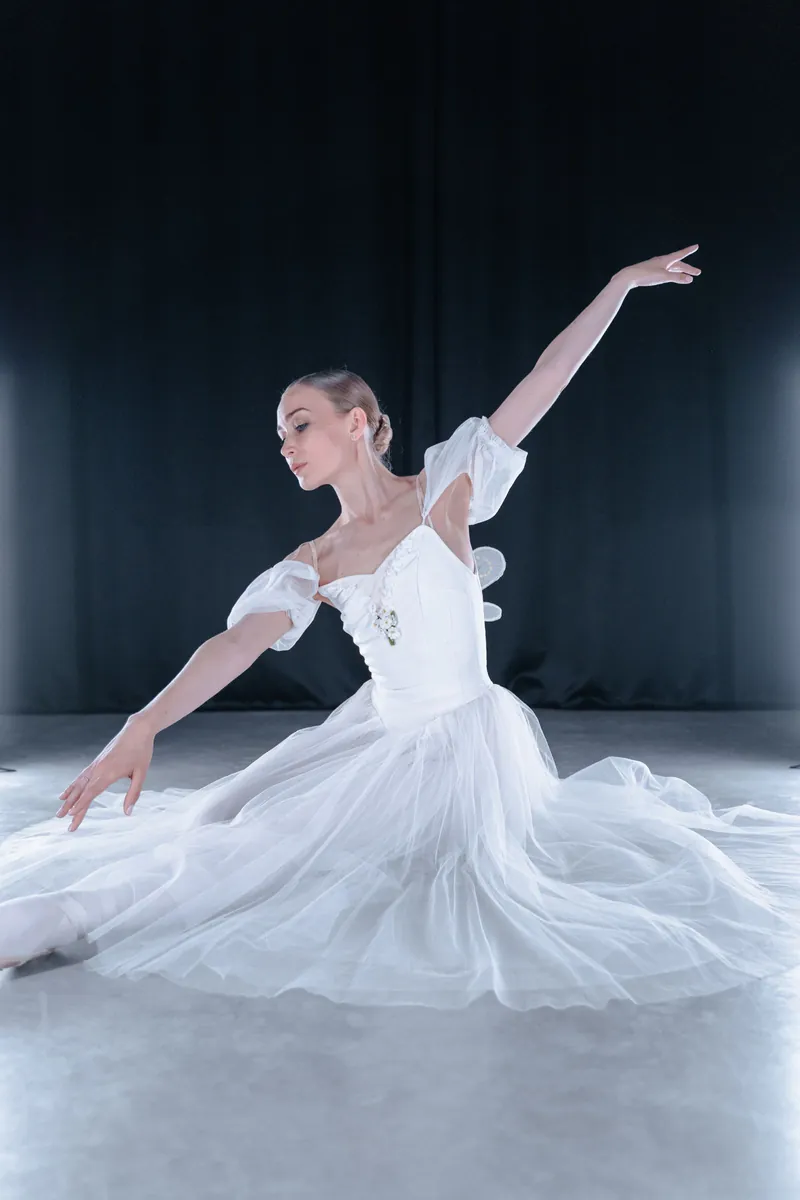
Layer count works with cut width, so the two numbers must be read together. A layer cut at twice the waist gives gentle gathers. A layer cut at two and a half or three times the waist gives dense gathers and far more lift. Three thin layers cut wide can outlift five narrow layers, and they weigh less at the waistband. Width sets the lift. There is more on why paint cracks on denim in a separate guide.
Soft tulle needs the most layers because each layer adds only a little spring. One or two layers give a light lift under a cotton skirt, and three layers give a soft A-line shape. Four to six layers give a full party skirt, and eight or more layers give a ballgown that fills a doorway. Each extra layer adds warmth and weight, so a summer dress with eight layers will feel hot before it looks full.
Stiff tulle and organza need fewer layers because each layer carries its own structure. Three to five layers of medium weight tulle give drama for a formal dress. Two layers of crisp organza give a firm bell shape, and one layer can hold a short, flared skirt. Bulk at the waist is the limit on layer count, so stagger the gathers and trim the seam allowances inside the waistband. Watch the waist.
- Light lift: 1 to 2 soft tulle layers under a cotton skirt.
- Soft A-line: 3 soft tulle layers, or 1 crisp organza layer.
- Full party skirt: 4 to 6 soft tulle layers, or 2 organza layers.
- Ballgown lift: 8 or more soft tulle layers, or 2 to 3 organza layers.
| Fullness wanted | Soft tulle | Stiff tulle | Crisp organza |
|---|---|---|---|
| Light lift | 1 to 2 layers | 1 to 2 layers | 1 layer |
| Soft A-line | 3 layers | 2 layers | 1 layer |
| Full party skirt | 4 to 6 layers | 3 to 5 layers | 2 layers |
| Ballgown lift | 8 or more layers | 5 to 8 layers | 2 to 3 layers |
DrWeave Sheer Organza Fabric by the Yard 59'' Off-White Tulle Fabric 1 Yard
At 59 in wide, one cut covers your full knee or midi skirt panel with no piecing, and the tight polyester weave gives enough body to hold a shape.
- Size 1 Yard
Tulle stiffness: why it varies between bolts
Tulle stiffness varies because fibre, yarn thickness, mesh size and finish all change from one bolt to the next. Nylon tulle often feels crisper than polyester tulle, and a thicker yarn makes a stiffer net. A dense mesh with more holes per inch holds its shape better than an open mesh. Two bolts labelled tulle can sit at opposite ends of that range, so the name alone tells you almost nothing.
Finish matters as much as fibre, and it can fool you in the shop. Many bolts carry a light starch or sizing that keeps the net steady while it is cut and sewn. That coating washes out with the first wash, so a bolt that feels stiff on the roll can turn soft after washing. Ask whether the tulle has a stiff finish, a soft finish, or no finish at all. Washing changes it.
A swatch test takes five minutes and saves a whole skirt. Hold a square of tulle over your hand and watch how far it droops past your fingers. Scrunch it and see whether it springs back or stays crushed, then bend a folded edge and pull it gently on the diagonal. A stiff tulle for a petticoat should spring back, hold a fold for a moment, and stretch very little. Buy from a seller who prints fibre, width, and finish, and order a swatch first when you buy online. Many listings omit the weight, so judge the stiffness by hand.
VACVELT Black Sheer Organza Fabric by The Yard 60" Wide (1 Yard)
A 60 in wide black organza that spans a full skirt panel in one piece, with a wrinkle-resistant finish that keeps pleats sharp through wear.
- Size 1 Yard
- Weight 2.1 oz
- Height 0.03 inches
One layer of crisp organza can do the work of four soft tulle layers, and the wrong bolt can undo the whole skirt.
Outer layer: when organza wins and when tulle wins
Organza wins as the outer layer when the skirt needs a firm, readable shape. Its smooth surface catches light with a soft sheen, and its crisp weave holds a pleat, a fold, or a flared hem without sagging. A ballgown skirt, a structured A-line, or a short flared skirt all look better with organza outside. The trade off is feel, since organza can scratch at the neck or waist when it sits against bare skin. Feel matters too.
Tulle wins as the outer layer when the skirt needs softness, movement, and a cloud like edge. Its net surface scatters light instead of reflecting it, so the skirt looks airy rather than polished. A romantic bridal skirt, a flower girl dress, or a dance skirt all suit tulle outside. The layers float and settle as the wearer turns. Tulle also feels gentler against skin than organza, which matters for a dress worn all day.
Colour and sheen change the choice in a way that weight alone does not. Organza shows colour with a clear, bright sheen, so a coloured organza outer layer reads as a deliberate design choice. Tulle softens colour and lets the layers beneath show through, so it works well over a coloured lining. Use organza outside for a firm bell shape, and tulle outside for a skirt that should drift and settle.
- organza: clean line and sheen
- tulle: soft movement and gentle feel
- organza: scratchy and creases show
- tulle: needs more layers for shape

IONTACH White Tulle Fabric 54 Inch X 40 Yards Tulle Roll
A 54 in wide soft tulle roll, but its light, soft hand will not stand a skirt out without many extra layers.
- Height 0.03 inches
- Width 54.0 inches
- Length 1440.0 inches
Layering order and edges: building the petticoat
Put the stiffest layer closest to the lining, and work outward to the softest layer. The stiff inner layer does the lifting, the middle layers add volume, and the outer layer gives the surface you see. A lining of soft cotton sits against the skin first, then the stiff tulle or organza, then one or two softer tulle layers outside. This order keeps scratchy fabric away from the body.
Cut each layer a little longer than the one beneath it, so the outer layers fall past the inner ones and hide their hems. A common step is about 1 in (2.5 cm) longer per layer, though a short skirt needs a smaller step. Gather each layer on its own before you join them. Gather tulle with two rows of long stitches, and pleat organza in soft folds instead, since its stiff weave resists tight gathers. Adding a layer is easy, while taking one out after the waistband is sewn is slow work. Check after each layer.
Organza frays fast, so every raw edge needs a finish before the skirt is worn. A narrow rolled hem on a serger gives a light, tidy edge. A baby hem by hand gives a fine edge on a small skirt. French seams enclose the raw edges inside the seam, which suits organza because every stitch shows through the sheer cloth. Tulle does not fray, since its net holds together at a cut edge, so you can leave a tulle hem raw. Bind a tulle edge with satin ribbon or bias binding when you want weight at the hem.
- Sew a soft cotton lining first, with a waistband that fits snugly.
- Add the stiffest tulle or organza layer next, gathered on its own.
- Add middle layers, each about 1 in (2.5 cm) longer than the last.
- Add the soft outer layer last, then check the shape on a hanger.
- Press the waistband, hang the skirt, and check the hem line before you wear it.
DrWeave Sheer Organza Fabric by the Yard 59'' Pink Tulle Fabric 1 Yard
A 59 in wide pink polyester organza whose firm see-through body keeps bows and rents standing away from the frame.
- Size 1 Yard
Yardage: working out how much fabric to buy
Yardage starts with three numbers: waist, finished length, and fabric width. Measure the waist where the waistband will sit, and measure the length from waist to hem with shoes on. Tulle often comes 54 in (137 cm) wide, and some bolts run 108 in (274 cm) wide. Organza is often narrower, so check the width on the listing before you run the numbers.
Work the arithmetic in four steps, and write each number down before you cut. Multiply the waist by the fullness ratio, which is usually 2 to 3 times the waist for a gathered petticoat layer. Multiply that cut width by the layer count to get the total cut width. Then divide by the fabric width and round up to whole panels. Multiply the panel count by the cut length, then divide by 36 to get yards. Do the sums twice.
A worked example makes the method clear, and you can swap in your own numbers. Take a 30 in (76 cm) waist and a 24 in (61 cm) finished length. Use three layers at two and a half times fullness on 54 in (137 cm) tulle. Each layer needs a cut width of 75 in (191 cm), so three layers need 225 in (572 cm) in total. That total needs 4.2 panels, rounded up to five, and each panel is cut 25.5 in (65 cm) long. Five panels at 25.5 in each come to 127.5 in, which is 3.5 yards. Buy 4 yards to allow for uneven edges and a cutting mistake.
| Step | Figure |
|---|---|
| Cut width per layer | 75 in (191 cm) |
| Total cut width, 3 layers | 225 in (572 cm) |
| Panels from 54 in tulle | 4.2, rounded to 5 |
| Cut length per panel | 25.5 in (65 cm) |
| Total length | 127.5 in, or 3.5 yards |
| Buy | 4 yards |

SCHMETZ Microtex Sharp Sewing Machine Needles
A 70/10 sharp needle with an ultra-thin acute point that slips through tulle mesh and organza without snagging the layer below.
Crisp organza is the pick for a stiff shape from few layers, with stiff tulle as the softer, springier alternative.
Still wondering?
Can one layer of organza hold a stiff skirt on its own?
Yes, for a short or knee length skirt with a firm bell shape. A floor length skirt usually needs a second layer near the hem, since the cloth weight pulls the shape in.
Why does my tulle feel stiff in the shop and soft after washing?
Many bolts carry a light starch or sizing that steadies the net for cutting. Washing removes that coating, so the fibre underneath may be soft even when the bolt feels stiff.
How do I tell stiff tulle from soft tulle before buying?
Ask for the fibre, the weight in gsm, and the finish, then order a swatch when you buy online. Fold the swatch and check how it holds a curve.
Should organza or tulle go on the outside of a petticoat?
Use organza outside when the skirt needs a clean, firm line and a soft sheen. Use tulle outside when the skirt needs soft movement and a gentle feel.
Do I need to hem tulle?
No, tulle does not fray, so you can leave the hem raw for a light edge. Bind the edge with ribbon or bias binding when you want weight at the hem.