Identify a yarn tool or an unlabeled skein
Yes, you can identify this yarn tool from its shape, and you can identify an unlabeled skein from its wraps per inch. If the photo shows a small card with graduated slots, you are holding a wraps-per-inch gauge. For an unlabeled skein, use WPI, a fibre test and a washed swatch before choosing a needle or hook.
On this page (11 sections)
- The short version
- Can you identify this yarn tool? Start with its shape
- Skein check: record the clues before cutting
- Burn test basics: use heat only for a small clue
- Wraps per inch: count strands across one inch
- Commercial tools: know what each reading means
- Gauge swatch: test the fabric you will actually make
- Novelty yarn: replace WPI with a fabric test
- Needle or hook choice: match fabric before labels
- Substitution: check care, stretch and finished size
- Still wondering?
Part of our guide on serger for knits
Key figures
- Slotted card
- Wraps-per-inch gauge
- Fan of holes
- Needle or hook sizer
- Sliding display
- Digital calipers
- Hanging arm
- McMorran balance
- Wool clue
- Burning hair
- Cotton clue
- Soft grey ash
- Acrylic clue
- Hard melted bead
- Best evidence
- Three checks together
The short version
- Burn only a detached strand outdoors or over a non-flammable surface.
- Count slack wraps across one inch, then record a range.
- A slotted card is a WPI gauge; a fan of holes is a needle or hook sizer.
- Novelty yarn needs a fabric test because WPI may not describe its usable thickness.
- A washed swatch settles what a thickness number cannot.
Can you identify this yarn tool? Start with its shape
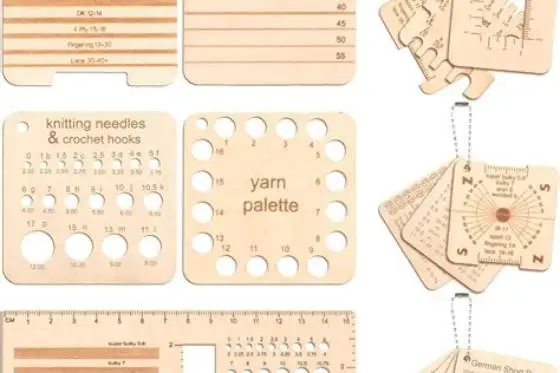
Start with a clear photo of the thing in front of you. Show the whole tool in frame, then a close view of any marks or numbers, and the tool beside a ruler for scale. Most yarn tools give themselves away by shape alone, and a photo with scale settles the rest. The question behind it is usually one of two: what is this gadget, or what yarn is this skein?
A flat card or block cut with stepped slots is a wraps-per-inch gauge. Lay the yarn in a slot without forcing it and read the width the slot marks. It tells you how thick the yarn is, not what fibre it is made from.
A flat plate pierced with round holes sizes needles or hooks: the hole the tool slides through is its size. A sliding metal jaw with a digital readout is a caliper, and it measures the width of one strand. A balance arm hanging from a hook with a sliding scale is a McMorran balance.
McMorran balances still turn up from specialist textile suppliers and second-hand stalls, but few home crafters own one. Unless one is already in your drawer, treat it as a specialist or historical piece rather than a tool to buy. It helps to understand making knitting easier for beginners before going further.
- Card with stepped slots: wraps-per-inch gauge.
- Plate with round holes: needle or hook sizer.
- Sliding jaw with a display: digital caliper.
- Hanging arm with a scale: McMorran balance.
Skein check: record the clues before cutting
Begin with a loose strand and a notebook, and cut nothing yet. Write down the colour, the halo, the shine, the ply, the twist and anything uneven you can see. Those notes are the baseline every later test gets judged against.
Pull a short length from the centre or the tail, stretch it gently, then let it go. Wool often springs back toward its old length, while cotton usually stays longer after the pull. Acrylic can act like either one, so treat the stretch as a hint and nothing more.
Count the plies where the twist shows clearly. A loose, airy yarn can look thick because air fills the gaps between its fibres. Photograph the skein beside a ruler before any testing starts. We go through yarn weight explained step by step elsewhere on the site.
When a label scrap or a vendor listing gives you the skein's weight and meterage, divide weight by meterage to get grams per metre. Without those two figures, measuring meterage at home is hard, so WPI and a swatch give you more for less effort.
- Surface: halo, shine, fuzz and smoothness.
- Stretch: how the strand recovers after release.
- Ply: smaller strands, counted where the twist shows.
- Label data: grams divided by metres, when both figures are known.
Burn test basics: use heat only for a small clue
The safest small burn test needs a detached strand, tweezers and a heatproof dish. Work outside, keep water close, and burn only a few centimetres. Never set light to a garment, a large sample or yarn with metallic decoration.
Animal fibres such as wool draw back from the flame, burn slowly and smell of singed hair. They leave a rough ash that crumbles between your fingers. Cotton and other plant fibres often keep glowing once the flame is gone, smell of paper and leave a soft pale ash. We cover circular needle length for knitting in its own article.
Acrylic and most other synthetics melt, draw in and harden into a bead, with a sharp chemical smell. Blends give mixed signs, so mark the fibre as uncertain when the clues point in different directions.
Stop at once if the yarn sparks, smokes oddly, flares, or will not go out. Step away from the smoke, let the sample cool, and use water only when it is safe to reach it. Air the area out, throw the sample away, and do not try the test again indoors.
| Likely fibre | Flame behaviour | Residue or smell |
|---|---|---|
| Wool or animal fibre | Shrinks and burns slowly | Singed-hair smell; crushable ash |
| Cotton or plant fibre | Continues glowing | Paper smell; soft grey ash |
| Acrylic or synthetic | Melts and shrinks | Hard bead; chemical smell |
| Blend | Mixed behaviour | Mixed ash, bead or smells |
- quick fibre clue
- needs only a tiny sample
- can expose synthetic content
- smoke can irritate
- blends give mixed results
- cannot prove an exact fibre

A yarn tool measures thickness. A burn test and swatch provide the remaining clues.
Wraps per inch: count strands across one inch
Wraps per inch, or WPI, counts how many strands lie side by side across one inch. Use a ruler with clear inch marks, and wind the yarn around the ruler or a smooth card, strand beside strand.
Keep the yarn slack as you wind it. Pulling it tight makes a thick yarn read finer than it knits. Count across one inch, repeat the count nearby, then write down a range such as 12 to 13 WPI.
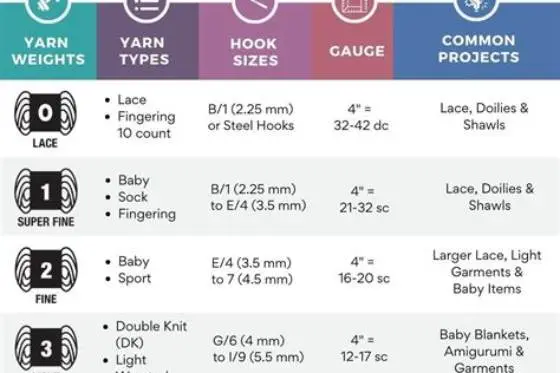
Reference charts disagree near sport, worsted and aran. Use the result to choose a starting tool.
Novelty yarn, eyelash yarn and heavily textured yarn can make WPI unreliable. Record the yarn's width in plain words, then test the fabric it makes.
| Category | WPI | Typical use |
|---|---|---|
| Lace | 30 or more | Fine shawls and delicate fabric |
| Fingering | 16-28 | Socks and light garments |
| Sport | 12-16 | Light sweaters and accessories |
| DK | 9-11 | Sweaters and baby blankets |
| Worsted | 8-9 | Blankets, hats and garments |
| Aran | 6-7 | Warm garments and textured fabric |
| Bulky | 4-5 | Fast, thick projects |
| Super bulky | 1-3 | Thick accessories and blankets |
Commercial tools: know what each reading means
Each tool answers a different question. A WPI gauge counts strands across an inch. Calipers read the width of one strand in millimetres. A needle sizer tests which tool fits its hole. A scale weighs the yarn, and tells you nothing about fibre.
Grams per metre needs exact meterage first, and a home scale cannot give you that on its own. Measuring a set length sounds simple, yet stretchy or fuzzy yarn makes the length itself hard to pin down.
With a trustworthy length in hand, weigh it and divide the grams by the metres. A known 10-metre sample, for instance, gives grams per 100 metres when you multiply its weight by ten.
A McMorran balance belongs to specialist yarn testing and labelling. For home use, WPI and a scale with a known length cover the same ground with less fuss.
| Tool | What it measures | What the reading gives you |
|---|---|---|
| Slotted WPI gauge | Strands across an inch | A starting tool size |
| Digital calipers | Strand diameter | A diameter for comparison |
| McMorran balance | Yarn fineness against a reference | A specialist labelling reading |
| Needle sizer | Tool passing through a hole | A needle or hook size |
| Digital scale | Mass | Grams for a known length |
- repeatable readings
- useful for comparison
- helps narrow a starting tool size
- specialist balances are uncommon
- loft changes readings
- no tool proves fibre content
Gauge swatch: test the fabric you will actually make
Only a swatch shows how the yarn acts in real stitches. Cast on enough for a square at least five inches wide, with a tool from the middle of the range your WPI count suggests.
Cast on wider than the patch you plan to measure, because edge stitches pull the count out of shape. Work it in the knitting or crochet method the project calls for.
Treat the swatch the way the finished piece will be treated: wash it or block it. Wool may relax, cotton may soften and acrylic may shift with heat, so pick a treatment you can repeat.
Count stitches and rows across the centre, then judge drape, stretch, thickness and spring-back. Too many stitches means tight fabric, so go up a size. Too few means open fabric, so go down.
- Knit or crochet a generous swatch in the project method.
- Wash or block it the way the finished piece will be treated.
- Measure the centre, away from the edge.
- Adjust one tool size and test again.
- Check drape, stretch and care before committing.
Novelty yarn: replace WPI with a fabric test
Eyelash, bouclé, slub and ribbon yarns have no single dependable diameter. Metallic threads can skew a burn test, and mixed strands can come apart before you finish testing.
Never force these yarns through a WPI slot, and never treat a burn result as proof. Make a bigger swatch instead, note the fabric's width and height, and test how it washes, stretches and sheds.
When texture, metal content or mixed strands block reliable WPI or burn testing, judge the yarn by the fabric it makes. Watch how that fabric behaves in care. Keep the project loose, and skip fitted or heat-sensitive uses until those checks pass.
Needle or hook choice: match fabric before labels
Thickness sets the starting range, and fibre plus fabric purpose settle the final pick. Firm socks, bags or amigurumi want a smaller tool. Drape or open fabric wants a larger one.
Wool's spring suits textured knitting and colourwork. Cotton bounces less, so tight stitching can tire your hands. Acrylic may slide, split or flatten, depending on how it was spun.
Tool material changes the handling too. Smooth metal lets grippy wool slide, while bamboo or wood can slow slippery synthetics. Your tension matters, so check your own gauge before you commit.
| Evidence | Start with | Change it when |
|---|---|---|
| Thick yarn | Larger needle or hook | Fabric feels stiff or gauge is tight |
| Fine yarn | Smaller needle or hook | Fabric feels loose or gauge is open |
| Elastic wool | Pattern’s middle range | Drape or washed gauge changes |
| Inelastic cotton | Comfortable moderate tension | Hands tire or fabric lacks movement |
- tool choice follows evidence
- swatch reveals real fabric
- material can improve control
- WPI cannot set an exact size
- personal tension matters
- one tool may not suit every project
Substitution: check care, stretch and finished size
Thickness alone does not guarantee a good swap. Fibre changes the stretch, warmth, weight, drying time and care. Cotton can leave a garment heavier and less springy than the wool it replaces.
Read the pattern's gauge, finished measurements, construction and fibre needs before you substitute. Fitted sleeves and socks need careful stretch testing. A blanket forgives far more variation.
Set your WPI, fibre clues and washed swatch beside the pattern yarn. Match stitch gauge, row gauge and fabric feel. Check yardage on its own, because fibres of the same weight can run to different lengths.
Spend mystery yarn on a scarf, a sample or a relaxed blanket once the swatch passes. Save labelled yarn for fitted clothing, baby items or anything that must wash predictably.
Mystery yarn is usable when several checks agree, but labelled yarn remains safer for fitted or care-sensitive work.
Still wondering?
What is the tool with slots that I slide yarn into?
That is a wraps-per-inch gauge, sometimes called a yarn gauge. Find the slot where the relaxed strand fits without being squashed, then read the marked width.
Can I identify yarn without burning it?
Yes. Use texture, stretch, WPI and a washed swatch. Fibre identification stays less certain, especially with blends.
What if my yarn gives different WPI readings?
Record the range and inspect the yarn for loft, slubs or uneven spinning. Choose the tool from the middle of the range.
Can a burn test prove yarn is wool?
No. A hair-like smell and crushable ash support animal fibre, but cannot identify the species or rule out every blend.
What should I do if the burn test sparks or will not go out?
Stop, move away from smoke and let the sample cool. Use water only when safe, ventilate the area and do not repeat the test indoors.
What is the safest use for unidentified yarn?
Choose a scarf, swatch or decorative item where exact care and fit matter less. Avoid baby clothing and fitted garments.