What circular needle length fits hats or blankets
Use a 16-inch circular for many adult hats, measured tip to tip. Adult hat circumferences vary with head size and intended ease. For a blanket, multiply your actual gauge by the blanket width, then choose a cable that holds the active row without tight bunching.
On this page (9 sections)
- Fit check
- The short version
- What length circular needle for a hat?
- Hat options: use 24 or 32 inches when needed
- Blanket shape: knit flat or in the round
- Blanket calculation: use your actual gauge
- Alternatives: choose panels or another needle method
- Buying check: confirm how the seller measures
- Still wondering?
Part of our guide on getting smooth stretchy seams on knits

cuteDIY 16 Inch Circular Knitting Needles Set
Gives you six etched sizes in one set at the confirmed 16-inch length, letting you switch needle diameter for
Check it on Amazon
KnitPal 12 Inch (30cm) Bamboo Circular Knitting Needles Set
Delivers 11 pairs at 12 inches each for smaller hat tubes, sleeves, and socks, with bamboo tips that glide
See this alternative
18 Pairs Circular Knitting Needles Set
Delivers 18 pairs at 16 inches each with sizes from 2mm to 10mm, covering the full range of hat gauges in
See this alternative| Product | Assembled needle length and usable stitch | Verdict | |
|---|---|---|---|
| cuteDIY 16 Inch Circular Knitting Needles Set cuteDIY | Listing states 'Total length is 16" long' measured tip-to-tip across all six sizes | Meets it | View on Amazon |
| KnitPal 12 Inch (30cm) Bamboo Circular Knitting Needles Set KnitPal | Listing states '12 Inch (30cm)' for all 11 pairs | Meets it | View on Amazon |
| 18 Pairs Circular Knitting Needles Set Vancens | Listing states '16 Inches Length' for all 18 pairs | Meets it | View on Amazon |
| Circular Knitting Needles Set,9 Pack Stainless Steel Knitting Needles Boliyoooki | Listing states 'approximately 16"/40 cm' tip-to-tip for all nine needles | Meets it | View on Amazon |
| ChiaoGoo Red Lace Circular 16 inch (41cm) Stainless Steel Knitting ChiaoGoo | Title states '16 inch (41cm)' tip-to-tip length | Meets it | View on Amazon |
Key figures
- Many adult hats
- 16 inches, tip to tip
- Small hat
- 12 inches, double points, or magic loop
- Blanket
- Choose from the active row and gauge
- Measure
- Check whether the listing means cable-only or tip to tip
- Common middle lengths
- 24 or 32 inches
The short version
- A 16-inch circular suits many adult hats, but head size and ease affect the fit.
- Small hats may need a 12-inch needle, double-pointed needles, or magic loop.
- Blankets are usually knitted flat, so the needle holds one row at a time.
- Multiply your actual stitches-per-inch gauge by the blanket width to estimate the row count.
- A 24-inch or 32-inch needle can work when its active stitches fit without strain.
What length circular needle for a hat?
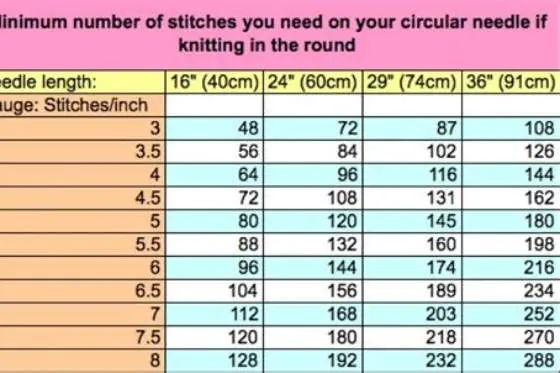
A 16-inch circular needle suits many adult hats, but it won't fit every cast-on. Head size and intended ease change the finished circumference. Yarn stretch matters too. Start with the pattern's finished measurement, not a standard needle label.
Measure the hat's intended working circumference before joining. Compare it with the assembled needle length. The stitches should form a relaxed circle around the cable and tips. They shouldn't stretch tightly across the needle. A loose, distorted circle usually means the needle is too short.
Many adult hats work well on 16-inch needles. That's only a starting point. A small hat can have too few stitches for that circumference, especially with bulky yarn. Try a 12-inch circular, double-pointed needles, or magic loop instead.
Your yarn weight changes the cast-on count. Bulky yarn reaches the hat circumference with fewer stitches, while fine yarn needs more stitches. Check the cast-on count and relaxed stitch width before joining. Avoid forcing stitches around a cable that cannot hold them comfortably. We cover best knitting loom for beginners in its own article.
Use this quick check before knitting the first round:
- Many adult hats: start with a 16-inch circular and check the pattern measurement.
- Small hat: try a 12-inch circular or double-pointed needles.
- Very small crown: use magic loop if your available cable is longer.
- Tight circle: choose a longer needle or cast-on suited to the pattern.
The needle should support the stitches without pulling the fabric. That keeps your tension steadier and reduces laddering at the join. A comfortable setup is more useful than copying another knitter's needle choice. There is more on sock knitting needles in a separate guide.
Hat options: use 24 or 32 inches when needed
A 24-inch circular can work for a hat if the cast-on stitches spread across it without pulling the fabric flat. It can also work for a hat knitted with magic loop, though the cable length may feel excessive for a small project.
A 32-inch circular usually works best for magic loop rather than ordinary small-circumference knitting. Pull a loop between stitch groups, then knit each group in turn. The method lets one long cable handle a circle smaller than its full length.
A short circular can feel cramped in larger hands, especially with thick yarn or short needle tips. Double-pointed needles avoid the cable issue, but they require more needle tips and careful joins. Loose joins prevent ladders.
Check your pattern's cast-on count, yarn weight, and finished circumference together. No single hat length works for every combination.
| Project | Useful option | If it feels wrong |
|---|---|---|
| Many adult hats | 16-inch circular | Try a longer cable with magic loop |
| Child hat | 12-16-inch circular | Use magic loop or double points |
| Baby hat | 12-inch circular or magic loop | Choose the method that keeps the circle stable |
| Very small crown | Magic loop or double points | Do not force stitches around a large circle |
cuteDIY 16 Inch Circular Knitting Needles Set
Gives you six etched sizes in one set at the confirmed 16-inch length, letting you switch needle diameter for different yarn weights without buying separate circulars for each hat project.
- Weight 1.8 oz
- Height 0.39 inches
- Length 9.05 inches
Blanket shape: knit flat or in the round
Most blankets are knitted flat, back and forth, rather than in the round. A circular needle still helps because its cable holds one wide row while you turn the work. You knit across, turn, and work back across the same active stitches.
A blanket knitted in the round has different needs. Its needle must form a circle around the blanket's active circumference, so the finished width and shape affect the cable choice. Check the pattern before choosing a length.
For a flat blanket, the needle does not need to equal the finished blanket width. It only needs to hold the current row with enough space for smooth movement. A wide row can need a long cable even when the fabric is still growing.
Heavy fabric also benefits from a cable that supports its weight. If the stitches drag at the tips, a longer cable or narrower panel can make knitting easier.
- holds many active stitches
- supports heavy fabric
- makes wide flat rows easier to manage
- long cables can be awkward on narrow projects
- extra slack needs regular adjustment
- a full-width blanket may still feel heavy
KnitPal 12 Inch (30cm) Bamboo Circular Knitting Needles Set
Delivers 11 pairs at 12 inches each for smaller hat tubes, sleeves, and socks, with bamboo tips that glide smoothly and a storage pouch to keep the set organized.
- Size US 0-10, 12 inches
A hat needs a small working circle, while a blanket usually needs room for one wide row.
Blanket calculation: use your actual gauge
Multiply your actual gauge by the blanket width to estimate the stitch count. If your swatch gives eight stitches per inch and your planned width is 40 inches, multiply eight by 40. Use the result as your estimated active row count.
The calculation tells you how many loops the needle must hold. It does not predict the exact cable space those loops occupy. Yarn thickness, stitch pattern, and fabric tension change the space between stitches.
Ribbing can draw a row inward, while lace can spread it wider. Garter stitch can sit deeper on the cable than smooth stockinette. Measure a real section of your fabric when the pattern has a strong texture.
Spread the live stitches along your cable before committing to a length. Choose a longer cable if the edges pull inward, the center forms sharp folds, or the tips separate from the fabric.
| Measurement | How to get it | What it tells you |
|---|---|---|
| Blanket width | Measure the planned finished width | Width of each flat row |
| Gauge | Count stitches per inch in your blocked swatch | Stitch density |
| Estimated stitches | Multiply gauge by blanket width | Approximate loops in one row |
| Cable choice | Compare the active row with the needle space | Whether the stitches can move freely |
18 Pairs Circular Knitting Needles Set
Delivers 18 pairs at 16 inches each with sizes from 2mm to 10mm, covering the full range of hat gauges in bamboo that's gentler on hands during long knitting sessions.
- Size 16" Knitting Needles
Alternatives: choose panels or another needle method
Knit blanket panels when a full-width row overwhelms your hands or your longest cable. Narrow sections place less weight on the needle. Shorter circulars can then hold each panel comfortably. Join the panels after washing and blocking them consistently.
Plan the seam before casting on. Match the panel widths and keep their edge stitches neat. A simple mattress stitch can join prepared edges with little bulk. Block every panel to the same measurements, or the finished blanket may ripple.
Magic loop suits small circumferences, such as hats and sleeves. It also helps when a pattern requires knitting in the round but your circular is longer than the project. The cable folds into a loop between stitch groups. Don't force a flat blanket onto an unsuitable cable.
Double-pointed needles suit tiny hats and crowns. They remove cable slack, but you'll manage several needle tips at once. Keep the joins relaxed to avoid ladders between needles. Shift the beginning of the round occasionally if the pattern permits it.
Interchangeable needles offer more combinations. Change the tip size for gauge and the cable length for the project's width. A set costs more than one fixed needle, so buy one when you knit several project types.
Use the method that keeps the work stable:
- Cast on and arrange the stitches without twisting. - Pull a cable loop between two stitch groups for magic loop. - Knit across the active group, then reposition the work. - Slide the next group into place and continue. - Check for loose joins or stretched edges.
Small changes help. A smooth cable reduces pulling, while sharp tips can make crowded stitches easier to work. Your hands should move the fabric, not fight the needle.

Circular Knitting Needles Set,9 Pack Stainless Steel Knitting Needles Kit (16
Provides nine needle sizes at 16 inches each, spanning 2mm to 6mm for fingering through worsted weight hat projects, with stainless steel that won't warp or split like wood.
- Size 40cm(from tip to tip
Buying check: confirm how the seller measures
Circular needle measurements vary between manufacturers and sellers. Some list only the flexible cable. Others list the complete needle from tip to tip. A product marked 24 inches can therefore describe different physical lengths.
Read the product details for cable length, cord length, assembled length, or tip to tip. Photos can help, but written specifications are safer. Contact the seller when the listing leaves the measurement unclear. A few seconds of checking can prevent an unusable purchase.
A 24-inch needle can work for some hats, especially larger circles or magic loop. It can also hold a narrow blanket row, baby blanket, or panel. A 32-inch needle gives magic loop more room and suits medium blanket rows when the stitches fit without strain.
Wide blankets need the longest practical cable you can handle. Check your row count and fabric width before buying. Too few stitches on a long cable can make the work slide and twist. Too many stitches can crowd the cable and stretch the fabric.
Check needle diameter separately. Cable length controls physical fit. Millimetres or US sizes control gauge. Neither measurement replaces a swatch. A 4 mm needle can have several cable lengths, yet each length behaves differently on the project.
Keep this buying checklist nearby:
- Length: confirm cable-only or tip-to-tip measurement.
- 24 inches: useful for some hats, panels, and smaller blankets.
- 32 inches: useful for magic loop and medium-width rows.
- Size: match millimetres or US numbers to the pattern and swatch.
- Cable: check flexibility, especially for magic loop.
The best listing states both measurements clearly. If it doesn't, ask before ordering. Clear measurements protect your money and save you from returning the wrong needle.
Use a 16-inch circular for many adult hats, but check the actual circumference. For blankets, knit flat unless the pattern says otherwise, then choose the cable from your gauge and active row.
Still wondering?
Can I knit a hat on a 60-inch circular needle?
Yes. Use magic loop instead of forcing the hat around the full cable. A 60-inch cable creates more slack, so a 32-inch cable may feel easier for many hats.
Is a 40-inch circular needle long enough for a blanket?
It can work for a narrow blanket, lace project, or panel. Multiply your actual gauge by the active width, then check whether the live stitches spread without sharp folds.
Does blanket width have to equal needle length?
No. Most blankets are knitted flat, so the circular holds one row at a time. Match the cable to the active stitches, not the blanket's eventual finished width.
What does 16 inches mean on a circular needle?
It often means the complete tip-to-tip length, including both tips and the cable. Some sellers list cable-only length, so check the product description.
Will a 24-inch circular work for a hat?
It can work for a larger hat or magic loop. It may feel too long for ordinary small-circumference knitting, so compare the cast-on circle with the assembled needle.
Will a 32-inch circular work for a blanket?
Yes, for a narrow blanket, panel, or suitable stitch count. A wider blanket may need a longer cable to keep the row moving freely.