Twin needle on knits: why a 4mm ball point and how to sew it
Use a 4mm ball point twin needle (also called a double needle) for knit fabric hems. Thread two spools so they unwind in opposite directions, set a 2.5mm straight stitch or a 0.5mm zigzag, and drop your top tension by one number. The two top threads share one bobbin thread, giving you parallel topstitching and a zigzag underside that stretches with the fabric.
On this page (9 sections)
- The short version
- What a twin needle does and which machines handle it
- Why ball point matters: the difference between sharp and stretch
- What 4mm spacing means and when to choose 2mm or 6mm
- How to sew with a double needle: threading two spools
- Stitch settings: length, width, tension and whether a walking foot helps
- Fixing tunneling, skipped stitches and broken needles
- How a twin needle hem compares to a coverstitch and when it's enough
- Still wondering?
Part of our guide on upholstery sewing machine
Key figures
- Needle type
- 4mm ball point twin (stretch knit)
- Spacing
- 4mm for T-shirts, 2mm for fine jersey
- Stitch setting
- 2.5mm straight or 0.5mm zigzag
- Top tension
- Drop by 1 from regular single-needle setting
- Stretch retained
- Good for hems, moderate for seams
- Machines
- Any with zigzag plate and two thread pins
The short version
- A 4mm ball point twin needle is the right choice for most knit hems; universal and sharp points skip stitches or snag the fabric
- Thread two spools unwinding in opposite directions, or wind one bobbin and stack it under a spool with a felt pad between them
- Test on scrap first: a ridge between the stitch lines means the tension is too tight
- If the needles keep snapping on very stretchy fabric, the stitch setting is the first thing to change
- The result looks like a coverstitch from the top but won't replace one for activewear that needs serious stretch recovery
What a twin needle does and which machines handle it
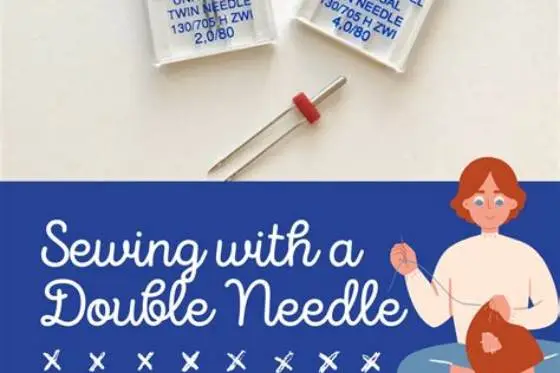
A twin needle is two needles on a single shank, held parallel by a crossbar. You thread two separate top threads, one through each needle eye. Both share one bobbin thread below. From the top you get two parallel lines of stitching; underneath, the bobbin zigzags between them, giving the seam its stretch. That zigzag is what lets the hem stretch with the fabric.
Any machine with a zigzag stitch plate can take a twin needle. The plate needs an oval opening, not a single round hole. You also need two thread sources: two spool pins, or one pin wide enough to stack two spools.
The spacing between needles is stamped on the crossbar as millimeters then needle size: 4.0/80 means 4mm apart, size 80/12 needles. Your needle plate opening must be wider than the needle spacing. A 4mm twin needle needs at least a 5mm opening. Test by turning the handwheel slowly with no thread and the presser foot down, watching both needles drop cleanly through the plate. If either strikes metal, the spacing is too wide.
Why ball point matters: the difference between sharp and stretch
Knit fabrics are interlocking loops, not woven threads. A sharp or universal needle has a pointed tip that pierces between warp and weft in woven cloth. When that tip hits a knit loop, it can pierce the yarn itself instead of sliding between loops. The yarn splits or snags, and you see skipped stitches or tiny holes along the seam. We cover when a home machine stalls on denim in its own article.
A ball point needle has a rounded, slightly blunted tip. It pushes knit loops aside instead of cutting through them. The needle passes through cleanly, the loops close back around the thread, and the stitch holds without snagging. That matters more with a twin needle: two needles pass through the same line of fabric in quick succession. A sharp point that skips occasionally on a single needle will skip or break consistently when doubled.
The 4.0/80 ball point covers most T-shirt weight jerseys. Go to 2.0/75 for very fine knits like rayon jersey. Use 6.0/100 for thick sweater knits and fleece. For woven fabric, swap the ball point for a universal point twin needle in the same spacing.

SCHMETZ Euro-Notions Twin Stretch Machine Needle
Sews your stretch jersey with two rows of stitches from one 4/75 stretch twin needle - a size 75 needle on a 4.0mm spacing that parts knit loops instead of piercing them, so you get even twin-needle hems without skipped stitches
What 4mm spacing means and when to choose 2mm or 6mm
The spacing number is the distance between the two needle shafts. A 4mm twin needle gives two lines of topstitching 4mm apart. That width suits hems and neckline binding on most adult T-shirts and knit dresses. It looks intentional, yet the fabric between the lines stays flat on medium-weight knits. The other half of this decision is lockstitch machine for 6 oz canvas.
A 2mm twin needle puts the stitching lines closer together. Use it for fine jerseys like rayon, where a 4mm span would pull and distort the fabric. The tradeoff is less stretch underneath.
A 6mm twin needle gives a bold, wide double hem, about 1/4 inch apart. It suits thick knits like French terry and ponte, where 4mm looks too timid. Check your needle plate opening first. Run the same handwheel test with the needle threaded before you sew.
The needle size, the second number like 80 or 75, is each shaft's diameter. For most knits, 75/11 or 80/12 is right. Go to 70/10 for sheer knits, or 90/14 for heavy fleece. Thicker needles make bigger holes; thinner ones bend or break on heavy fabric. Keep a note of needle and thread combos that worked for each fabric you sew regularly. People in this spot often ask about sewing machine for vinyl as well.
| Spacing | Fabric type | Needle size | When to use it |
|---|---|---|---|
| 2.0mm | Fine jersey, modal, rayon knit, baby clothes | 70/10 or 75/11 | Lightweight hems and delicate topstitching |
| 4.0mm | T-shirt jersey, interlock, cotton/Lycra, athletic knits | 75/11 or 80/12 | Standard adult T-shirt and dress hems |
| 6.0mm | French terry, sweatshirt fleece, ponte, sweater knits | 80/12 or 90/14 | Bold hems on thick or structured knits |
The twin needle that works on wovens will skip stitches and snap on jersey, and the 4mm ball point is the specific tool that prevents both.
How to sew with a double needle: threading two spools
A twin needle pulls two separate top threads, one through each eye. Both must unwind at the same rate, or one stitch line pulls tighter. Two horizontal spool pins work best. Arrange the two spools so they unwind in opposite directions from each other. One may feed off the top and the other off the side, so they do not fight or tangle.
If you have one spool pin, stack two spools with a felt cushion or straw spacer between them so both spin freely. You can also wind a bobbin, place it on the pin, add a spacer, then slide a full spool above it. Both unwind without fighting. Check the accessory box first; many machines hide the second pin there.
Thread both strands together through every guide and tension disc to the needle bar. At the bar, separate them: left thread through the left eye, right through the right. Use a needle threader if the eyes are small. The bobbin uses one strand only. Do not double the bobbin thread; the twin needle zigzags by pulling one bobbin thread between two tops. The two needles are fixed on one shank, so there is no left or right needle to track.
- Two horizontal pins: set the spools to unwind in opposite directions, so they do not tangle
- One pin: stack two spools with a felt or straw spacer, or use a wound bobbin below a full spool
- Thread both strands together through the guides, then separate them at the needle bar
Stitch settings: length, width, tension and whether a walking foot helps
Set a straight stitch (width zero) and length 2.5 to 3mm. Longer stitches skip because the fabric stretches between penetrations. Shorter stitches pack tight and cause tunneling, a ridge between the stitch lines. If one top thread is heavier topstitch thread, lengthen the stitch to 3mm.
Top tension needs adjusting with two threads. Two threads pull through the same discs, so tension set for one will choke both. Too tight pulls the fabric into a ridge. Too loose and the stitches sit loopy on top. Test on a matching scrap. A flat hem with neat stitches means the tension is right.
On very stretchy fabric, switch to a narrow zigzag: width 0.5mm, length 2.5mm. That tiny side motion gives the needles room to flex as the fabric stretches. It prevents the left needle from snapping.
A walking foot helps on thick or springy knits. It grips both layers and feeds them evenly. Skip it for standard jersey; use it for wavy hems and fabric creep. Test on a double-layer scrap. Sew six inches and pull the sample widthwise. If stitches break, drop the tension another half number or switch to the slight zigzag.
Fixing tunneling, skipped stitches and broken needles
Tunneling means the fabric between the stitch lines pulls up into a ridge. Top tension is too tight, or the stitch length is too short. Drop tension by one number and test again; if it persists, drop another half. If tension is not the cause, raise the stitch length to 2.5 or 3mm. A strip of wash-away stabilizer under the hem stops tunneling: it holds the fabric flat and washes out after.
Skipped stitches show as gaps where the needle missed the bobbin thread. First, confirm you are using a ball point twin needle, not universal or sharp. Universal points skip constantly on knits. Second, push both needles fully into the clamp and tighten the screw. A needle sitting low misses the hook timing. Third, slow down. Fast sewing makes the fabric slip and the timing miss. Let the feed dogs pull the fabric; do not push or stretch it. Clean lint from the hook race.
Needles snapping, usually the left one, happens on very stretchy fabric when the stitch is straight and the fabric stretches sideways under the foot. The needle flexes and hits the presser foot or the hook. Switch to the narrow zigzag from the settings section instead of straight stitch. That gives the needles side-to-side room. Slow down and stop pulling the fabric. A bent needle breaks or skips, so toss any needle that has hit a pin.
- Skipped stitches: ball point needle, needles fully in the clamp, slow down
- Broken needles: use the narrow zigzag, and stop pulling the fabric
How a twin needle hem compares to a coverstitch and when it's enough
A twin needle on a regular machine gives you a hem that looks like a coverstitch from the top. You see two parallel rows of straight stitching. A true coverstitch machine uses two or three needles and two loopers instead of a bobbin. A twin needle uses one bobbin thread zigzagging between two top threads. Both stretch, but the coverstitch has more recovery and a flatter underside. The coverstitch underside is a chain of loops; the twin needle underside shows one bobbin thread zigzagging.
For home sewing, a twin needle hem is good enough for T-shirts, dresses, leggings, and kids' clothes. The hem stretches when you pull it on, lies flat when worn, and holds up through washing. It will not replace a coverstitch for high-performance activewear like running tights or swimwear, where you need maximum stretch and recovery. The twin needle saves you from buying a second machine for everyday hems. If you sew activewear weekly, a coverstitch earns its place. For the odd T-shirt hem, the twin needle is the cheaper answer. Try it on a scrap first: one hem tells you whether the look suits the garment.
- Looks like a coverstitch from the top for a fraction of the cost
- Stretches enough for T-shirt hems, casual wear and kids' clothes
- Uses your regular sewing machine with a needle pack costing a few dollars
- Flat underside that doesn't feel bulky or scratchy
- Less stretch recovery than a true coverstitch for activewear
- Bobbin zigzag underside not ideal for construction seams
- Requires tension and stitch testing on every fabric type
- Won't survive the constant stress of performance sportswear
Still wondering?
Can I use a twin needle on a straight-stitch-only machine?
No. A straight-stitch machine has a round needle hole, and the twin needle's two shafts will not both fit through it. You need a zigzag throat plate with an opening wide enough for both needles.
Do I need to change the bobbin thread or use two bobbins?
One bobbin is enough: wind it with the same thread you use on top. The twin needle pulls that bobbin thread up between the two top threads, creating the zigzag underside automatically.
Why does my left needle keep breaking but the right one is fine?
The left needle is hitting something as the fabric stretches. Switch to the narrow zigzag in the settings section, which gives the needles side-to-side room. Slow down and stop pulling the fabric; let the feed dogs move it.
Can I use a twin needle to sew a seam, or is it only for hems?
You can, but the bobbin zigzag inside makes it bulkier than a serged seam. Twin needles are best for hems and decorative topstitching. For construction seams, use a serger or narrow zigzag, then finish the hem with the twin needle.
Will a 6mm twin needle fit my machine if it has a 7mm zigzag width?
Probably, but run the handwheel test first. If either needle touches the foot or the plate, the spacing is too wide for your machine. Some machines with a 7mm zigzag max can take a 6mm twin needle. Others cannot, because the plate opening is narrower than the zigzag width.
Can I backstitch at the start and end of a twin needle seam?
Yes, but go slowly. Backstitching with a twin needle is dense and can cause thread buildup. Backstitch two or three stitches, or tie off the thread tails by hand for a cleaner finish.