How to prepare an embroidery needle for hand and machine work
To prepare an embroidery needle, match it to your thread and fabric first. A sharp or crewel in size 7 to 10 suits most stranded cotton. Thread it, knot the tail, and check the point before you stitch. Machine needles differ from hand needles in eye, point and shank. Seat a machine needle fully up, flat side as your manual shows.
On this page (8 sections)
- The short version
- How to prepare an embroidery needle: what the size numbers mean
- Sharps, crewel and chenille: which hand needle fits the job
- Threading and knotting: get a hand needle ready to stitch
- Metallic thread by hand: condition it, cut it short, knot it flat
- Machine embroidery needles: eye, point, scarf and seating
- Skipped stitches and shredded thread: when the needle is the fault
- Still wondering?
Part of our guide on embroidery machine for beginners
Key figures
- General hand needle
- size 7-10 sharp or crewel
- Hand thread length
- 18 in (46 cm) at most
- Metallic thread length
- 12 in (30 cm) at most
- Machine needle change
- about 8 hours, Schmetz rule
- Machine needle, cotton
- 75/11 or 80/12
- Blunt needle sign
- skips, shreds or pops
The short version
- Test the needle on a scrap before you stitch the real piece.
- Use short lengths for metallic thread, and condition it before you stitch.
- Knot the tail with two or three wraps, or anchor it under your first stitches.
- Seat a machine needle fully up, and check your manual for the flat side.
- Swap a needle when stitches skip or thread shreds, before you change tension.
How to prepare an embroidery needle: what the size numbers mean
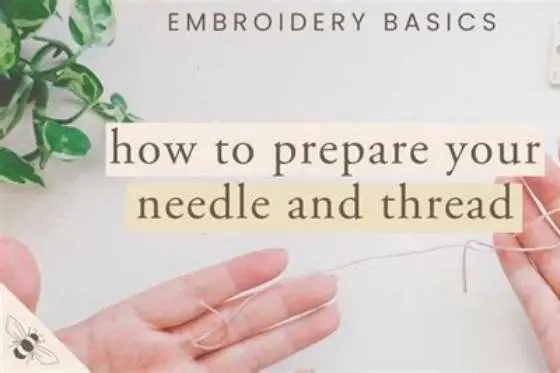
Hand embroidery needles are chosen by two measures: the thread passing through the eye and the fabric under the point. Size 7 to 10 sharp or crewel needles suit most stranded cotton on medium cotton or linen. Fine silk and 60 wt thread want size 10 to 12, while heavier perle cotton wants size 3 to 5 chenille with a large eye.
Thread weight is the number on the spool, and lower numbers mean thicker thread. A 20 wt thread is heavier than a 50 wt thread. The eye must be wide enough for the thread to slide without fraying. It must not be so wide that the needle punches a visible hole in the weave. That balance is the whole job, and a scrap test settles it faster than any chart.
Fabric weight sets the point you need. Tightly woven cotton and linen take a sharp point that pierces cleanly. Loosely woven Aida or evenweave takes a blunt point that slips between fibres instead of splitting them. Stitch a few lines on a scrap first. When the thread drags at the eye or frays at the tail, go up one needle size before you blame the thread.
| Thread | Fabric | Needle |
|---|---|---|
| Stranded cotton, 2 strands | Cotton quilting | Size 9-10 sharp |
| Stranded cotton, 6 strands | Medium linen | Size 7-8 crewel |
| Perle cotton 5 | Evenweave | Size 3-5 chenille |
| Fine silk, 60 wt | Silk or batiste | Size 10-12 sharp |
| Metallic floss | Any stable weave | Size 10-12 metallic |
Sharps, crewel and chenille: which hand needle fits the job
Sharps have a short, pointed tip and a small eye. They suit fine detail and surface embroidery on tight weaves, where you need to pierce cleanly. A regular sewing needle is a sharp too, but its eye is smaller and shorter, so it frays stranded cotton as it passes through. For the detail, see our notes on embroidery machine thread weight.
Crewel needles are sharps with a longer eye. They take heavier thread or more strands without fraying, and they are the usual choice for wool and thick floss. The longer eye is the point of the needle, not the tip itself, and that extra room is what keeps thick thread smooth.
Chenille needles run thicker in the shaft with a large eye. They make a bigger hole, which suits loose weaves and thread-dense work, yet leaves a mark on tight cotton. Blunt-tipped needles for counted work belong on evenweave, where they slide between threads instead of splitting them. Save the packet after you open it. The size and type printed there are what you match next time. Guessing from memory buys the wrong needle. A sharp used on Aida splits the weave and gives uneven stitches. Store spare needles in a felt needle book or on a magnet, points covered, so they stay sharp and out of the way.
| Type | Tip | Eye | Best for |
|---|---|---|---|
| Sharp | Pointed | Small | Fine detail, tight weave |
| Crewel | Pointed | Long | Wool, thick floss |
| Chenille | Pointed, thick shaft | Large | Loose weave, heavy thread |
| Blunt point | Blunt | Large | Evenweave, counted work |

SCHMETZ Embroidery Sewing Machine Needles
Gives your embroidery machine the 75/11 needle with the enlarged eye and widened groove that keeps rayon and polyester thread from shredding at speed.
Threading and knotting: get a hand needle ready to stitch
Cut a length no longer than 18 inches (46 cm). Long thread twists on itself and wears thin before you finish the row. Cut from the freshly trimmed end of the skein, not the tangled end still attached, because that end threads cleanly. We cover embroidery needles by fabric type in its own article.
Separate stranded cotton one strand at a time. Pull each strand gently and smooth it between your fingers before you put the strands back together. Flat, aligned strands lie smooth in the stitch, while a twisted bundle frays at the eye.
Hold the needle with the eye facing you in good light, and damp the thread end between your lips to stiffen it. Push the thread through the eye, then pull 3 to 4 inches (8 to 10 cm) through so it does not slip back. Thick or frizzy thread threads better folded: fold it over the needle, pinch the fold flat, and push the fold through the eye. A wire needle threader helps in poor light or when your eyes tire.
Knot the tail with two or three wraps around your finger, then roll the knot off and pull it tight. One wrap pops through the fabric on the first pull. On loose canvas, use a waste knot instead. Knot the tail, start from the top a few inches away, and trim the knot once your stitches hold the thread. It helps to understand building basic hand stitching skills before going further.
- Cut 18 inches (46 cm) of thread from the freshly trimmed end.
- Separate the strands one at a time, smooth each between your fingers.
- Hold the needle eye toward you and push the thread through.
- Pull 3-4 inches (8-10 cm) of tail through the eye.
- Wrap the tail twice or three times around your finger and roll off.
- Pull the knot tight and check it sits at the end, not an inch up.
The needle is the cheapest part of your stitching, and the one most likely to cause the trouble.
Metallic thread by hand: condition it, cut it short, knot it flat
Metallic thread behaves nothing like cotton, so it needs a different routine. Its metal wrap frays, splits and kinks each time it passes through fabric. A knot in it tightens into a snag instead of a neat anchor. Low-impact stitches suit it best: couching and backstitch treat the wrap gently, while French knots and bullion wrap it tight and invite tangles.
Keep metallic lengths to 12 inches (30 cm) at most, even when you usually stitch with 18 inches (46 cm) of cotton. Fewer passes through the fabric mean less wear on the wrap, and the loose end has less time to unravel and tangle. When a length starts to fray near the needle, cut it off and start fresh instead of forcing it through.
Condition the thread before you thread the needle. Press it lightly onto pure beeswax or a silicone thread conditioner. Pull it through once in each direction, then run it between your fingers to spread a thin, even coat. A light coat cuts friction and keeps the strands together, while a heavy coat dulls the shine and can darken pale thread over time.
Fasten metallic thread onto the needle instead of knotting the tail. Fold the cut length in half, push the loop end through the eye, then pass the needle tip through the loop and pull it tight. The knot sits just under the eye, holds the strands in line, and stops the thread twisting as you stitch. Start the length by catching the tail under your first few stitches on the back, not with a bulky knot.
Machine embroidery needles: eye, point, scarf and seating
Machine embroidery needles are not hand needles scaled down. The eye sits lower and wider to take thread at speed. The point is a light ballpoint that slips between weave threads instead of cutting them. Above the eye sits the scarf, a short groove that lets the bobbin hook pick up the thread loop.
Use the size the fabric and thread call for. A 75/11 or 80/12 suits most cotton with thread up to 40 wt. Heavier fabric and thicker thread want 90/14 or 100/16. A regular universal needle has a sharper point and a smaller eye than an embroidery needle, so it shreds thread at embroidery speed.
Seat the needle with the flat side facing the way your manual shows. On most home machines that means flat to the back, away from you. Push it fully up into the clamp until it stops, then tighten the screw. Some machines differ, so check the manual before you assume. The Singer Featherweight takes the flat side to the left, and some semi-industrial straight-stitch machines take it to the right. A needle seated even slightly low skips stitches and pops on every stroke.
| Fabric | Needle (EU/US) | Thread |
|---|---|---|
| Cotton quilting | 80/12 | 40-50 wt |
| Denim or canvas | 100/16 | 30 wt |
| Fine batiste | 70/10 | 60 wt |
| Stretch fabric | 75/11 ballpoint | 40 wt |
Skipped stitches and shredded thread: when the needle is the fault
Skipped stitches on a machine usually mean the needle is blunt, the wrong point, or seated too low. Swap in a new needle first, because it is the cheapest fix and takes seconds. Re-thread with the presser foot up, then stitch a test line on scrap. Clean stitches on the scrap mean the needle was the fault.
Shredded thread at the eye points to a needle too small for the thread, or a burr on the eye. Enlarged holes mean the needle is too thick for the weave, so drop one size and check the stitch again. Puckered seams point to the wrong point for the fabric: sharp needles cut knit fibres and leave holes, while ballpoints slip between them.
Check a needle before you blame the tension. Hold the point up to a light and look for a flat or a hooked tip. Then run a fingernail along the shaft near the eye and feel for a catch. A sharp point is a clean cone, and any burr or flat means the needle is done. Hand needles last longer than machine needles because they run slower and cooler. Change them when they drag or the plating wears off around the eye.
Schmetz recommends changing a machine needle after about 8 hours of sewing, or at the start of each new project. That is a rule of thumb, not a clock to watch. Heavy fabric and metallic thread wear a needle faster, so swap sooner when thread starts to shred or stitches skip. Keep a spare of each size you use beside the machine, and toss blunt needles instead of mixing them back into the packet.
Still wondering?
Can I use a regular sewing needle for hand embroidery?
You can, but the eye is smaller and shorter, so it frays stranded cotton as it passes through. Crewel and sharp embroidery needles have a longer eye and slip through fabric with less damage. When thread shreds at the eye, that is the sign to switch to an embroidery needle.
How many strands of floss should I use with which needle?
Two strands suit a size 9 to 10 sharp. Four to six strands suit a size 7 to 8 crewel, or a chenille for heavier work. Test the pairing on a scrap first, and watch how the thread sits in the stitch.
Why does my machine embroidery thread keep breaking?
Start by re-threading with the presser foot up, so the thread seats in the tension discs. Check the thread path for a snag, and stitch a test line on scrap. When the break keeps happening at the same spot, the timing may be out, and that needs a technician.
Should I use the same needle for hand and machine embroidery?
No. Hand needles have a sharp point and a plain round shank. Machine needles have a flat shank, a scarf for the hook, and a point chosen for the fabric. They are not interchangeable, and each one fails in the other role.
How do I stop metallic thread from knotting while I stitch?
Cut metallic thread short, and condition it with a light coat of beeswax or thread conditioner before threading. Knot it onto the needle with the loop method, and choose low-impact stitches like couching or backstitch. Long lengths and tight knots are what tangle it.