Drawing on cotton vs polyester: which fabric marker holds the line
On cotton and linen, use a pigment fabric marker and heat-set it if the label calls for it. On polyester, use an acrylic paint marker, because pigment ink bonds poorly to smooth synthetics. Wash cold and inside out, and wait a day before the first wash.
On this page (8 sections)
- The short version
- How to draw with fabric markers starts with the fabric, not the pen
- Fibre: what cotton, linen, blends and polyester do to marker ink
- Marker chemistry: pigment, dye and paint compared
- Bleed and feather: how to draw a clean edge on a gap-prone fabric
- Heat-setting: method, drying and what a dryer does
- Test patch first: checking a marker on a scrap of the same fabric
- Still wondering?
Part of our guide on choosing fabric marker tips
Key figures
- Best on cotton
- pigment fabric marker
- Best on polyester
- acrylic paint marker
- Heat-set
- dry iron, only if the label calls for it
- First wash
- at least 24 hours after drawing
- Wash
- cold, inside out
- Dry
- line dry, not tumble dry
The short version
- Cotton and linen absorb pigment ink; polyester repels it, so synthetics need paint-based markers.
- Check your marker's label first: some need a dry-iron heat-set, some need none at all.
- Wash marked fabric cold, inside out, and expect some fading every cycle even on a well-set line.
- Dense, smooth fabric gives a clean edge; loose weaves bleed, so back the fabric or draw on the grain.
How to draw with fabric markers starts with the fabric, not the pen
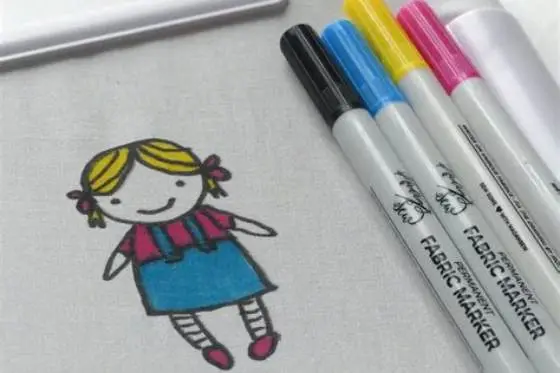
Most advice on how to draw with fabric markers begins in the craft aisle. It should begin with the fabric in your hand. A marker is an ink delivery system, and ink behaves differently on thirsty natural fibre than on slick plastic. The same pen that draws a crisp line on a cotton quilt label can wipe off a polyester jacket after one wash.
Work backwards from the fabric. Ask four things before you uncap anything. What is the fibre? What colour is it? Will the finished piece be washed? How fine must the line be? A signed quilt label on washed cotton needs pigment ink and heat. A logo on a synthetic sports shirt needs paint, not ink.
This page works through that decision in order. Fibre first, then marker chemistry, then the clean-edge techniques that stop bleed. Last comes the heat-setting step, which turns a drawing into something the washing machine cannot easily remove. Skip the last step and nothing else matters. Unset ink is temporary ink, no matter what the packet promises. A line worth drawing is worth setting properly.
Fibre: what cotton, linen, blends and polyester do to marker ink
Cotton and linen are cellulose fibres with a rough, absorbent structure. Ink wicks into them the way water wicks into a paper towel. Pigment particles lodge in the fibre surface, where heat can bond them in place. Natural fibres are the friendliest surface a fabric marker can meet. There is more on best fabric paint for denim in a separate guide.
Polyester, nylon and other synthetics are extruded plastic. Their surface is smooth, non-absorbent and chemically uninterested in water-based ink. Pigment markers often look fine going on. Then they sit on top of the fibre as a fragile skin that scuffs, cracks or washes away. Dye markers made for synthetics exist, but they are a specialist purchase.
Blends sit between the two. Behaviour follows the dominant fibre, so a mostly-cotton blend acts more like cotton and a mostly-polyester blend acts more like polyester. Rayon and bamboo absorb like cotton but are weaker when wet, so scrubbing frays the line faster. Read the fibre content on the bolt label before you buy the pen, not after.
Some fabrics refuse a permanent line whatever marker you choose. Stretch knits, jersey and spandex blends resist ink because the fibre moves too much for a binder to hold. High-gloss finishes, coated nylon and technical fabrics repel every marker type. The coating blocks the fibre, so ink has nothing to bond with. Thick fleece hides the line in texture, and thin voile lets ink bleed through. For these fabrics, skip markers and use heat-transfer vinyl or screen printing instead. We cover best fabric markers for sewing in its own article.
| Fibre | Absorption | Marker type that works | Wash survival when heat-set |
|---|---|---|---|
| Cotton, linen | High | Pigment ink, dye, paint | Good to very good |
| Cotton-poly blends | Moderate | Pigment ink, paint | Moderate to good |
| Rayon, bamboo | High but weak wet | Pigment ink, gentle handling | Moderate |
| Polyester, nylon | Very low | Acrylic paint marker | Paint only; ink usually lifts |

Tulip Fine-Tip Fabric Markers
Gives you a fine tip for lettering, outlines and small illustrations on cotton, denim and tote bags, and the ink is permanent with no heat-setting step, so the drawing survives washing instead of fading out.
Marker chemistry: pigment, dye and paint compared
Three chemistries dominate the fabric-marker shelf, and they fail in different ways. Pigment markers carry solid colour particles suspended in a binder. On natural fibre the particles settle into the weave, and heat locks the binder there. They give the most reliable permanent line on cotton and linen, with fine tips that suit signing and outlining.
Dye markers dissolve colour into the fibre itself, which can look beautifully soft. But unbonded dye bleeds in the wash and migrates along the grain. Dyes made for natural fibre do nothing on polyester. Acrylic paint markers deposit a thin plastic film that sits on the surface of any fibre. That is why they suit synthetics and crack where fabric flexes.
Read the label before you buy. Some markers need heat-setting and some do not, and a marker with no care instructions was never designed to survive laundering. The other half of this decision is best white fabric marker.
An acrylic paint marker on fabric is a thin layer of plastic on top of cloth. It cracks exactly where cloth moves most: across creases and folded seams. The fix is not a better brand, it is a thinner film. Build colour in two or three light passes rather than one wet coat.
A quick wipe with rubbing alcohol removes sizing and skin oils. Paint markers earn their keep on tote panels, banners, shoe canvas and cushion covers, items that do not fold in the same spot. On a garment knee, expect hairline cracking eventually.
| Type | Best fibre | Edge quality | Flexibility | Wash behaviour |
|---|---|---|---|---|
| Pigment ink | Cotton, linen, blends | Crisp, fine tips common | Moves with fabric | Very good once heat-set |
| Dye-based | Natural fibre only | Can feather along grain | Fully flexible | Prone to bleed and ghosting |
| Acrylic paint | Polyester, synthetics, dark fabric | Solid, slightly raised | Can crack at hard folds | Good if applied in thin coats |
Bleed and feather: how to draw a clean edge on a gap-prone fabric
Bleed happens when ink travels further than the tip. Loose weaves, open linen, thin quilting cottons and any fabric with big gaps between yarns let ink wick sideways along the threads. On polyester, ink that cannot soak in sits on the surface and smears under the pen.
Cut the travel before you draw. Press the fabric flat and put freezer paper or card stock underneath, to stop ink reaching the layers behind. On light fabric, starch or a light fusible interfacing tightens the weave. Draw with the grain, not across it, since ink travels faster along the yarns.
Tap or press rather than scrub. Avoid re-tracing a line while it is wet, which doubles the ink load. Work in short strokes and let the fabric drink between them. If a crisp edge still matters, outline with a fine pigment marker after filling with a broader tip.
Fabric markers are usually opaque enough that you cannot trace through the cloth. For light fabrics, tape your sketch to a window and tape the fabric over it. Trace lightly with a water-soluble marking pen or tailor's chalk, then draw over the guide with your marker. For dark fabrics, use transfer paper made for fabric, not office carbon paper. Test it on a scrap first. If the design is simple, skip tracing and draw freehand. Mark key points with chalk dots, then connect them in one smooth pass.
- Press the fabric and place freezer paper or card behind the drawing area.
- Starch or interface loose weaves to tighten the yarn spacing.
- Draw along the grain with light pressure, letting ink dry between strokes.
- Trace outlines last with a fine tip to define the edge.
Heat-setting: method, drying and what a dryer does
Heat-setting converts a drawing into a permanent one, because pigment and paint binders cure under heat. Without it, the binder never fully locks and the first wash carries colour away. Check the instructions printed on your marker first. Some fabric markers need no heat-setting at all, while others need a dry iron. Some brands market no-heat-set markers.
Let the ink dry completely first, often overnight for wetter paint markers. Cover the design with parchment paper or a pressing cloth. Press with a dry iron on the cotton setting for several minutes, keeping it moving, per your marker's label.
A few brands accept tumble drying as part of the cure, and others do not. Follow the drying and first-wash interval printed on your marker; 24 hours is a common minimum.
Even a properly set line fades over time. Pigment ink on cotton, heat-set and washed cold inside out, softens gradually over repeated washes. Friction from other clothes, twisting through the drum and hot water do the damage. Wash it inside out with similar fabrics. Stress at one spot shortens life: a folded tote flap, a shirt hem rubbed by a belt. A signature in a seam allowance survives because nothing rubs it. The same signature on a tea towel in daily use fades much sooner.
- Let the drawing dry fully, ideally overnight for paint markers.
- Cover the design with parchment or a pressing cloth, drawing-side protected.
- Press with a dry iron, iron moving, for the full stated time.
- Give the piece a full day before its first wash.
Test patch first: checking a marker on a scrap of the same fabric
Every rule above bends with the fabric, dye and finish in front of you. A ten-minute test patch beats any amount of reading. Use an offcut of the actual project fabric, not something that looks similar. Shake a paint marker well and test the flow on scrap paper before the first stroke on fabric. Draw the finest line and the boldest fill you plan to use. Then run the whole process on the scrap: dry, heat-set, wash and dry it the way the finished piece will be treated.
Judge four things when it comes out. Edge quality: did the line feather or stay crisp? Colour: did it hold, fade or shift? Hand: does the marked area feel stiff against the unmarked fabric? Adhesion: scratch it with a thumbnail across a fold. If the scrap passes all four, the project will too. If it fails, you have lost a scrap instead of a finished quilt label.
Ghosting is a faint return of the line after it seemed to wash out. Some of the ink never left. Water and detergent lift the surface colour, but pigment that has wicked deep into the fibre stays put. As it dries, the remaining colour shows through as a pale shadow. This is why erasable and water-soluble markers must never be treated as ink. A soaked line drives pigment deep, and depth is what a wash cannot reach. Pre-wash new fabric to remove sizing, and skip fabric softener. Draw with a dry rather than drenched tip. Heat-set before anything wet touches the design.
Keep the tested scrap pinned near your work as a reference for pressure and dryness. If you sell marked pieces, test each new fabric batch. Dye lots and finishes vary.
Match ink to absorbent fibre and paint to synthetics, then earn permanence with a careful heat-set - no marker survives the wrong fabric and an unset line.
Still wondering?
Can I use a regular Sharpie instead of a fabric marker?
A permanent office marker will draw on cotton. But its solvent-based ink is not formulated to bond with fibre, so it often fades, bleeds or ghosts in the wash. A pigment marker labelled for fabric, properly heat-set, is far more reliable for anything that will be laundered.
How long after drawing can I wash the fabric?
Let the ink dry fully, then heat-set if your marker calls for it. Follow the first-wash interval printed on your marker; a day is a common minimum. Washing sooner often leaves a faded first wash.
Do I need a special marker for dark fabric?
Yes. Standard pigment inks are semi-transparent and disappear on dark cloth. Look for paint-based markers labelled opaque, which lay down a light-blocking film, and apply in thin layers so they do not crack.
Why did my line wash out even though the pen said permanent?
Permanent usually means permanent once heat-set. If the drawing was never pressed with a dry iron at the maker's stated setting, the binder never cured and the first wash removed it. Re-draw, then set before the next wash.
Will the design survive the tumble dryer?
An occasional tumble dry after setting is fine, but air-drying keeps the line sharp longer. Line dry marked fabric when you can, since that is the safer habit.