Can a regular sewing machine sew leather: what weight it handles
Yes, a regular home machine can sew leather, but only thin, soft leather about 0.6-0.8 mm thick (1-2 oz). Use a leather needle 90/14 to 100/16, longer stitch, and light pressure. Anything over about 1.2 mm or two layers will stall the motor and skip.
On this page (8 sections)
- The short version
- The short answer: can a regular sewing machine sew leather at home
- Weight and thickness: what your machine can and cannot clear
- Needle and thread: the cutting point and weight that work
- Presser foot, feed and stitch setup: how to stop sticking and skipping
- Test on scrap: a quick check and the stop signs to watch
- When to hand-sew or switch to a heavy-duty machine instead
- Still wondering?
Part of our guide on best sewing machine for upholstery
Key figures
- Safe single layer
- 0.6-0.8 mm (1-2 oz)
- Max stack at foot
- ~1.2 mm total
- Leather needle
- 90/14 to 100/16
- Thread weight
- 40 wt to 69 wt
- Stitch length
- 3.0-3.5 mm
- Presser foot
- Roller, Teflon or walking foot
The short version
- Keep the total stack under 1.2 mm and soft chrome-tanned leather for a domestic machine.
- Use a fresh leather needle 90/14 to 100/16 with 40-69 wt bonded thread.
- Fit a roller or Teflon foot, lengthen stitch to 3.0-3.5 mm, and lower pressure slightly.
- Test on scrap with the real layers and stop at heavy handwheel, skipped stitches or stretched holes.
The short answer: can a regular sewing machine sew leather at home
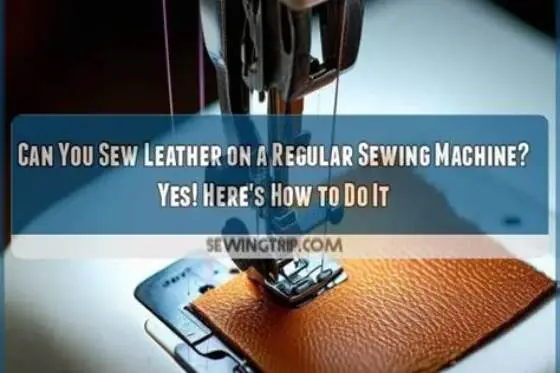
Yes, can a regular sewing machine sew leather, but only the thinnest kind. Your domestic machine can clear soft garment leather around 0.6-0.8 mm thick, which tanners label as 1-2 oz, if you make three changes first. It needs a cutting-point needle, a longer stitch, and a foot that will not stick. Beyond that thickness the feed stalls and the needle deflects.
Think of your machine as a light-duty feeder. It was built to move cotton and quilting layers with a drop feed and a small motor. Leather does not feed like fabric. It grips, it does not compress much, and every hole stays forever. You get one pass to make it right, so you must plan the seam and test it first.
You will know quickly if you have pushed too far. The handwheel feels heavy, the stitch length shortens on its own, and the needle leaves large, stretched holes. That is your stop sign. I would keep my home machine for wallets, pouches, and garment overlays in lamb or pigskin, and I would not ask it to sew belts or bag straps. Check your leather with calipers before you cut.
If you do not own calipers, use a ruler and a scrap stack. Most craft leather sold as 2 oz measures about 0.8 mm or 1/32 inch (0.8 mm) and still flexes easily. Hold it to light and bend it. If it drapes like a shirt, your machine might manage. If it stands up like a belt, save it for hand sewing. The next section sorts the weights so you can see where that line sits. If that sounds like your situation, read up on sewing leather on a regular machine next.
Weight and thickness: what your machine can and cannot clear
Tanners sell leather by weight in ounces, which tells thickness. 1 oz equals about 0.4 mm or 1/64 inch (0.4 mm), so 2 oz is roughly 0.8 mm. Domestic machines clear that range well when the leather is soft and you sew one or two layers. Past 3 oz or about 1.2 mm, the presser foot struggles to climb and the feed dogs slip.
Stiffness matters as much as thickness. A supple lambskin at 2.5 oz will sew easier than a stiff cowhide at the same weight. Chrome-tanned garment leather stays soft, while vegetable-tanned tooling leather stays firm. You can feel the difference in your hands. If you can roll the leather easily, the motor has a chance.
Layers add up fast. Two layers of 2 oz is 4 oz under the foot, or about 1.6 mm, and seams with folds count as three or four layers at the overlap. That is why a bag gusset or a strap fold fails even when a single layer sewed fine. Measure the thickest stack you will actually sew, not just the flat piece. People in this spot often ask about sewing 12oz denim and leather layers as well.
Use this as your sorting rule. Keep the total stack under 1.2 mm for a regular machine, and keep it soft. Anything thicker, stiffer, or bulkier at the seam belongs to hand sewing or a walking-foot machine. You will hear the motor change tone long before you see damage, and that sound is your cue to stop.
| Weight (oz) | Thickness | Home machine? |
|---|---|---|
| 1-2 oz | 0.4-0.8 mm (1/64-1/32 inch) | Yes if soft, 1-2 layers |
| 2-3 oz | 0.8-1.2 mm | Borderline, test on scrap |
| 3-4 oz | 1.2-1.6 mm | No, expect skipped stitches |
| 5-6 oz+ | 2.0 mm+ | No, hand-sew or heavy-duty machine |

SINGER Leather Sewing Machine Needles
Lets your regular home machine punch clean holes in leather with a wedge cutting point in the exact 90/14 and 100/16 sizes so it does not tear or skip.
Needle and thread: the cutting point and weight that work
Leather needs a needle that cuts, not pushes. A leather needle in 90/14 to 100/16 has a wedge-shaped point, called a cutting point, that slices a clean slit. A universal needle with a round point will punch and stretch the hole and skip stitches. Change to a new leather needle for every project, and change again if you hit a pin or a thick seam.
Match thread to needle eye and to the leather. For garment leather, 40 wt to 69 bonded nylon or polyester feeds smoothly and fills the slit without bulk. Heavier thread like 92 wt needs a larger 110/18 needle and more presser pressure than a home machine can give. If the thread looks too thick to pull easily through the needle eye, it is too thick for this setup.
You can check the match in ten seconds. Thread the needle and hold the thread tail. The thread should slide without catching, and the needle should not flex when you pull. If you see the needle bend, go up one size or down one thread weight. The Needle & Thread Finder tool on this site lets you pick leather and weight to confirm needle, thread, and stitch length before you cut.
- Leather needle 90/14: best for 1-2 oz soft garment leather, one layer
- Leather needle 100/16: better for 2-3 oz or two layers, still within home limits
- Thread 40-69 wt bonded: strong, smooth, fits 90/14 to 100/16 eyes
- Avoid 92 wt and up on domestic machines: needs larger needle and higher tension
Most home machines can sew leather, but only below 1.2 mm total stack and only with a cutting-point needle.
Presser foot, feed and stitch setup: how to stop sticking and skipping
Leather sticks to a standard metal foot, so the feed drags. Swap to a roller foot or Teflon non-stick foot so the leather glides instead of grabbing. If you have a clip-on walking foot, that helps more because it feeds from the top as well as the bottom. Lower presser foot pressure by a quarter turn if your machine has a dial, just enough to keep the layers moving.
Lengthen the stitch to 3.0-3.5 mm, which is about 7-8 stitches per inch. Short stitches perforate leather like postage stamps and weaken the seam, and they make the feed work harder. Longer stitches cut fewer holes and let the feed advance cleanly. Set tension a touch lower than for cotton, then test on scrap until both sides show even knots in the middle of the leather.
Do not use pins. Every pin hole stays. Use small binder clips or double-sided tape for leather to hold layers, and keep seam allowance narrow so bulk stays low. Sew slowly and guide without pulling. If your machine lets you reduce speed, use it. Steady, even pressure beats fast bursts on leather.
A quick rule of thumb helps: longer stitch, lighter foot, slower hands. That combo solves most skipping on thin leather. If you still see the foot leaving marks, place tissue or painter tape on the leather surface and tear it away after. It lifts off without residue and keeps the finish clean.

TISEKER 2 Pieces Roller and Non-Stick Zigzag Teflon Presser Foot
Stops leather sticking and dragging on your low-shank snap-on machine with both a roller and a Teflon sole so it feeds evenly.
Test on scrap: a quick check and the stop signs to watch
Every hide varies, so a scrap test tells you more than any chart. Cut two scraps the same thickness and layers as your real seam, including any fold. You will run the exact stitch you plan to use, so you see the real feed and tension before you risk the project piece.
Run the test at your planned speed and watch the machine, not just the seam. Leather shows problems early if you look and listen. A good test leaves even stitches, no drag marks, and holes that close slightly around the thread. A bad test warns you before the needle breaks or the motor overheats.
If any stop sign appears, do not push through. Stop, lift the foot, and check the stack. Forcing it bends needles, burrs the throat plate, and can throw timing out. That repair costs more than hand sewing the seam. Keep the scrap and label it with needle, thread, and settings that worked.
- Stop signs: handwheel hard to turn, motor hums or slows, needle deflects or hits plate
- Stop signs: skipped stitches, uneven length, thread shredding, large oval holes
- Stop signs: foot leaves deep marks or leather will not feed without pulling
- Fit a new leather needle 90/14 or 100/16 and re-thread with presser foot up.
- Set stitch length to 3.0-3.5 mm, fit roller or Teflon foot, lower pressure slightly.
- Sew 4-5 inches (10-12 cm) on the scrap stack at slow, steady speed.
- Inspect: even stitch length, no skipped stitches, no stretched holes, no foot marks.
- Try to pull the seam gently. Thread should not show on either side and leather should not pucker.
When to hand-sew or switch to a heavy-duty machine instead
Hand sewing or a heavy-duty walking-foot machine is the right call when the stack goes past about 1.2 mm or the leather is firm. Think belts, straps, thick bag seams, holsters, and any seam that folds over itself. Those jobs need a feed that pulls from the top and a motor that holds torque at low speed. Your domestic drop feed cannot do that without strain.
Hand sewing gives you control on small, thick pieces. You punch holes first with a pricking iron or awl, then stitch with a saddle stitch using bonded thread 69-92 wt. Holes stay even, tension stays consistent, and you avoid broken needles. It takes longer, but the result is stronger on thick leather because each stitch locks.
A walking-foot or compound-feed machine moves thick stacks without slipping. It is the tool for frequent leather work, especially if you sew bags or upholstery. For occasional projects, hand sewing is cheaper and safer for your home machine. I would hand-sew anything over 3 oz and save the home machine for linings and trim.
Decide by the scrap test, not by hope. If the test needed pulling, skipped, or left stretched holes, change methods. You protect the machine and the leather at the same time. A clean hand-stitched seam on a thick strap looks better than a wavy machine seam that weakened the hide.
- hand sewing handles 3-6 oz and folds without motor strain
- holes punched first stay even and strong
- low cost for occasional thick projects
- slower than machine
- needs pricking iron and practice for even spacing
- not ideal for long garment seams
A regular machine is fine for thin garment leather with the right setup, but thick or stiff leather belongs to hand sewing or a walking-foot machine.
Still wondering?
Will sewing leather damage a regular sewing machine?
It can if you force thick or stiff leather. A heavy stack strains the motor, bends needles, and can knock timing out. Stay under about 1.2 mm total stack, use a leather needle, and stop at any laboring sound or skipped stitches.
What needle size is best for leather on a home machine?
Use a leather needle 90/14 for 1-2 oz soft leather and 100/16 for 2-3 oz or two layers. The wedge point cuts a slit instead of punching. Put in a new needle for each project.
Do I need a special presser foot for leather?
Yes. A roller foot or Teflon foot stops sticking. A clip-on walking foot is even better because it feeds top and bottom together. Lower pressure slightly so the leather glides without marks.
Can I sew real leather and faux leather the same way?
No. Faux leather and vinyl also stick but they melt if the needle heats. Use a Teflon foot and a leather or microtex needle, lengthen stitch to 3.0-3.5 mm, and sew slower. Test, as coatings vary a lot.
Why are my stitches skipping on leather?
Common causes are a dull or wrong needle, thread too heavy for the needle eye, stitch too short, or leather too thick. Fit a new 90/14 to 100/16 leather needle, use 40-69 wt thread, set 3.0-3.5 mm, and re-thread with the foot up.