What size sewing machine needle works best for quilting cotton
The best sewing machine needle for quilting cotton is a Sharp/Microtex 80/12 with 50 wt cotton thread. This choice fits home machines using the 130/705 H system, common in quilting. It balances stitch quality and fabric care for accurate 1/4 inch (approx. 6.35 mm) seams on standard quilting cotton. Adjust needle size for fine lawns or heavy denim quilts, and use specialized needles for long-arm quilting machines.
On this page (9 sections)
- Fit check
- The short version
- Best sewing machine needle for quilting cotton: why 80/12 is the starting point
- Needle type for piecing quilts: Sharp versus Universal and what to choose
- Needle choice for machine quilting: when Quilting and Topstitch beat Sharp
- How needle size affects stitch quality in quilting: holes, skips and thread
- When to change it: timing, thread weight and fabric stack
- Fix it first: cheap checks before you blame the needle
- Still wondering?
Part of our guide on best sewing machine for quilting

SCHMETZ Microtex Sharp Sewing Machine Needles
Pieces quilting cotton cleanly on your home machine with the ideal 80/12 Microtex sharp point for two layers
Check it on Amazon
SCHMETZ Microtex Sharp Sewing Machine Needles
Offers the same 90/14 Microtex strength for batting and bulky seams in a single 5-needle card to try before
See this alternative
SCHMETZ Microtex Sharp Sewing Machine Needles
Keeps you piecing without reordering with the same accurate 80/12 Microtex point in a bulk 100-count box for
See this alternative| Product | needle size (EU/US) | Verdict | |
|---|---|---|---|
| SCHMETZ Microtex Sharp Sewing Machine Needles SCHMETZ | 80/12 Microtex size stated in title and bullets vs 80/12 required | Meets it | View on Amazon |
| SCHMETZ Microtex Sharp Sewing Machine Needles SCHMETZ | 90/14 Microtex size stated vs 80/12 required | Meets it | View on Amazon |
| SCHMETZ Microtex Sharp Sewing Machine Needles SCHMETZ | 80/12 Microtex size stated vs 80/12 required | Meets it | View on Amazon |
| SCHMETZ Universal Sewing Machine Needles SCHMETZ | 80/12 Universal size stated vs 80/12 required | Meets it | View on Amazon |
| SCHMETZ Universal Sewing Machine Needles SCHMETZ | 80/12 Universal size stated vs 80/12 required | Meets it | View on Amazon |
Key figures
- Go-to size
- 80/12 Sharp/Microtex
- Fine cotton
- 70/10 Sharp
- Thick seams
- 90/14 Quilting/Topstitch
- Thread pairing
- 50 wt cotton or poly
- Change interval
- Every 6-8 hours
- Stitch length piecing
- 2.0-2.5 mm
The short version
- Start with Sharp/Microtex 80/12 and 50 wt thread for quilting cotton on a home machine
- Use 70/10 for very fine cotton or detailed piecing, 90/14 for bulky seams and dense quilting
- Quilting and Topstitch needles help when you quilt through batting, not just piece
- Change a needle after 6-8 hours of sewing or at the first skipped stitch or dull thud
- Re-thread with the presser foot up and check bobbin before you blame the needle
Best sewing machine needle for quilting cotton: why 80/12 is the starting point
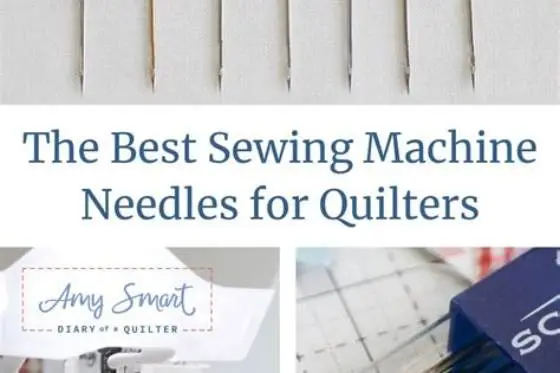
You want the best sewing machine needle for quilting cotton to get smooth, accurate seams. The 80/12 needle size suits standard quilting cotton well. It provides the right balance between strength and fabric care, helping you sew accurate 1/4 inch (approx. 6.35 mm) seams. This size equals 0.80 mm diameter in EU/US sizing and comes labeled as Sharp or Microtex by brands like Schmetz, Organ, and Klasse.
Home sewing machines usually take needles with a 130/705 H system. This means needles for industrial or long-arm machines won't fit or perform properly. The 80/12 Sharp or Microtex needle is designed to pierce quilting cotton cleanly without causing large holes or skipped stitches.
For very fine fabrics like lawn or batiste, go down to a 70/10 needle to avoid damage and puckering. For heavy denim quilts or thick batting layers, a larger 90/14 needle can handle the extra bulk and reduce needle deflection. Long-arm quilting machines often require specialized needles made for their speed and fabric stacks.
Start with the 80/12 Sharp/Microtex needle and 50 wt cotton thread for home machines with 130/705 H needles. This setup supports clean seams and reliable stitch formation on typical quilting cotton. Adjust your needle and thread choice for unusual fabrics or machine types to maintain quality and avoid stitching problems. If that sounds like your situation, read up on what kind of thread to use for machine quilting next.
Needle type for piecing quilts: Sharp versus Universal and what to choose
For piecing quilts, needle type decides how cleanly the point enters quilting cotton. A Sharp/Microtex has the sharpest point for woven cotton. A Universal has a slightly rounded point that works on many wovens and knits but is not quite as crisp on tight cotton. Both will sew, but Sharp gives straighter seams and less pucker when you press. You will see the difference at seam joins.
Use Sharp/Microtex 80/12 for accurate 1/4 inch (6 mm) seams and chain piecing. The acute point stays true when you cross previous seams. Use Universal 80/12 if that is what you have on hand or if your cotton is a looser weave. The result will still be good, just a touch less precise. Replace a bent or burred needle right away. A damaged point snags cotton and breaks thread.
Quilting cotton is a plain weave, usually 120-150 gsm, with little stretch. It wants a sharp point, not a ballpoint. Ballpoint and Stretch needles are for knits and will skip on cotton. Denim/Jeans needles are too heavy for most quilting cotton and will leave holes. Stick with Sharp for piecing. Save the specialty points for quilting through batting, which comes next. There is more on hand quilting needles in a separate guide.
If your machine skips at the start of a seam, try a fresh Sharp before you touch tension. A new needle solves more piecing problems than any dial. When you move from piecing flat layers to quilting a sandwich, the stack gets thicker and the ideal point changes.
- Sharp/Microtex 80/12: best for precise piecing on quilting cotton, clean entry, least pucker
- Universal 80/12: acceptable all-rounder if Sharp is out of stock, slightly less crisp
- Ballpoint/Stretch: avoid for quilting cotton, designed for knits
- Denim/Jeans: avoid unless sewing heavy seams, leaves visible holes in cotton
- Sharp/Microtex: straightest piecing, clean holes that close
- Sharp/Microtex: less deflection on seam intersections
- Sharp/Microtex: dulls faster if you hit pins
- Universal: can push weave and pucker on tight cotton
SCHMETZ Microtex Sharp Sewing Machine Needles
Pieces quilting cotton cleanly on your home machine with the ideal 80/12 Microtex sharp point for two layers plus batting, 25 needles ready to go.
- Height 0.75 inches
- Length 1.25 inches
- Width 1.75 inches
Needle choice for machine quilting: when Quilting and Topstitch beat Sharp
Machine quilting adds batting and a backing, so the needle must sew three layers without skipped stitches. For straight-line or walking-foot quilting on cotton with 50 wt or 40 wt thread, a Quilting 75/11 or 80/12 often runs smoother than a Sharp. The Quilting needle has a tapered point and a slightly larger eye that helps the thread pass at steady speed. You hear fewer thuds and see fewer skipped stitches.
For free-motion quilting or when you use a thicker 40 wt or 30 wt thread, step up to Topstitch 80/12 or 90/14. The larger eye and deeper groove protect heavier thread from shredding. If your thread frays near the eye or breaks every few inches, the eye is too small for that thread weight. Going up one size or switching to Topstitch usually fixes it without touching tension.
Match needle to thread and batting. With thin cotton batting and 50 wt thread, stay at 80/12 Quilting. With lofty polyester batting or dense quilting lines, use 90/14 Quilting or Topstitch so the needle does not deflect. With very fine 60 wt thread for detailed quilting, a 70/10 or 75/11 Sharp or Quilting keeps holes tiny. Test on a sandwich scrap first and check the back for even stitches.
Change direction matters. Walking-foot quilting pulls straight, free-motion pulls in curves. Both increase side load on the needle. A fresh needle with the right eye reduces skipped stitches in curves. If you still skip after a fresh needle, re-thread with the presser foot up and check the bobbin is correct for your machine.
SCHMETZ Microtex Sharp Sewing Machine Needles
Offers the same 90/14 Microtex strength for batting and bulky seams in a single 5-needle card to try before committing.
- Height 0.1 inches
- Length 3.7 inches
- Width 2.1 inches
Most skipped stitches on quilting cotton trace back to a dull or wrong-size needle, not tension.
How needle size affects stitch quality in quilting: holes, skips and thread
Needle size controls three things you see: hole size, stitch formation, and thread stress. A 70/10 makes the smallest hole in quilting cotton, good for fine cotton and micro-piecing, but it can flex on thick seams. An 80/12 balances hole size and strength for most quilting cotton. A 90/14 powers through bulky intersections and dense quilting but leaves larger holes that may not close fully after pressing.
Skipped stitches often mean the needle is too small, too dull, or the wrong type for the stack. The hook cannot catch the loop if the needle deflects or the thread cannot slide. If skips happen on seam intersections only, go up one size. If skips happen everywhere, install a fresh needle of the same size and re-thread with the presser foot up. That reseats the thread in the tension discs.
Thread weight must match the eye. A 50 wt thread runs well in 80/12. A 40 wt thread prefers 90/14 or Topstitch. A 30 wt or thicker needs Topstitch 90/14 or 100/16 or it will shred. You will hear a faint ticking or see fuzz at the eye when the fit is tight. Size up and the sound stops. Keep stitch length at 2.0-2.5 mm for piecing and 2.5-3.0 mm for quilting so the feed moves the sandwich evenly.
Fabric weight shifts the choice. Light quilting cotton at 100-120 gsm quilts well with 70/10 or 75/11. Standard 130-150 gsm likes 80/12. Backings, sashing with interfacing, or seams with six layers want 90/14. The rule is simple and it guides every switch you make.
| Needle size | Best for | Thread pairing | Watch for |
|---|---|---|---|
| 70/10 Sharp | Fine cotton, detailed piecing | 50-60 wt | Flex on bulky seams |
| 80/12 Sharp/Quilting | Standard quilting cotton piecing and light quilting | 50 wt | Go-to, most projects |
| 90/14 Quilting/Topstitch | Thick seams, dense quilting, heavier thread | 40 wt | Larger holes, use when needed |
SCHMETZ Microtex Sharp Sewing Machine Needles
Keeps you piecing without reordering with the same accurate 80/12 Microtex point in a bulk 100-count box for long quilting runs.
- Weight 1.5 oz
- Height 0.62 inches
- Length 1.85 inches
When to change it: timing, thread weight and fabric stack
Change the needle before it looks bad. For quilting, replace after 6-8 hours of sewing, at the start of a new quilt, or sooner if you hit a pin or hear a dull thud. A fresh point costs less than ripping seams. You will feel the difference in how easily the machine feeds. Keep a small sharps bin nearby so you actually swap it.
Let thread weight tell you when to size up or down. If you switch from 50 wt to 40 wt for quilting, move from 80/12 to 90/14 Topstitch. If you switch to fine 60 wt for paper piecing or mini blocks, drop to 70/10 Sharp. The eye must fit the thread. When in doubt, hold thread and needle up to light. The thread should slide through the eye without forcing.
Let the stack tell you too. Two layers for piecing is light work. A quilt sandwich with cotton batting is medium. A sandwich with polyester batting, plus seam intersections, is heavy. For light, stay at 80/12. For medium, stay at 80/12 Quilting. For heavy, go 90/14. If you add a flange, binding, or quilt-as-you-go seam, that spot counts as heavy even if the rest is light.
Store needles by size and type, not loose in a drawer. Label a small case with 70/10, 80/12, 90/14 and mark Sharp, Quilting, Topstitch. That way you grab the right one without guessing. The habit keeps your stitch quality steady from first block to binding.
- Start each quilt with a new 80/12 Sharp/Microtex and 50 wt thread
- Sew a test seam on two layers, then a test sandwich with batting
- Check front and back stitches and hole size after pressing
- If thread shreds, switch to Topstitch or go up one size
- If holes show, go down one size or back to Sharp
- Log the winning combo on the pattern for next time

SCHMETZ Universal Sewing Machine Needles
Covers your piecing with the correct 80/12 size in a forgiving Universal point, 30 needles across three cards for frequent changes.
- Size 3 Cards
- Weight 6.17e-05 pounds
Fix it first: cheap checks before you blame the needle
If stitches skip, nest, or pucker, work cheapest fixes first and test after each one. Install a fresh 80/12 Sharp/Microtex, re-thread with the presser foot up so thread seats in the tension discs, and use the correct bobbin for your machine. Clean lint from the bobbin case and feed dogs with a soft brush. Sew a straight seam on scrap quilting cotton and look for even stitches. Good stitches mean you fixed it.
Check thread and tension next. Use good quality 50 wt cotton or poly, not old thread that snaps easily. Set tension to auto or 4 as a starting point and stitch length to 2.2 mm for piecing. If the bottom shows loops, re-thread the top with the foot up. If the top shows loops, check the bobbin is inserted correctly. Change one thing at a time so you know what worked.
If problems stay after a new needle and re-threading, check the rest of the path. Look for a burr on the throat plate, a bent needle, or a dull blade on your rotary cutter that left thick seams. Try a Quilting 80/12 for sandwich quilting or Topstitch 90/14 for heavier thread. If the machine still skips, pulls, or makes a knocking sound, it needs service. Stop sewing and book a technician rather than forcing it.
The Sewing Machine Matchmaker on this site helps when your machine itself is the limit. Answer four quick questions and it reshapes into the type that fits your quilting plans, from piecing to larger throat space for quilting. Use it when you are choosing a machine, not just a needle.
For quilting cotton on a home machine, Sharp/Microtex 80/12 with 50 wt thread is the most reliable starting point, with Quilting or Topstitch 90/14 for thick stacks.
Still wondering?
What is the best needle size for quilting cotton for a beginner?
Start with Sharp/Microtex 80/12 and 50 wt thread. It handles most quilting cotton piecing and light quilting without visible holes. Keep 70/10 and 90/14 on hand for very fine or very thick spots.
Can I use a Universal needle for quilting cotton?
Yes, in a pinch. Universal 80/12 will sew quilting cotton, but Sharp/Microtex 80/12 gives a cleaner entry and straighter seams. Switch to Sharp when you want the most accurate 1/4 inch seams.
What needle should I use for machine quilting through batting?
Use Quilting 80/12 for cotton batting and 50 wt thread. For lofty batting or 40 wt thread, use Quilting or Topstitch 90/14. Test on a sandwich scrap and check the back stitches.
How often should I change my quilting needle?
Every 6-8 hours of sewing, at the start of a new quilt, or immediately after hitting a pin or hearing a dull thud. A fresh needle prevents skipped stitches and thread breaks.
Why does my thread shred when quilting?
The eye is too small for that thread weight. Move from 80/12 to Topstitch 90/14 when using 40 wt or thicker thread. Re-thread with the presser foot up and test again on scraps.