Quilt Sizes Chart: Finished Measurements for Every Bed Size
Quilt sizes chart: twin 66 x 90 inches (66 in x 90 in), queen 90 x 108 inches (90 in x 108 in), king 108 x 108 inches (108 in x 108 in). Finished sizes after quilting and binding. Designers vary, so check your pattern.
On this page (9 sections)
- The short version
- Chart: common quilt sizes with typical finished measurements
- Measurements: baby, throw and twin quilts and their fits
- Measurements: full, queen and king quilts for beds
- Differences: quilt size differences explained by drape and drop
- Printable: how to use a downloadable size chart at the cutting table
- Measure: how to choose and check the right quilt size for your bed
- Troubleshooting: when your quilt top does not match the chart
- Still wondering?
Part of our guide on best sewing machine for quilting
Key figures
- Baby quilt
- 36 x 52 in (91 x 132 cm)
- Throw / Lap
- 52 x 60 in (132 x 152 cm)
- Twin quilt
- 66 x 90 in (168 x 229 cm)
- Full quilt
- 80 x 90 in (203 x 229 cm)
- Queen quilt
- 90 x 108 in (229 x 274 cm)
- King quilt
- 108 x 108 in (274 x 274 cm)
The short version
- Cut to finished size after quilting, not before washing, to account for any shrinkage.
- Add 2-4 inches of drop per side if you want more coverage over thick mattresses.
- For backing, add 4-6 inches extra on all sides beyond the quilt top to allow for basting.
- Use the Quilt Calculator to turn any size into blocks, yardage, and binding length.
Chart: common quilt sizes with typical finished measurements
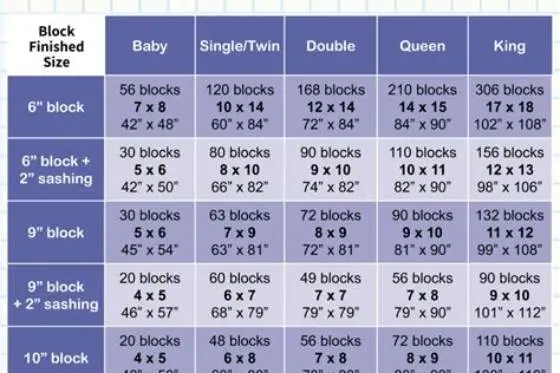
A throw at 52 x 60 inches (52 in x 60 in) covers your lap on the sofa, while a king at 108 x 108 inches (108 in x 108 in) fits a mattress around 76 inches wide plus drop on both sides. This jump in width shows why guessing can leave you short on backing or with a quilt that drags. This chart lists commonly used finished sizes quilters cut to in the US. The cm conversions are rounded based on 1 inch = 2.54 cm. Mattress sizes cited are US standards and may differ elsewhere. Keep this chart by your cutting table to avoid re-cutting borders.
You will see seven size names common in patterns and shops, from baby to California king. Each finished size assumes the quilt is quilted and bound. It includes a standard drape of 10 to 12 inches per side for beds. Your mattress depth, pillow tuck, and whether you want the quilt to cover pillows will shift the ideal by a few inches. Measure your bed before you cut. The Quilt Calculator on this site turns any finished size into blocks, backing, batting, and binding in one step.
Sizes vary by designer and fabric. According to industry sources, untreated quilting cotton may shrink slightly on the first wash, with shrinkage depending on weave and washing temperature. Prewashing changes this. If you do not prewash, add an allowance and note it varies. Dense quilting can draw in the quilt top slightly; how much depends on batting loft and stitch density. Square and measure your quilt after quilting and before trimming to ensure accuracy. When pattern sizes conflict with this chart, follow your pattern and adjust backing and batting accordingly, especially for directional prints or pieced backs.
| Quilt type | Size in inches | Size in cm | Typical use |
|---|---|---|---|
| Baby | 36 x 52 in | 91 x 132 cm | Crib, stroller |
| Throw / Lap | 52 x 60 in | 132 x 152 cm | Sofa, armchair |
| Twin | 66 x 90 in | 168 x 229 cm | Single bed |
| Full / Double | 80 x 90 in | 203 x 229 cm | Double bed |
| Queen | 90 x 108 in | 229 x 274 cm | Queen bed 60x80 in |
| King | 108 x 108 in | 274 x 274 cm | King bed 76x80 in |
| California King | 104 x 108 in | 264 x 274 cm | Cal King 72x84 in |
Measurements: baby, throw and twin quilts and their fits
A baby quilt at 36 x 52 inches (36 in x 52 in, 91 x 132 cm) fits a standard crib mattress around 28 x 52 inches with enough drape to tuck. Many parents prefer a smaller 30 x 40 inch (76 x 102 cm) version for strollers and play mats. It washes faster and stays out of the way. Choose the larger size if the quilt will be used daily on the crib. Choose the smaller if it will travel with you. Before you commit to anything, it is worth looking at beginner longarm quilting machine.
A throw at 52 x 60 inches (52 in x 60 in, 132 x 152 cm) reaches near the floor when you sit without pooling around your feet. It requires one width of 42 inch quilting cotton for the back if pieced, or a single 60 inch wide piece without a seam. Throws are often first quilts because they use less fabric and quilting time.
A twin quilt at 66 x 90 inches (66 in x 90 in, 168 x 229 cm) fits a mattress about 38 x 75 inches with roughly 14 inches of drop per side. Dorm beds are often longer at 38 x 80 inches, so add 5 inches to length and cut 66 x 95 inches if for college use. For a child who prefers a tighter tuck, consider 68 x 88 inches, and for a teen wanting more hang, try 70 x 90 inches. These differences affect comfort, not correctness.
- Baby 36 x 52 in: crib with tuck, needs about 1.5 yards of 42 in wide backing if pieced.
- Throw 52 x 60 in: lap quilt, one 60 in wide backing piece fits it.
- Twin 66 x 90 in: single bed; confirm dorm XL length if needed.
Measurements: full, queen and king quilts for beds
A full quilt at 80 x 90 inches (80 in x 90 in, 203 x 229 cm) fits a mattress around 54 x 75 inches with about 13 inches of drop per side. It also works as a queen topper if you do not want sides covered fully. Full quilts use less backing fabric than queens, which saves money when using expensive prints for the back.
A queen quilt at 90 x 108 inches (90 in x 108 in, 229 x 274 cm) fits a mattress about 60 x 80 inches. The length covers pillows when pulled up. The width allows about 15 inches of hang per side on a standard 14-inch deep mattress. If your mattress is 16 to 18 inches deep with a topper, add about 4 inches to width and length. Otherwise, the quilt will sit on top and may look too small.
A king quilt at 108 x 108 inches (108 in x 108 in, 274 x 274 cm) fits a mattress about 76 x 80 inches with about 16 inches of drop per side. California king beds are narrower but longer at 72 x 84 inches. Cut 104 x 108 inches (264 x 274 cm) to keep sides even and add length at the foot. Always measure mattress width, depth, and pillow tuck before cutting backing fabric.

GDMINLO Soft Tape Measure Double Scale Body Sewing Flexible Tailor Craft
Lets you measure mattress width, depth and drop to pick the chart size that will actually cover the bed with 60 inches (150 cm) of clear dual in/cm markings.
Most charts list names without numbers you can cut to. This one gives finished inches you can measure against your bed.
Differences: quilt size differences explained by drape and drop
Finished quilt size is not the same as coverage. Coverage equals mattress plus drop. Drop is the fabric hanging over the edge. A 12 inch drop covers a thin mattress to the box spring. A 16 inch drop hides a thick pillow-top and still brushes the dust ruffle. Two quilts with the same top size can look different on two beds if mattresses differ by 4 inches in depth.
Length matters as much as width. A 90 inch long quilt leaves 10 inches to tuck at the foot on a queen mattress. This keeps the quilt in place when you move. A 108 inch long quilt lets you fold over pillows without pulling the foot bare. If you like a pillow tuck, add 6 to 10 inches to the chart length. If you never tuck, stay with the chart to save fabric.
Dense quilting can draw the quilt top in slightly. How much depends on batting loft and stitch density. Thick wool batting adds puff and can make binding tighter. Square the quilt after quilting and before trimming. Measure width and length in three places. This evens out any draw-in and keeps binding even.
- Drop: how far fabric hangs past mattress edge; depends on mattress depth.
- Tuck: extra length folded over pillows, usually 6-10 inches.
- Draw-in: slight shrinkage from quilting; varies with density and batting.
- More drop hides mattress sides and looks plush.
- Longer length stays tucked and covers pillows.
- More fabric means heavier quilt and more quilting time.
- Too much drop can pool on floor and collect dust.
Printable: how to use a downloadable size chart at the cutting table
A printable chart helps when shopping and cutting. At the store, circle the finished size you want and read backing width from the row. This helps you buy the right amount. At home, use the chart to check your pieced top, batting, and backing match before basting. Keep a printed copy on the design wall to see when adding borders.
For backing, add 4 to 6 inches (10 to 15 cm) extra on all sides beyond the chart size. This gives grip for basting and room for quilting draw-in. For batting, add 3 to 4 inches per side. For binding, estimate perimeter plus 10 inches (25 cm) for joins and corners. Let the Quilt Calculator do this from your finished size. These buffers prevent the back from coming up short.
Print the table at 100 percent on letter or A4 paper and trim to one page. Laminate or slip it into a sleeve. Mark your most made size with a highlighter and note your mattress depth beside it. This turns a generic chart into your personal tool you will use often.
- Print the chart at 100% scale on letter or A4, portrait orientation.
- Highlight your quilt size and write mattress depth nearby.
- Add backing and batting allowances to finished size before shopping.
- Square and measure the quilted top in three spots, then trim to chart size.
Measure: how to choose and check the right quilt size for your bed
Use a 60 inch (152 cm) flexible tape for most beds, or 120 inch (300 cm) for kings. Measure mattress width, length, and depth. Decide how much drop you want. For a clean look, drop should just cover the mattress side. For a cozy look, add 2 inches so the quilt touches the dust ruffle. Write these numbers down. Calculate target quilt width as mattress width plus twice the drop.
Lay your pieced top on the bed before quilting. Check how it hangs. Does it clear the floor by 2 to 4 inches? Does it cover pillows the way you like? Adjust borders now. Adding width after quilting is hard. A 2 inch border on each side adds 4 inches to width and often fixes a skimpy queen size without re-piecing the center.
After quilting, square the quilt on a large table or clean floor. Measure width in three places: top, middle, and bottom. Measure length in three places: left, middle, and right. If differences exceed 0.5 inch (1.3 cm), re-square before binding. Cut binding at 2.25 inches (5.7 cm) folded double for most quilts. Use 2.5 inches (6.4 cm) for thick battings. Typical quilting cotton works well with 80/12 needles and 50 wt thread. Adjust needle and thread for thicker batting or denim.
- Tape needed: 60 inch flexible tape or 120 inch for king size.
- Check hang before quilting when borders are easy to add.
- Square quilt after quilting, then cut binding to the true perimeter.
Troubleshooting: when your quilt top does not match the chart
If your quilt top finishes 2 to 3 inches short after piecing, seam allowance drift is often the cause. A 1/4 inch seam that grows to 5/16 inch adds up over many seams to more than an inch lost. Check your 1/4 inch foot with a seam guide. Press seams consistently to one side. Add a coping border to bring the top back to chart size without distorting blocks.
If the quilt looks right on the design wall but is short on the bed, you may have underestimated mattress depth. Measure depth again, including any topper. Compare to the drop you planned. If short by 3 inches per side, add a 3 inch finished border on each side. This adds 6 inches in width. Fix this before quilting; it is much harder after. Decide while the top is flat.
If backing feels tight on the longarm or quilting table, you likely cut it without the 4 to 6 inch allowance. Do not stretch the backing to fit. Add a strip of backing fabric to one side, press the seam open, and re-baste. Place the seam off-center so it is less visible. Next time, cut backing using the chart size plus allowance to avoid patching.
Still wondering?
What is the most common quilt size to make for a gift?
A throw at 52 x 60 inches (52 in x 60 in) is the most gifted size. It fits most laps and sofas and uses less fabric and time. For a bed gift, make the size matching the mattress using the chart.
How much bigger should a quilt be than the mattress?
Add drop on both sides and extra length for a pillow tuck. For example, a 60 inch wide queen mattress with 15 inches of drop needs a 90 inch wide quilt. Add 6 to 10 inches to length if you want to fold over pillows.
Do quilt sizes include binding?
Yes. Chart sizes are finished after quilting and binding. Trim your pieced top to the chart size after quilting, then bind. Cut backing and batting larger to allow for basting and quilting draw-in.
Can I print this quilt sizes chart?
You can print the table at 100% on letter or A4 paper. Laminate it or put it in a sleeve to keep it in your sewing room.
Why does my queen quilt look small on my bed?
Usually this happens because the mattress is deeper than expected. Measure depth including any topper. Add that to the drop you planned. Adding a 2 to 3 inch border per side before quilting often fixes it.